

How Does The MacBook Air Stay Cool Without A Fan?

Laptop buyers looking for a MacBook model may find it difficult to choose between the MacBook Air and the MacBook Pro, especially if they haven't used Apple notebooks before, or if they haven't purchased a new model in a long time. The main confusion may come from the fact that the MacBook Air and the base MacBook Pro feature the same M-series chips. Apple is also using the same type of processor in iPad models. For example, the M5 iPad Pro, M5 MacBook Air, and M5 MacBook Pro come with similar M5 chip configurations. However, the MacBook Air comes with a thinner design, and that's because the laptop doesn't feature a built-in fan for active cooling like the MacBook Pro. Buyers may wonder how the MacBook Air stays cool, and whether it can offer the same performance as the MacBook Pro, which comes with a fan. The good news is that the MacBook Air uses its design to transfer heat from the chip to the metal case, and that's enough to allow the laptop to offer peak benchmark performance similar to the base MacBook Pro.
In other words, the MacBook Air can offer similar performance to the MacBook Pro for most tasks, including more complex workflows. MacBook Air users can edit video, run local AI models, and play graphics-intensive games as MacBook Pro users can, despite the Air lacking an internal fan to move heat more quickly. However, once the passive cooling can't remove heat efficiently, after extended use of intensive tasks that require peak chip performance, the chip will be throttled to allow the laptop to cool down.
How Apple made the fanless MacBook Air design possible
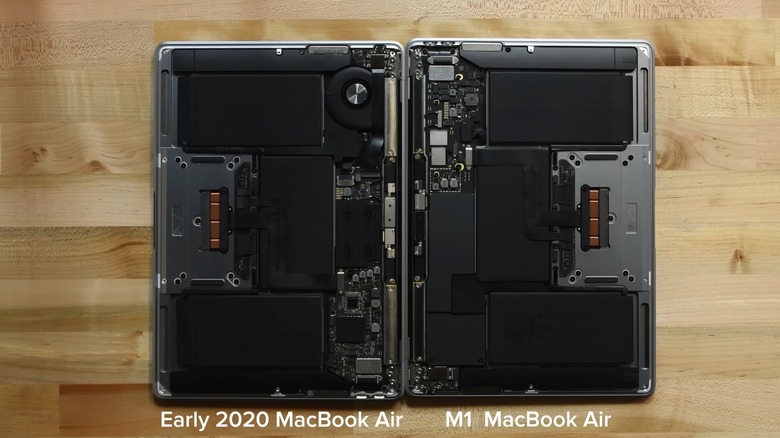
Not all MacBook Air models have featured fanless designs. Apple included a fan in Intel-based MacBook Airs launched until late 2020. That year, Apple introduced its first M-series chip for MacBooks, using the M1 processor for the brand-new MacBook Air and MacBook Pro launched that fall. Apple has kept upgrading the M-series chip since then, releasing M5 MacBooks in late 2025 and early 2026.
The M1's chip performance and efficiency are what allowed Apple to remove the fan from Air models without compromising on performance. "With the industry-leading power efficiency of M1, MacBook Air also delivers this performance in a fanless design, which means no matter what users are doing, it remains completely silent," Apple said in a press release in November 2020. Teardowns from iFixit compared the internal design of the M1 MacBook Air to the early 2020 Intel-based MacBook Air model, revealing that Apple had replaced the fan with "a simple aluminum heat spreader." The teardown experts explained that "a thick cold plate" draws heat from the M1 processor and then conducts it to the cooler end, allowing it to spread. That aluminum heat spreader comes in contact with the rear case, which is also made of aluminum, and that's how heat moves away from the laptop. iFixit also noted at the time that the fan removal is an advantage for repairability, as owners will not need to open the device as often to clean or replace the fan.
Reviews also showed that the M1 MacBook Air was a powerful computer, despite its fanless design. Apple introduced a new design with the M2 MacBook Air but kept the fanless concept in place.
Should you buy a MacBook with a fan?

The M5 MacBook Air offers the same fanless design while delivering higher performance than earlier Air models. Geekbench 6 benchmarks help illustrate that point. The 13-inch M5 MacBook Air scores 4,197 and 16,997 points in single-core and multi-core tests. The Metal GPU score is 64,817. The base 14-inch MacBook Pro reaches 4,223, 17,471, and 76,103 points in the same tests, respectively. Interestingly, the 11-inch M5 iPad Pro scores 4,139, 15,573, and 74,603 in the same tests. It's worth remembering that the M5 chips aren't perfectly identical. iPads may use 9-core and 10-core CPUs, while the MacBooks will run on 10-core CPU versions. Also, the 13-inch Air has an 8-core GPU compared to a 10-core GPU for the MacBook Pro.
These figures indicate that the MacBook Air can offer similar peak benchmark performance to the MacBook Pro, but benchmark tests like Geekbench 6 are short. The fanless MacBook Air design is enough to keep the laptop cool during these tests. However, YouTuber Geekerwan (via NotebookCheck) ran a test meant to show the difference in performance between passive- and active-cooled M5 MacBooks. The M5 MacBook Pro offered 40% better performance than the M5 MacBook Air in Cyberpunk 2077, producing higher frame rates. The MacBook Air also reduced frame rates in Elden Ring once the chip was throttled.
The fanless design is just one factor to consider when buying a MacBook Air. But if you don't plan to use the MacBook for intensive tasks, such as high-end gaming, you may not need a model with a fan. Finally, some MacBook Neo reviewers found ways to improve cooling to increase performance. The budget laptop also has a fanless design. The same methods may be used to improve passive cooling on a MacBook Air.