

5 Best Sci-Fi Movie Franchises That Aren't Star Wars Or Star Trek, Ranked
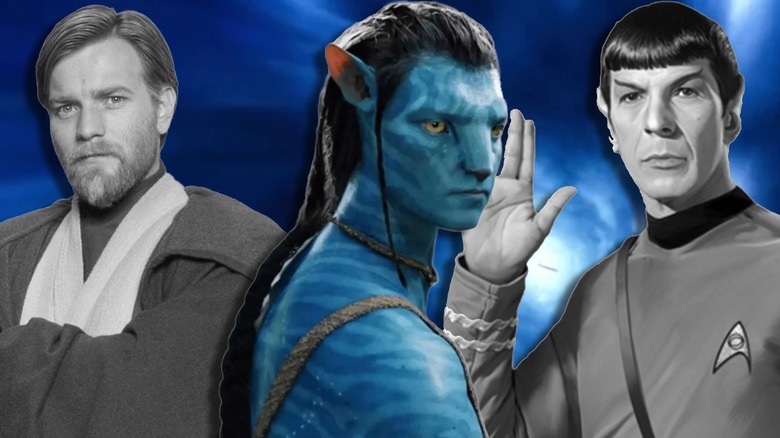
If you had to think of two of the biggest science fiction franchises to have ever hit the big screen, we'd understand if you included ones that involve phasers and force-wielders. There were 11 years between "Star Trek" making its television debut and George Lucas introducing us to a universe of droids and Jawas in 1977. In 1979, Starfleet made it onto the big screen in "Star Trek: The Motion Picture," followed by a series of highs and lows. Since then, debate has often sparked between which is the best, with even stars from both — Patrick Stewart and Mark Hamill — wondering if there's a world where the two could collide.
But while that debate rages on, other filmic franchises have flourished, even becoming just as adored as the ones Jean Luc-Picard and Luke Skywalker are involved in. With that, we've gathered up what we consider to be the best movie sci-fi franchises that aren't "Star Wars" or "Star Trek." Some involve a similar bit of space travel, while others send us off to dark and distant futures we'd prefer to avoid. So while you wait for the dilithium crystals to get fired up on the Enterprise or for Han to jump to hyperdrive, check out our rankings of the best sci-fi movie franchises that go beyond both, starting with a franchise that houses a pair of the most successful films ever made. That's right, not even Klingons or Darth Vader are a match for James Cameron.
Avatar
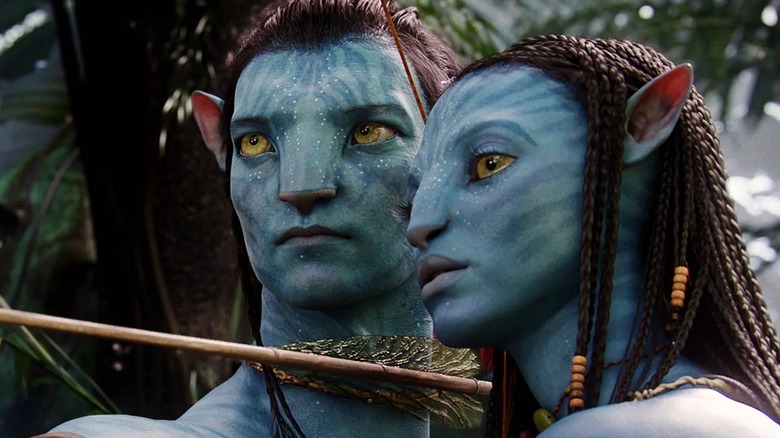
To start things off, we're going to put James Cameron's blue-coated sci-fi franchise, "Avatar," on this list, if only because of its otherworldly success at the box office. Collectively, the movies have made $6.7 billion worldwide, with two of the films holding the number one and number three spots for the most successful films of all time. Admittedly, the latest chapter, "Avatar: Fire & Ash," couldn't quite maintain the momentum of its predecessors (now sitting in the seventeenth spot), and there's no doubt that some of the criticisms the trilogy has earned over the years are acceptable. But that doesn't mean that the mark of this groundbreaking film series has faded.
Even with all its incredible CGI and motion capture wizardry, there's not a lot in "Avatar's" story that we haven't seen before. The jokes about this being an aquatic "Dances with Wolves" or "The Last Samurai" have hindered the movies so far and might explain why the third film failed to reach the levels of the first two (which were a decade apart, we might add). Nevertheless, the mark that the movies have left on cinema history can't be ignored — even its lowest-grossing entrant ranks higher on the box office leaderboards than all but one "Star Wars" or "Star Trek" movie — and for that, "Avatar" earns some praise. As it stands, Cameron recently mentioned that he has other stories to tell beyond tangled-up ponytails and giant space whales. We only hope that when James Cameron does go out with a bang, he makes it one worth sitting through for three hours.
Planet of the Apes
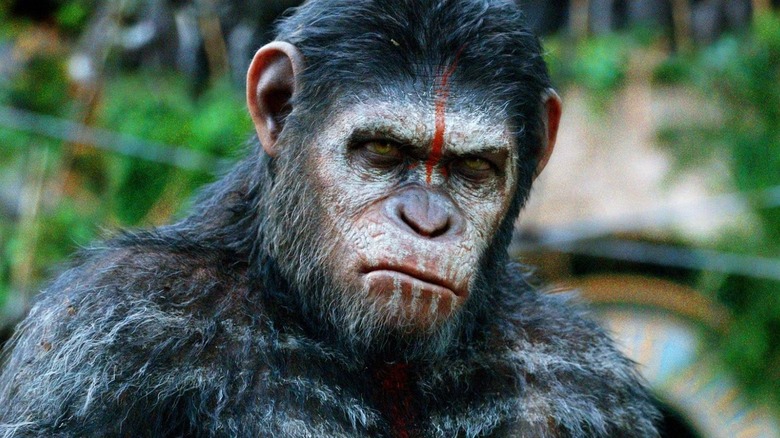
From one franchise with only three films under its belt to another composed of 10 that span more than 50 years, "Planet of the Apes" has been an inconsistent film series that has still managed to draw audiences back with some truly remarkable chapters. After ending the first movie on one of the all-time greatest sci-fi movie twists, the franchise continued to drag its knuckles onward. Four more films followed, involving mutants and time travel, and depending on which fans you talked to, things only got worse. Then Tim Burton tried his hand at remaking the original in 2001, and well, we all know how that ended up.
It seemed like all hope was lost until, in 2011, Andy Serkis threw himself into a motion-capture suit and led the charge in arguably one of the most underrated trilogies ever made. "Rise," "Dawn," and "War for the Planet of the Apes" followed the origins of Caesar, the first ape to fight back against humanity whose actions led the planet to become the one we were first introduced to back in 1968. With each film drawing in more creative talent, this trilogy elevated the franchise to new heights and showed it still had something to offer. The latest movie, "Kingdom of the Planet of the Apes," might have struggled to match the same level of success, but that hasn't stopped plans to make sure that this planet continues to spin, with a new movie expected for 2027.
Predator
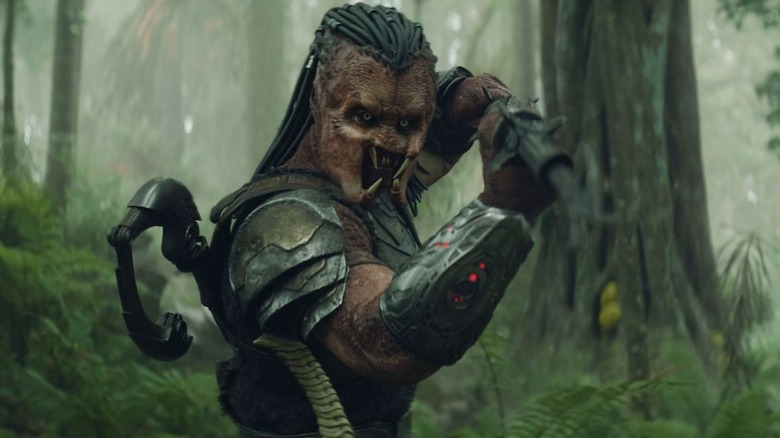
If there's one film series that has made a killer comeback in recent years, it's the "Predator" franchise. Beginning in 1987 with the John McTiernan-directed movie that saw Arnold Schwarzenegger perform the rare act of fearing for his life, the alien space hunters and their brutal trophy-killing outings have led to eight feature-film appearances. It hasn't been a consistently great hunt, though, with "Predator 2" struggling without Schwarzenegger and Shane Black's "The Predator" being an absolute dumpster fire. Also, the "Alien vs. Predator" movies are spin-offs that aren't fit to hang on the wall. Thankfully, in 2022, someone signed off on handing the Yautja over to "10 Cloverfield Lane" director Dan Trachtenberg, who has, quite frankly, been killing it ever since.
Trachtenberg's winning trick with the franchise so far is to consistently mix things up and throw this universe at us in ways we haven't seen before. "Prey" was a brilliant prequel that saw an alien hunter face off against a lone Comanche warrior (Amber Midthunder), whereas "Predator: Killer of Killers" was an animated anthology that saw warriors from across time fight to the death. Then we finally got a crossover done right with "Predator: Badlands," which not only planted seeds for the Xenomorph to venture back into this world by way of a Weyland-Yutani android (played by Elle Fanning) but also, for once, gave us a Predator story from the alien's perspective. It's this originality that has allowed the "Predator" franchise to climb so high on the list, and we hope it sticks around.
Alien
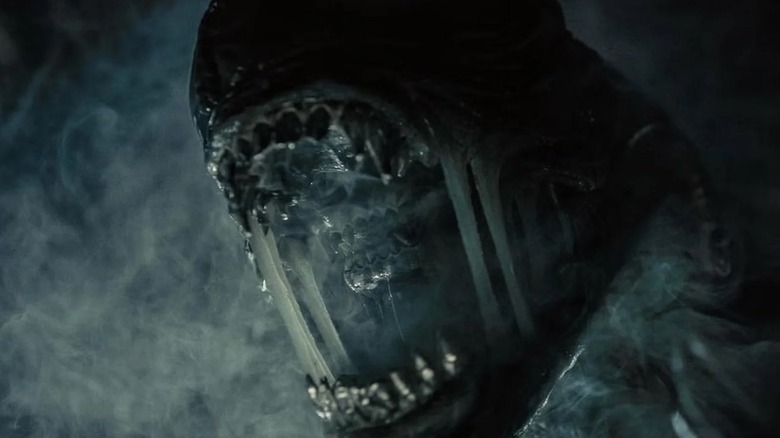
In 1979, Ridley Scott gave us one of the greatest science fiction horror movies ever made. "Alien" introduced a new monster to haunt our nightmares, as Sigourney Weaver's Ellen Ripley did her very best to avoid acid blood and a chest ripped open from the inside out (spoilers — she fails at that eventually). From there, the franchise hatched arguably a few bad eggs, but thanks to the nature of the beast at the center of this story, it has always kept us coming back for more.
James Cameron, who has already been mentioned on this list for building a world of his own, supercharged this one in 1986 with "Aliens," which will always stand as the closest competitor and, for some, even a successor. Then came David Fincher's studio-invading threequel, which became the misunderstood monster of the series. Sadly, things went downhill from there with the likes of "Alien: Resurrection" and the two aforementioned "AVP" spin-offs.
After those filmic fumbles, Ridley Scott returned to the franchise with prequels "Prometheus" and "Alien: Covenant," which more fans have put down than picked up over the years. Even Scott himself has acknowledged the issues, which is why "Alien: Romulus" was a welcome and refreshing jolt for the franchise in 2024, set between the first and second original movies. It was such a success that a sequel got the green light pretty quickly. Add in the critically acclaimed "Alien: Earth" television series from 2025, and it's clear that there's some bite left in the perfect lifeform after all.
Back to the Future
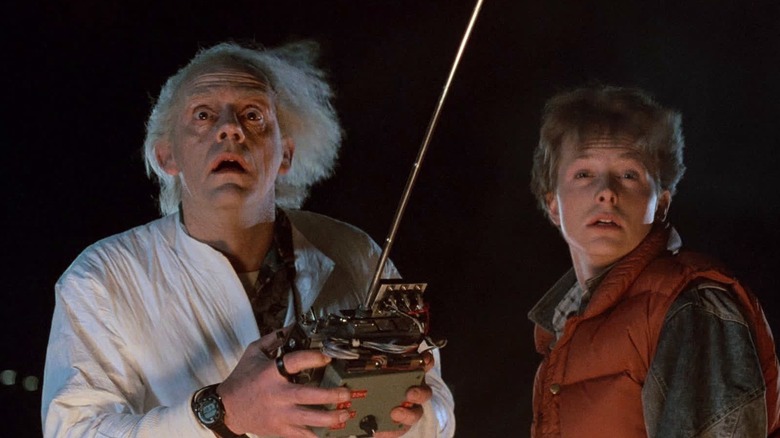
Sometimes it's good to know when to let things end, and there's no better example of this than the "Back to the Future" trilogy. It features what is easily one of the most perfect films ever made, "Back to the Future," and one of the most iconic sci-fi vehicles, the DeLorean, helps it get there. Robert Zemeckis' time-traveling tale might've aged in some areas, but it still remains timeless in others. The finely tuned story, the incredible score by Alan Silvestri, and the effortless chemistry between Michael J. Fox and Christopher Lloyd's Doc Brown make it a true classic of cinema.
Not satisfied with just one movie, though, Zemeckis filmed its two sequels back-to-back, and both were just as entertaining in their own right. Firstly, we were whisked off to a time when we don't need roads — good old (ahem) 2015, in "Back to the Future Part II," which continued to brilliantly play with the rules of time travel in ways that would set them in stone for other movies to follow years later. Then we got the perhaps least-loved but still fondly thought-of threequel, "Back to the Future Part III," which rounded things off perfectly and ended a journey that had spanned decades.
Since then, the legacy of the movies has remained adored by millions. It is also a franchise that's universally acknowledged as one that should remain untouched by Hollywood's remake-churning machine. "Back to the Future" should stay in the past as a piece of movie magic and one of the best there is.