

I Tried Honor's Robot Phone That Hides A Gimbal Inside, And It Has One Fatal Flaw
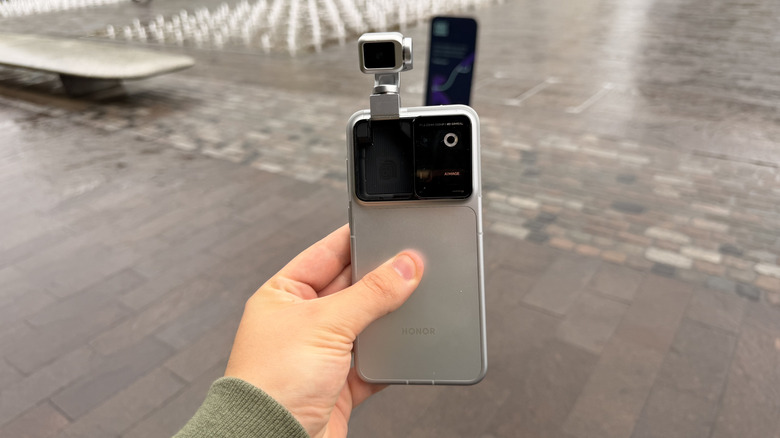
In case you missed it, Honor has put a working three-axis gimbal inside a phone it calls the Robot Phone. This isn't a concept device; it actually went on sale in China for 9,999 yuan, roughly $1,480 — though Honor has no plans to sell it anywhere outside of China for the time being. I spent an afternoon in London walking around in the rain with a pre-production version of the phone.
So this isn't a review in the usual sense. There's no buying advice to give, because if you're reading this, you almost certainly can't buy it through official channels — although I've seen a few eBay listings for the phone begin to pop up. What I wanted to find out is if bolting a motorized gimbal onto a phone's main camera actually beats the stabilization every other flagship already does in software.
The answer to that question is more confusing than I hoped it would be. The actual gimbal mechanism works better than I expected, but the footage looks worse than I hoped. I'd go as far as saying the Honor Robot Phone is actually almost good, which is not what I expected before I got my hands on the device. However, it does have one fatal flaw, and that's the fact that the camera mode you'd actually want to film with is the one with the lowest resolution.
What actually is the Robot Phone?
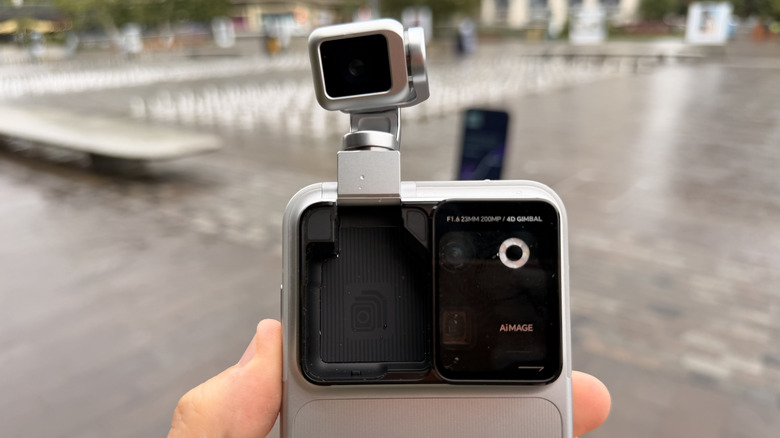
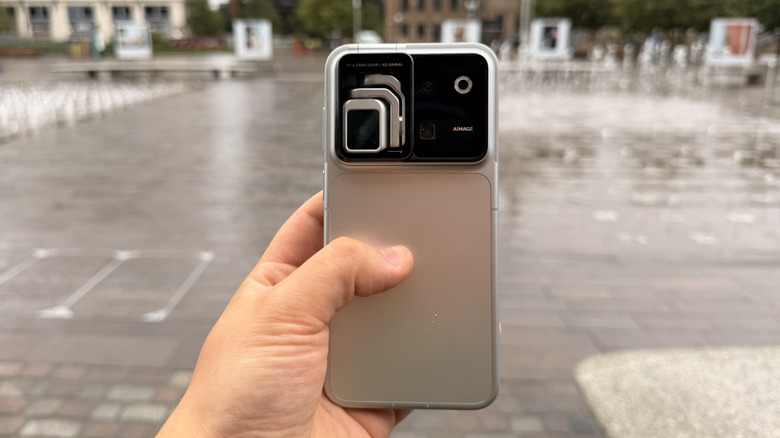
Honor is calling this device the Robot Phone. The gimbal lives in the camera plateau on the rear panel, behind a dust cover you have to manually slide open. Tap the gimbal button in the camera app, and a titanium arm rises out of the phone, carrying the 200 MP main camera on four degrees of freedom. When you've got the gimbal tucked away, that same 200 MP sensor sits behind the cover for regular camera use, so this is one camera with two modes rather than a bonus lens. Alongside it, you'll find a 200 MP periscope telephoto lens with 2.7x optical zoom and a 50 MP ultrawide lens, both fixed in the body as usual. One interesting feature I noticed is that the LED flashlight is a circular ring, rather than a covered light you'd see on most phones.
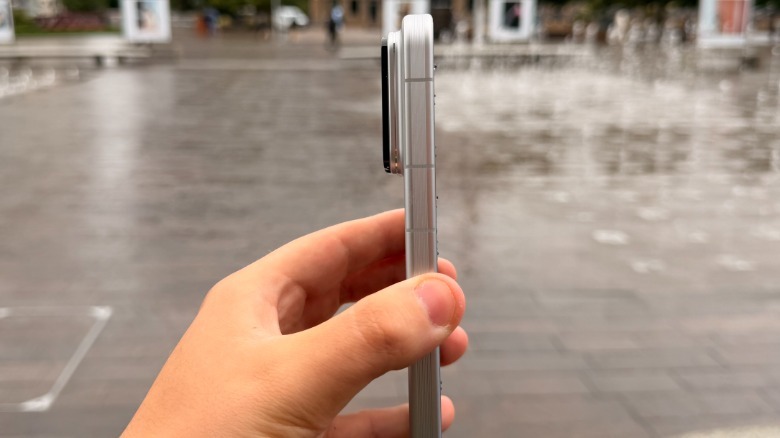
Honor also partnered with cinema camera maker Arri on the imaging side, which brings LogC3 video recording, official Arri color styles, and LUT previewing. It weighs 8.75 ounces and measures 0.37 inches thick, which is to say it's a heavy, chunky phone by 2026 standards. While the phone was, understandably, slightly top-heavy, it wasn't as unbalanced as I expected it might be.
 Connor Jewiss/BGR
Camera aside, the Honor Robot Phone looks very similar to some of the other top Android phones you can buy. It packs a Snapdragon 8 Elite Gen 5 chipset, a 7,060 mAh silicon-carbon battery with 120 W wired charging, a 6.31-inch LTPO OLED rated up to 6,800 nits peak, and it runs Android 16 under MagicOS 10. While Honor doesn't offer its devices in the U.S., it still sells phones across Europe, so the Play Store and Google services are present and functional.
What works
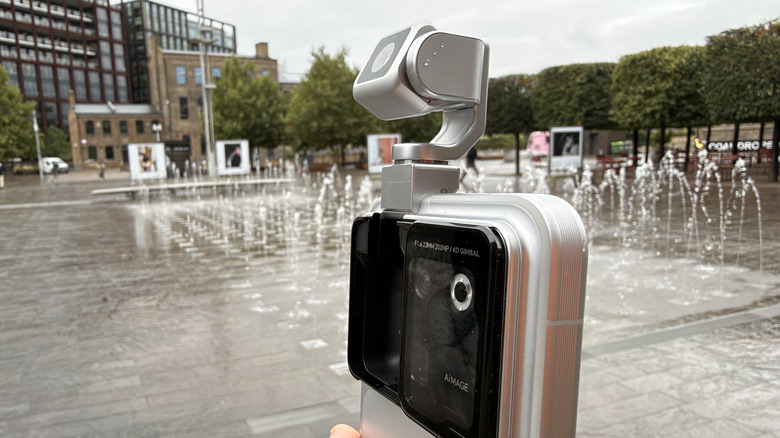
I have to say, I was impressed by the gimbal arm; it's quite the engineering feat. The arm unfolds at a modest pace; it's not slow, but it's certainly not snappy either, and I couldn't hear the motor over ambient street noise. When I tried to deploy the gimbal with the dust cover still shut, the phone didn't attempt the motion, which would risk damaging the system. Instead, it displayed a message on the screen telling me to open the cover.
Stabilization is the reason this thing exists, and it delivers. Walking at a normal pace, the Honor produced the steadiest footage of every device I tested that day (more on this later), including a phone strapped into a dedicated handheld gimbal. Tracking is the other standout, with the gimbal keeping subjects centered through a full 180-degree turn of the phone body without struggling. Honor claims it tracks objects as well as people, and from what I saw, that seems pretty accurate.
There's no official IP rating on this phone, which Honor confirmed directly. The company clarified that the figures circulating online aren't its own. Despite that, Honor was happy for me to keep filming with the phone in steady rain with the arm extended, which tells you that the device isn't at immediate risk of danger.
I didn't get to shoot with the Arri modes or LogC3 myself, so I can't tell you how the grade holds up. The camera app shows you a preview of the Arri LUTs applied, however, and it looks like they make a meaningful difference. For professional videographers, these filming options might be the most useful feature of the phone, though they do come with the trade-off of rather large file sizes.
What doesn't work
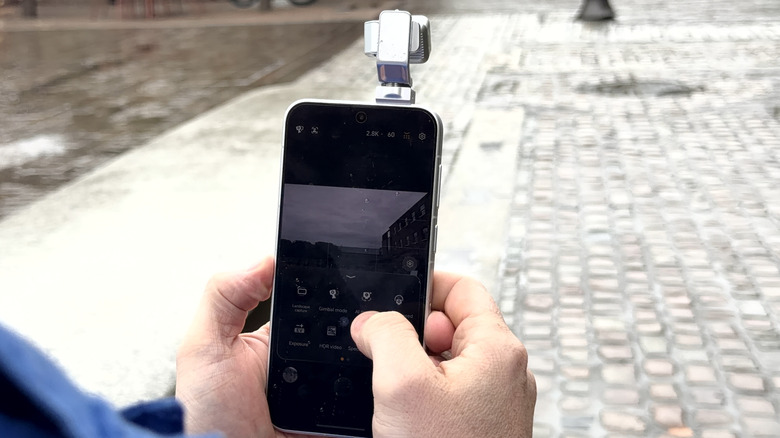
Unfortunately, the biggest downside of the Robot Phone is that the gimbal caps video at 2.8K resolution. When you deploy the arm, 4K video recording disappears, though it remains available when you record with the gimbal tucked away. That means that the feature you actually want to film with is the one that gives you the lowest resolution. Honor didn't confirm whether that's due to a sensor crop or a resolution limit, but a crop is the obvious explanation.
While filming with the phone, I found that the built-in microphones are a little too sensitive, and its noise handling doesn't keep up. I walked past a set of fountains, and the recording made them sound like a thunderstorm rolling in. Tracking held well until I got too far away and drifted toward the edge of what the sensor could see, at which point it lost me entirely. The display also didn't strike me as particularly bright outdoors, despite the 6,800-nit display, and it lost around 10% of the battery in under an hour of filming with the gimbal.
The Robot Phone is also noticeably top-heavy, though less than the official measurements had me expecting, and it's thicker than any other phone you'd buy in 2026. YOYO Robot Mode, the dancing and gesture-recognition personality layer, isn't available outside China, so I couldn't test it. Though, from the demos, it doesn't look like a particularly useful feature — I certainly wouldn't use it.
Honor told me the gimbal is durable enough for regular use, but wouldn't go into detail on what durability testing the company has done. But replacing the gimbal camera module costs approximately 3,079 yuan, which works out to about $457 — close to a third of what the phone costs.
How Honor's Robot Phone stacks up against devices you can buy
I pitted four setups against each other outdoors, in daylight under heavy cloud and rain, in the same spot at the same time, walking in a straight line at a normal pace. I had the Robot Phone with the gimbal deployed, the Pixel 11 Pro XL using its locked stabilization mode, the iPhone 17 Pro Max shooting standard video, and that same iPhone mounted in an Insta360 Flow 2 Pro handheld gimbal.
For steadiness alone, I'd say the Honor just about came out on top. The iPhone in the Insta360 followed in second place, and the Pixel came next, while the bare iPhone was the shakiest, as you'd expect from a phone doing no software stabilization at all. The gap between the top two is small enough that many viewers may not be able to tell, but the Honor was the smoothest of the lot.
But smoothness isn't the full story, and when you consider image quality, the results flip completely. Restricted to 2.8K resolution, the Honor's footage was visibly softer and noisier than the Pixel's, which is slightly worse than the phone's regular footage as it crops to 2x. That's partly resolution and partly because Google throws far more processing at video than Honor does. But that means the Honor phone has the worst image quality out of the bunch. Personally, I'd rather have shakier footage and video I'd actually want to watch.
Devices such as the DJI Osmo Pocket, or any phone dropped into a gimbal handle, sidestep the sensor crop problem entirely, as they can record at full quality. The Robot Phone's advantage is that you're not carrying a second device, but that convenience certainly comes at a cost.
Where this technology goes next
Honor hasn't committed to a global release for the Robot Phone, but hasn't ruled one out either. There's also no clarity on whether this is the start of a new product line with subsequent devices to follow or if it's just an expensive way to get people talking about Honor. If there is a next one, Honor needs to switch to a larger sensor so it can offer higher-resolution video. Because as it stands, those that would need video stabilization likely wouldn't be happy with the results.
The Robot Phone's engineering certainly deserves more credit. Shrinking a four-axis titanium gimbal into a 0.37-inch phone body is an incredibly hard problem, and Honor has solved it well. The gimbal mechanism was flawless in my time with the device, though it remains to be seen how well it'll hold up over time.
Mechanical stabilization beats software stabilization when both are working, and the Honor Robot Phone proves this. Honor did a commendable job building the hard moving part of this device — it's the easy part, producing clear 4K video from the camera, that's holding the whole thing back.