

12 Of The Weirdest Gadgets Made In The '70s
The 1970s don't really get the attention they deserve, wedged between the swinging '60s and synthwave cyberpunk revolution of the '80s. This is the era where electronics had become pretty advanced, but the microchip hadn't really found its way into every corner of our homes the way it would in the '80s. That means this groovy decade was filled with gadgets developed just before that digital technology tipping point.
On the other hand, mass production and various manufacturing techniques were opening all sorts of doors for those with a wacky vision and the willingness to sell their ideas to the public, whether they were ready or not. For those of us looking back from the year 2026 (or later, depending on when you read this), it means there's a slew of delightfully strange gadgets from this era sold with a straight face in TV commercials and on store shelves. These bonkers devices really show that this wasn't just another time, but rather a completely different world from the one we know today. Step into the land of disco and shag carpet with us now as we dive into 12 of the weirdest gadgets made in the '70s.
Bone Fone
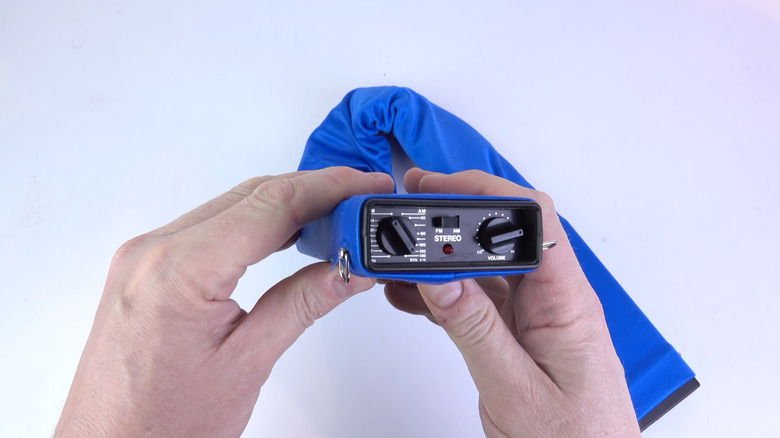
With a name like Bone Fone, how could you go wrong? We're kicking off with peak weirdness, although, as you'll see, the Bone Fone was an idea ahead of its time, and not just because it's a radio that's integrated into a scarf-like tube. The idea is that the sound is transmitted through your bones, letting you listen to stereo audio with a wide soundstage and clear, loud audio without the use of headphones.
Considering that this was a product patented in 1977 and released in 1979, that sales pitch is remarkable. Companies like Shokz, which is known for making the best bone conduction headphones, have really only been pushing this technology since the 2010s. Likewise, personal noise control technologies like noise cancelling and transparency are something you'd associate with the last decade or two. So the idea that someone was painting this advanced personal audio picture the year before Sony's Walkman launched in the United States is frankly shocking.
The problem was that, while the marketing material around the Bone Fone promised a patented personal audio experience to rival your home hi-fi played directly into your inner ear through your skeleton, the reality fell far short. When YouTuber Techmoan got his hands on a Bone Fone, he realized that the way the device is designed and sits on your body means that little, if any, bone conduction is happening at all. Instead of the modern transducers we associate with bone-conducting headphones, the Bone Fone just has some regular speakers that barely make contact with your neck.
Ronco Inside-the-Shell Egg Scrambler
At this point, we're all familiar with the playbook used in infomercials selling As Seen on TV products. First, you invent a problem no one has, and then you offer a solution that's often worse than the problem it's meant to solve.
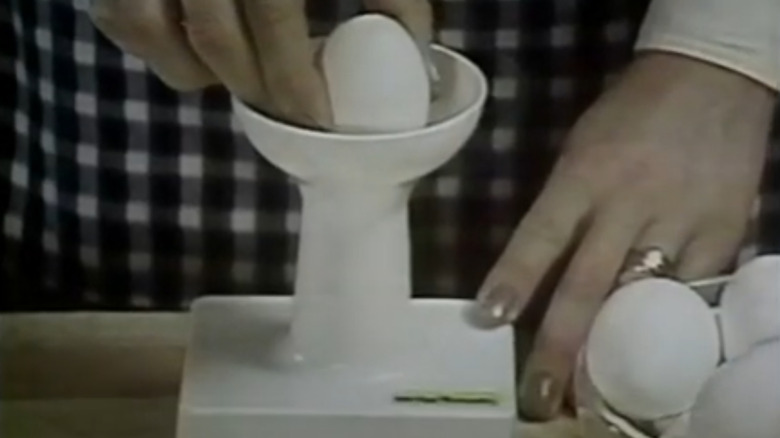
The Ronco Inside-the-Shell Egg Scrambler was one of a long line of household gadgets brought to the world by the inventor Ron Popeil. The pitch here is that, instead of breaking your eggs into a separate bowl and scrambling them with a fork or a whisk, you scramble each egg individually by using this machine. A needle penetrates the egg, and then rotates rapidly to swirl the insides around until the yolk and whites are a nice, consistent mix. Then crack your pre-scrambled eggs into your pan and cook them. The purported benefits included saving time and reducing mess, a seemingly reasonable idea that sold only around 150,000 units at $19.95. Those are 1970s dollars, though!
Despite this lukewarm reception, this is an idea that's been reinvented again and again. You can find online instructions showing you how to scramble an egg inside its shell by spinning it really fast inside a tube. Then there was The Goose, which had a Kickstarter raking in over $170K. This is yet another spinning carnival ride for an egg. At least these more recent takes don't require penetrating the egg or electricity. So they're technically an improvement.
Mego 2-XL robot
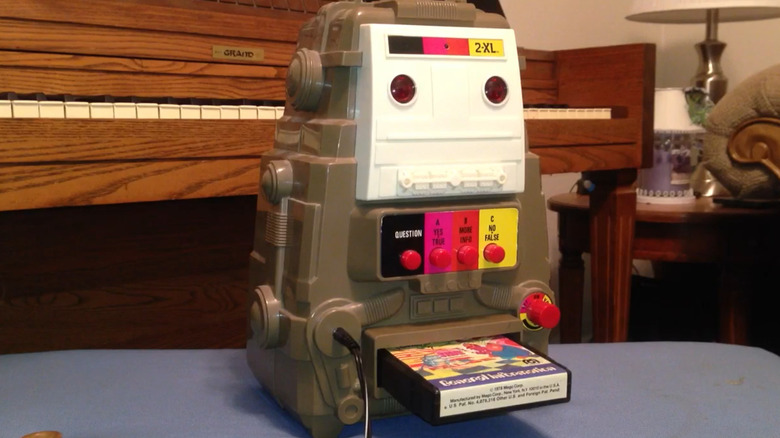
When you think about cool toy robots, most people will go straight to the 1980s with Transformers, Nintendo R.O.B., and Tomy's Omnibots. However, toy robots have been around for much longer than that, even if only as classic windup versions. The Mego 2-XL, for example, was released in 1978 and offered an interactive experience.
It's not really a robot, of course. It's an 8-track player shaped like a robot. Now, 8-track tapes are another obsolete media format that would be quickly replaced by cassette tapes in the '80s, but this late-1970s toy put the format to good use. The accompanying tapes covered different subjects, and the robot would ask questions, which you could answer using the multiple-choice answer buttons on its front. The tapes gave the 2-XL an amusing personality, and it doubled as an educational toy.
The 2-XL was fairly popular by all accounts, and a decent number of tapes were produced for it. It could also work as a standard 8-track music player, producing mono audio. The 2-XL slightly predates the Milton Bradley Omni, which debuted in the early '80s. This concept continued with famous products like the mid-80s Teddy Ruxpin, a toy that's worth serious cash today. After going bankrupt in the early '80s, the Mego brand itself was resurrected in 2018. In 2024, a new AI-powered version of the 2-XL was announced, but its Amazon listing currently shows it as unavailable.
JVC Videosphere
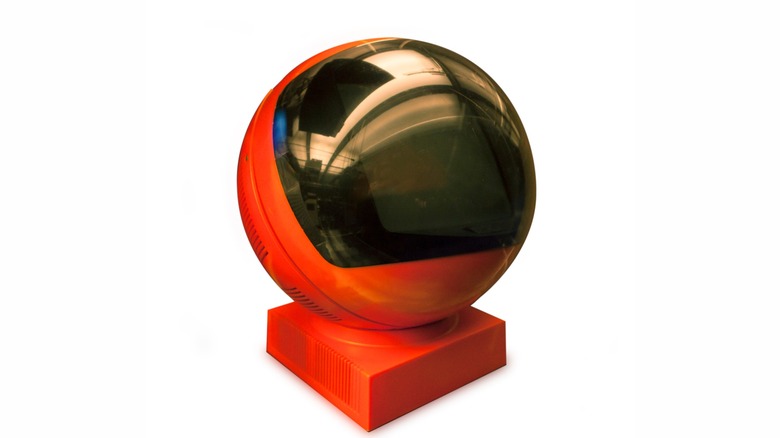
Setting aside the flat-screen models that came out near the end of the CRT era, most tube-based TVs had a convex curve to the outside of the screen, and that exterior bubble helped the TVs look like the shiny visor of an astronaut's space suit. The JVC Videosphere TV was released in the year following the moon landing, and it was timed just right with the space-based mania that would follow throughout the 1970s. The coolness of the space age was somewhat book-ended by the launch of MTV in 1981, prominently featuring an astronaut in its marketing.
So the Videosphere was definitely released at just the right time to appeal to the cool kids, and it was sold right into the early '80s. It was more than just a cool gimmick, too. The TV could rotate 360 degrees on its base, and it could run on AC or battery power. Speaking of the base, a version that included an alarm clock was an optional extra, though most of the examples you'll see these days have a plain base instead.
While color TVs already existed when the Videosphere hit the market, this is a black-and-white set. However, given its size, this was completely reasonable. Looking at eBay listings for Videospheres today, they can go for hundreds or even over a thousand dollars, at least partly driven by the retro enthusiast love for CRT displays.
HP-01 calculator watch
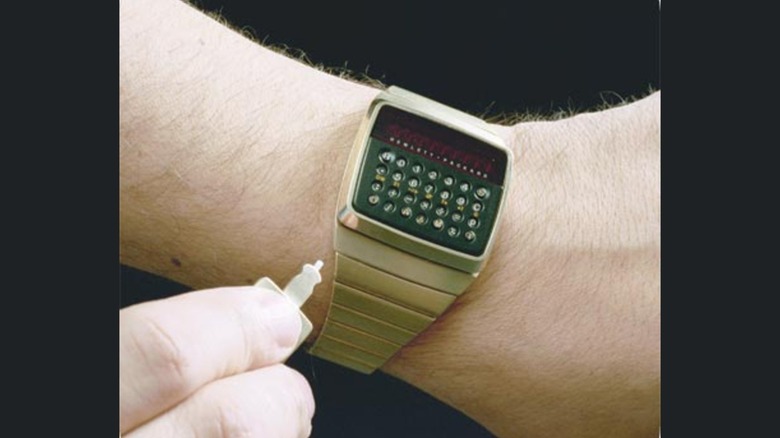
We tend to all be a little blasé when it comes to modern smartwatches, even though your Apple Watch might have more computing power than a data center did in the '70s. Yet, somehow, the HP-01 wristwatch calculator is still impressive today. Starting at an eye-watering $650 in 1977 money, you got a wrist wearable that could act as a watch (phew!) while also offering alarm, timer, calendar, and stopwatch functionality. You could use the time data and calculator function together to (for example) work out a time zone difference, or count the number of days between two dates.
One big problem with this device is that it crams 28 buttons onto the face, which means it's not really practical to work those tiny buttons with your fingers. Instead, tapping those buttons usually involves pulling out a stylus stored in the wrist strap. Just like the smartwatches of today, there were tiers to the options available with the HP-01, with more valuable wrist straps and casing materials pushing the price up to $750. That must have given you bragging rights over the average nerd who would actually buy an HP-01. As a very early ancestor to modern smartwatches, there's a lot here that looks familiar to today's techies, but HP was clearly jumping the gun here by a long shot. The HP-01 sold poorly, and the planned HP-02 never came to market.
Mattel Optigan

Mattel was really pushing the envelope in the 1970s when it came to electronics. Its 1979 Intellivision home game system would go on to become one of the gaming consoles that defined the '80s, and who can forget its smash-hit handheld electronic football games from the late '70s? So perhaps it's not surprising that Mattel, through its Optigan subsidiary, developed an innovative electronic music instrument in the form of a small electric organ.
What made the Optigan special is its use of optical discs containing sound information. This isn't like a CD or DVD that's read by a laser, but instead similar technology to how analog audio is stored in theatrical films, read by a photodiode. The discs stored audio samples of chords, sounds, and rhythms. Each disc had 57 tracks, of which 37 were reserved for the keys of the organ. To change the pitch of the sounds, the disc simply spun faster or more slowly. Unfortunately, the sound quality of this optical system wasn't great, and even at the relatively low price ($200-$400), the Optigan wasn't enough to sustain its sales.
Polaroid Polavision
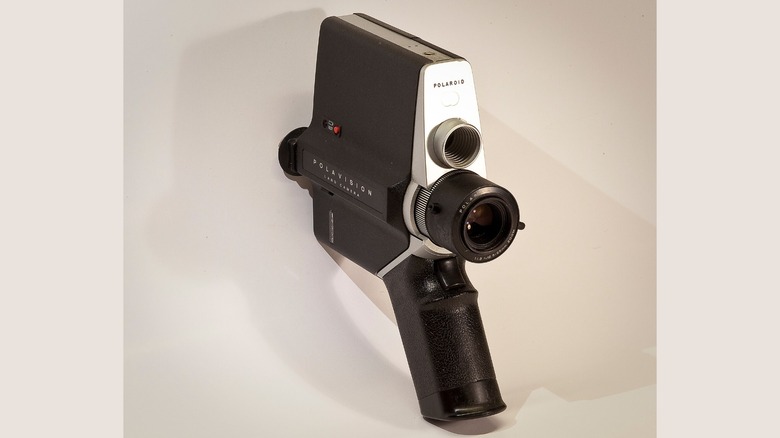
The Polavision camera is sometimes called the camera that killed Polaroid, and that's a pretty ominous way to kick off the story of an otherwise weird and wonderful '70s gadget. As most people probably know, Polaroid became an enormous global company off the success of its instant camera film. In the age of digital photography, it's hard to remember that not too long ago, you needed to take your camera film to a special store to get it developed.
Polaroid's special film, on the other hand, would develop right before your eyes. That meant you could share a photo with someone right away, or if a photo didn't come out to your liking, you could take another rather than only realizing it was a dud weeks later. So, Polaroid thought, why not make a video camera with film you could develop at home as well? Keep in mind that home camcorders would only come into existence in the '80s. So taking home movies meant using a film camera up to that point. These were expensive and complicated to operate, and you had to develop the film too.
Polavision was a product in development for years, aimed at solving all of these pain points. It used a special cassette system and home player unit that developed the film for you. Unfortunately, the short 2.5-minute playtime, lack of sound, and grainy, low-quality images were quickly blown out of the water by tape-based camcorders, which arrived shortly after. The project's massive financial loss was the beginning of the end for the company.
Popeil Pocket Fisherman
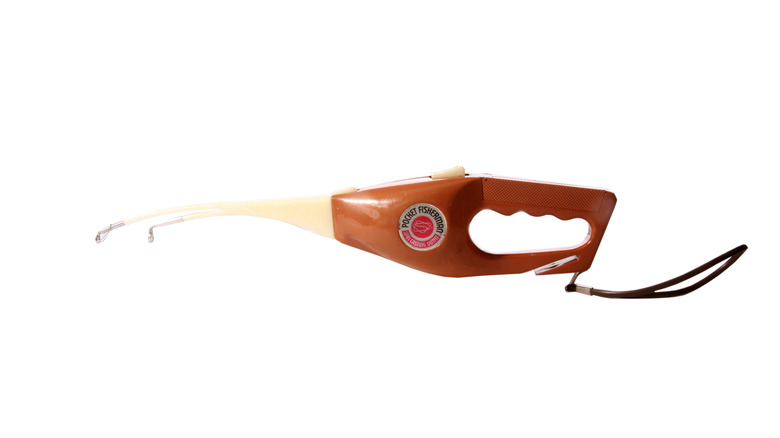
That's right, the egg scrambler wasn't Mr. Popeil's last appearance on this list. One of the many problems he attempted to solve was the sudden and impromptu need to go fishing. Just imagine you're driving somewhere and see a nice spot next to the water. Usually, you'd have to come back later with your rods sticking out of your car windows. But with the Pocket Fisherman, all you have to do is reach into your glove compartment and pull out your Pocket Fisherman, and you'll soon have a completely different problem: Where do you put the fish?
The Pocket Fisherman is still with us today, and of course there are many other pocket-sized fishing rods on the market, as well, but none of them are the original that you see above. The Pocket Fisherman was actually invented in the '60s by Ron Popeil's father, following an injury caused by the tip of a full-sized rod. But it took Ron's gift for selling things on television to make it a household name.
The actual device is quite ingenious. It folds down to a size where it won't quite fit in an actual pocket, but you could probably tuck it away somewhere in your car or easily transport it in a backpack. A compartment in the handle serves as your tackle box, letting you store the hook, line, and sinker. According to the manual, you'll have to procure and store bait yourself. Seems like a great deal for just $19.95!
Panasonic Panapet R-70
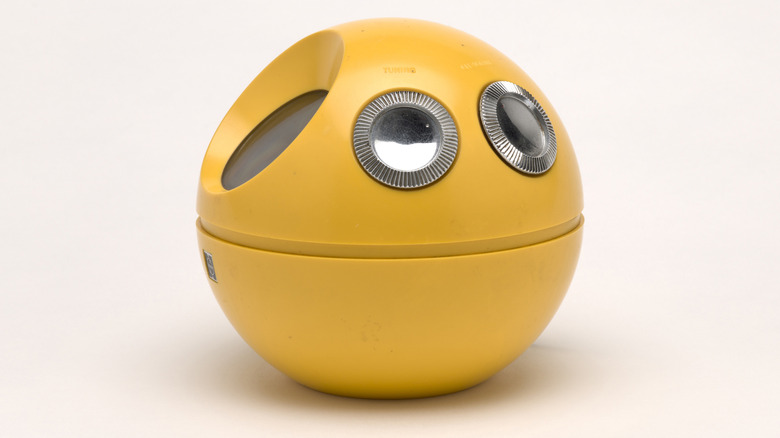
Sometimes the thing that makes a gadget memorable is purely its presentation. The Panasonic Panapet R-70 isn't particularly special from a technical standpoint. It's an early '70s AM radio that runs off a single nine-volt battery — not exactly a rare item for the time. However, Panasonic's design, with this spherical radio and bright colors, made quite the impression.
There are a few ways of looking at this design. One is as a ball and chain, since there is a chain running from the radio to a ring that allows you to attach it to an item of clothing or anything else you can fit on the ring. The Panapet part likely comes from the radio's face, with the volume and tuning dials as the eyes, and the seam between the two halves of the case resembling a mouth. So, you know, it's a Pana(sonic) pet — or a Panapet in portmanteau-speak.
The Panapet was created to commemorate the World Expo in Osaka, and it was the radio's bold colors and funky design that made it a hit. It came in red, yellow, blue, white, and avocado green. No doubt this was one product that would later influence companies like Apple to create products with bold coloring and designs that celebrate being plastic, rather than trying to hide it with faux wood and metal finishes.
Weltron Model 2001
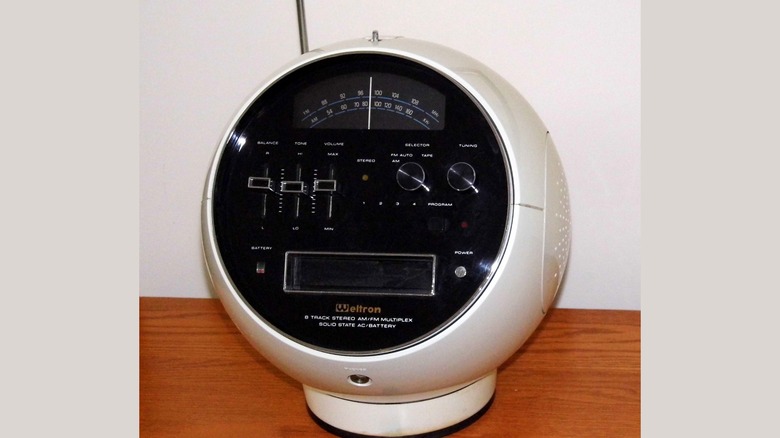
The Weltron Model 2001 is like a combination of the JVC Videosphere and a hi-fi. It's even got a little of the Panapet in there, given that you can suspend it from a chain. It's actually comparable in size to the Videosphere, and this is more than just a radio.
Like the Videosphere, the Weltron 2001 was likely influenced by the space craze and films like "2001: A Space Odyssey." This is quite a capable little audio system, regardless of whether the space helmet design appeals to you. It has a stereo speaker setup, AM and FM radio reception, and an 8-track tape player.
The Weltron is quite versatile when it comes to its power source. You can plug it into a wall outlet, but it can also run on flashlight batteries or get power from a car's 12V DC outlet. There's a carrying handle on top and a rubber suction cup on the bottom of the neck, making it easy to take with you and set up for an impromptu party. In some sense, this is a precursor to the famous boomboxes of the 1980s, at least when it comes to functionality, if not design.
Cartrivision
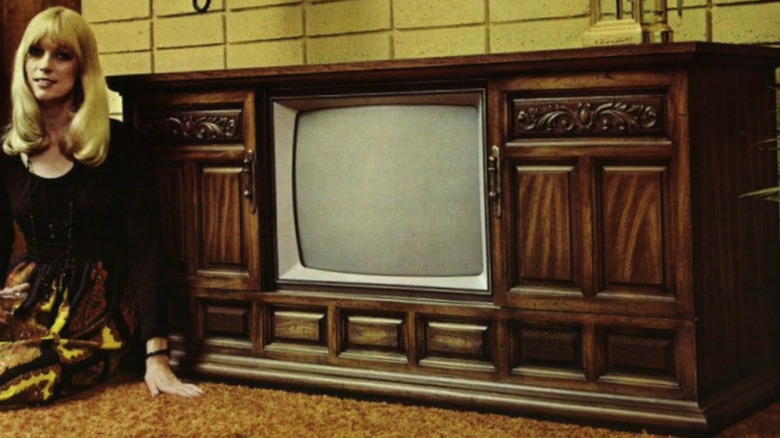
The 1980s are known for the home video revolution, with the VHS and Betamax formats duking it out in a bloody battle until VHS stood victorious. But the flickering fires of home video were already there in the '70s. For example, in 1978 the world was introduced to LaserDisc, an early analog precursor to high-fidelity home media like the DVDs and Blu-rays of today.
All the way back in 1972, the Cartrivision system became the first consumer video system with pre-recorded tapes you could rent or buy. It wouldn't be until three years later, with Sony's Betamax, that this idea went mainstream. In the meantime, the Cartrivision system had a few obstacles standing in the way of its adoption. For one thing, you couldn't just buy a player and then attach it to your existing TV. The player came with its own TV built in, so it was obviously quite expensive.
The actual cartridge media was large and bulky, too, which goes to show we don't give enough credit to the ingenious, compact design of Betamax and VHS cassettes. The red rental tapes also had a weird quirk where you could play them, but not rewind them. This was basically an early form of rights management. You paid to see the movie once and, by Jove, once is all you were going to get. That wasn't even the worst issue. The videos had poor image quality with choppy footage, thanks to showing only every third frame, and, in the end, the format lasted barely a year.
Panasonic Toot-a-Loop
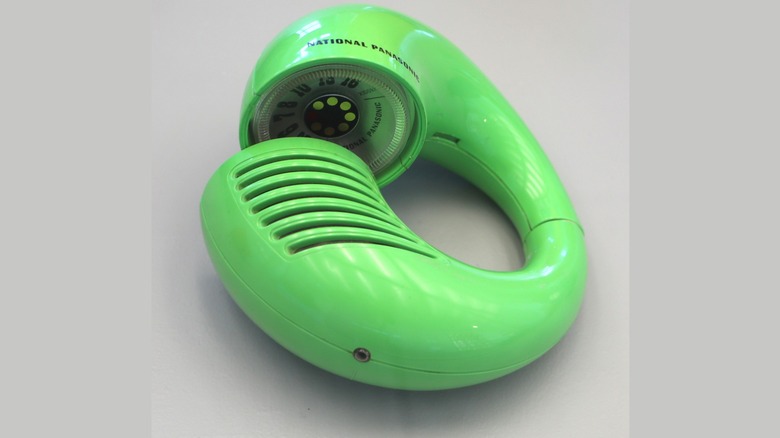
Yes, we're going to end this list of '70s weirdness with yet another radio, but you need to understand that a personal, portable radio was an incredibly desirable gadget at the time. It was like having the internet and Netflix with you, except radio was, of course, not an on-demand service. A tape player would probably bring things more in line. Regardless, a personal transistor radio was pretty cutting edge in the 1970s.
The hilariously-named Toot-a-Loop might also be an early example of wearable electronics. Technically, the Bone Fone is also a wearable, but this neat little gadget could be worn as a bracelet. Like the Panapet by the same company, the Toot-a-Loop came in a range of bold colors that go well beyond the stereotypical brown-and-beige aesthetic often associated with the '70s. Its design and rainbow might have looked more at home in the neon-plastic era of the '90s. Like the Panapet, this is an AM radio, and there's only mono sound. To change the station, you had to twist the device open to access the dial. The Toot-a-Loop and Panapet were actually part of the same Crazy Color Portable line of radios, which would have really stood out in the '70s, not to mention the '80s and '90s, too.