

7 Home Theater Upgrades That Just Work
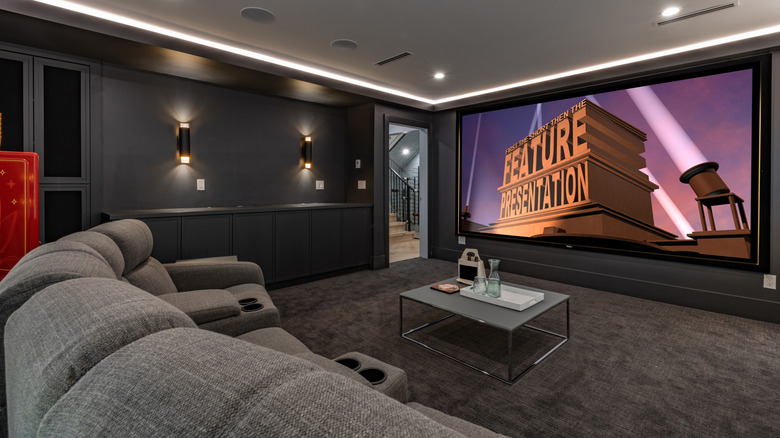
If you've already got a home theater, you don't need to rebuild it all just to get a better movie night. Some upgrades make an immediate difference: a bigger or better picture, sound that actually surrounds you, bass you can literally feel in your bones, or just somewhere more comfortable to sit.
We've already covered the cheapest ways to turn your basement into a home theater – so that's a great starting point if you're on a budget — but here we're focusing on the upgrades that will just work for instant, high-impact results.
That doesn't mean we've thrown the budget out of the window, only that we're looking at upgrades that will fundamentally change and improve the home theater experience. Which upgrades make the most difference will depend on where your current setup is weakest, so we've focused on three key areas: visuals, audio, and comfort. You can read more in our methodology about how these upgrades were selected.
Cinematic projector
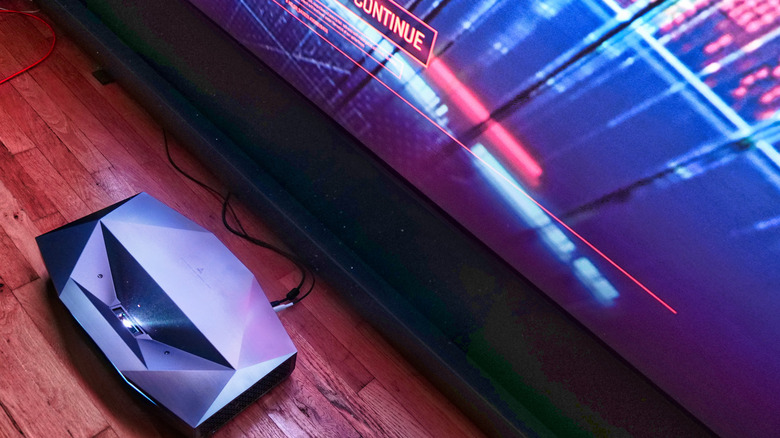
For those who are used to watching movies on a TV screen, you might have heard that a projector would be a downgrade in contrast and black levels, as well as daytime visibility. While it used to be true that choosing a projector meant sacrificing image quality for sheer cinematic projection size, modern ultra short throw (UST) laser projectors have closed the gap significantly, with much less of a compromise to be made.
Devices like the AWOL Aetherion Max offer an outstanding home theater experience with stunning 4K HDR visuals and 3,300 lumens for daytime visibility. Such devices can be placed next to your screen, avoiding complex ceiling installations. As well as AI scene enhancements, AWOL incorporates an Enhanced Black Level algorithm that dynamically adjusts luminance during dark scenes, turning a native 1:6000 contrast ratio into a perceived 1:60000, without crushing the details.
If you only upgrade one thing in your home theater, it should be this. The AWOL Aetherion Max is available from $3,799 on Amazon.
A bigger, better screen
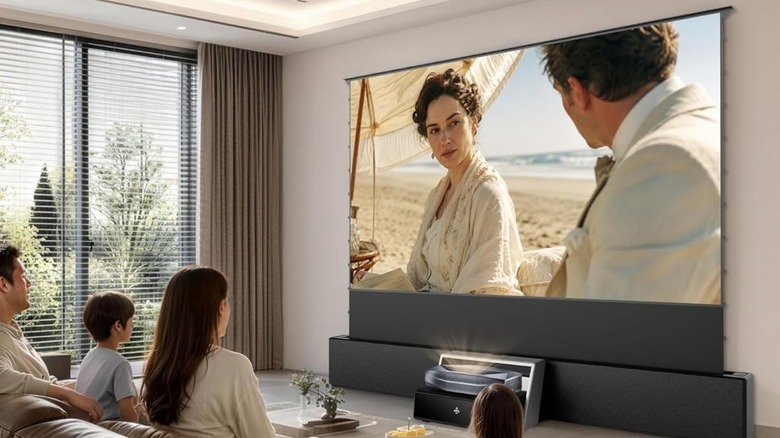
A projector is only half of the equation for a big, cinematic experience. If it's been some time since your home theater was installed, you might still be rocking a 60-inch screen; or even worse, you might just be projecting onto a plain white wall (one of the biggest mistakes people make when buying a projector). Most UST lasers are capable of pushing up to 150-inches comfortably; so, the real limitation is how much space you have.
Don't just assume that a big, bright white screen is best either. If there's any amount of ambient light in your home theater, a darker, grey Ambient Light Rejection screen will improve black levels and contrast by reducing reflections and other light sources. The AWOL Vision 120" Motorized Floor Rising Screen (from $1,799 on Amazon) is a great option so you can still see the wall behind when it's not in use.
For perfectly dark rooms, a white screen is fine, but a special textured white screen is needed to get the best from a close up UST laser. Again, AWOL offers a fantastic fixed frame 120" white screen from $399.
Genuine surround sound
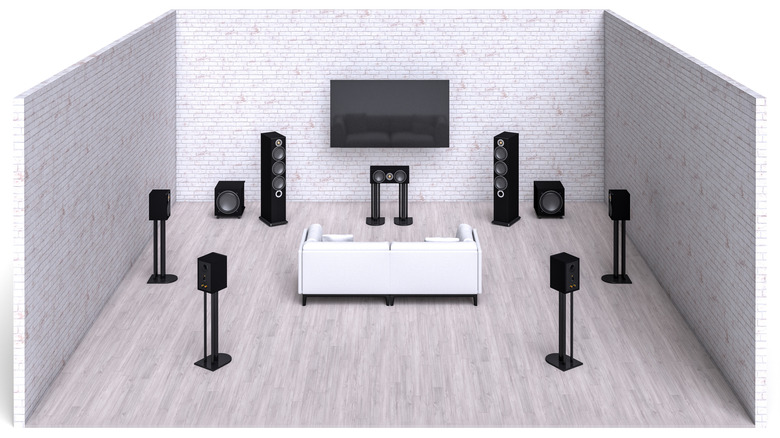
Soundbars are great for convenience — some even claim to offer virtual surround sound: the Samsung HW-Q990C ($1,099, Amazon) apparently manages a mind-boggling 11.1.4 sound channels despite only having two rear speakers, a sub, and a soundbar. However, no amount of technical psychoacoustic wizardry can get sound that's coming from in front you to sound like it's coming from behind — that's just not how physics works. Soundbars are undoubtedly an upgrade on what's coming from your TV, but they don't match up to even the most basic of physical 5.1 speaker surround sound systems.
Take some time to figure out how many speakers your room actually needs, or can accommodate. The Klipsch Reference Cinema Dolby Atmos 5.1.4 System is an excellent upgrade at just $749. However, bear in mind that you'll need a matching AV receiver too — the Denon AVR-X1800H ($849) is often recommended, offering 7.2 channel potential, as well as 8K video support for solid future-proofing, plus a microphone for calibration. Combined, the set offers immersive spatial audio to elevate any movie experience.
Acoustic dampening
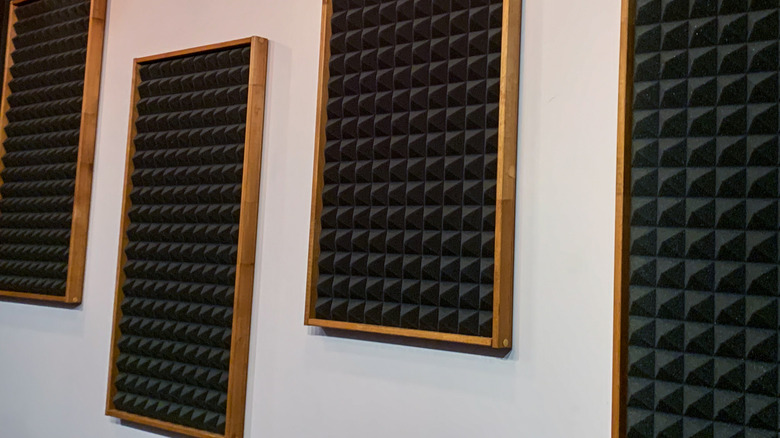
The best AV receiver and speaker combination in the world can still sound terrible if the room acoustics are bad. Sound reflects around a space, but it's the early reflection points that do the most damage in muddying your sound. You can use a simple mirror trick to identify where those are, and place acoustic dampening panels there. Sit in your usual spot, with a mirror on the left side of the room. Have someone slowly move the mirror until you can see your left speaker, then mark that location, and continue until you spot the right speaker, and mark it. Then, repeat this on the other wall.
The marked spots are where you should place acoustic dampening panels to catch those initial reflections — but don't cover your entire wall, or the room will sound dead and lifeless, as well as being very costly. Umiacoustics offers a four-pack of 2" thick fiberglass panels for under $100, and they will perform significantly better than basic foam panels.
Reclining theater seats
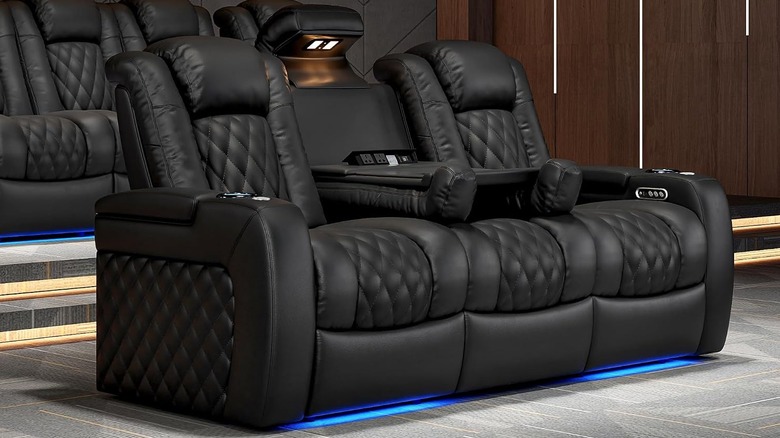
Assuming that your home theater isn't doing double duty as a general family living room, some dedicated theater seating can go a long way to improving comfort for movie marathons — as well as adding to the overall aesthetic and feel.
A set of leather recliners is perfect for home theater enthusiasts, such as the Tuscany 2025 model from Valencia Theater Seating. This row of three is kitted out in premium Italian leather, with motorized comfort and a convertible middle seat that can fold into a power console and snack tray. It's not cheap though at almost $1,000 per seat.
If you'd rather keep the big bucks for a different upgrade, Tiooii has two faux-leather reclining seats for around $1,000 total. It's important to not forget about raising the floor if you want a second tier of seating in your home theater. Between 12 and 15 inches is recommended for unobstructed viewing.
A bass shaker
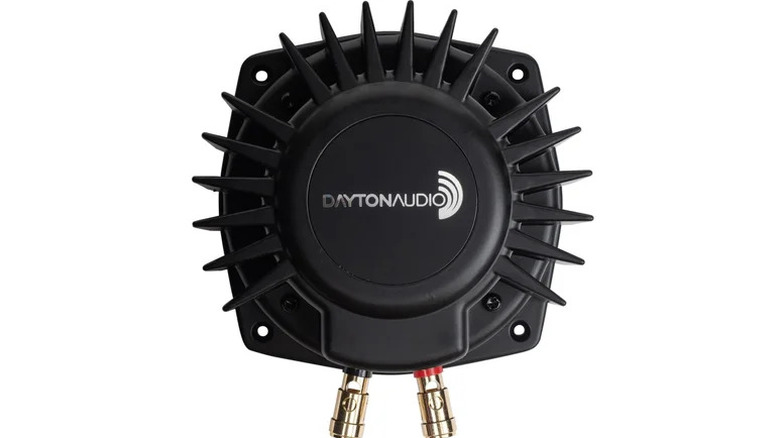
The first number after a decimal point of a surround sound speaker system (such as 5.1 or 7.2.4) refers to a dedicated subwoofer, for immersive booming bass sounds. However, you can take it even further with a less widely-known bit of kit: a bass shaker. One of the best upgrades you can make to your home theater audio, a bass shaker doesn't actually add to the audio track. Instead, it turns the bass frequencies into tactile feedback, allowing you to physically feel the thump of an explosion or the burst of gunfire; it's effectively a giant rumble motor. A bass shaker — or to be technical, a tactile transducer — screws directly on to your furniture to transfer kinetic energy — they're an essential part of a 4D cinema experience.
To set up a tactile transducer, you'll need a "pre-out" on your AV receiver, or some other way to extract a raw audio signal — they're powerful devices that need their own amplifier to drive them, rather than just be plugged into an existing speaker output. The Dayton Audio BSK2 Dual Bass Shaker Couch Kit ($439.98, Amazon) is a great all-in-one option that includes two transducers and a matching amplifier. Wearable transducers like the Woojer Vest 4 ($255, Walmart) are also available, but not a lot of good if you have multiple viewers, so they're mostly confined to gaming.
Motorized blackout shades
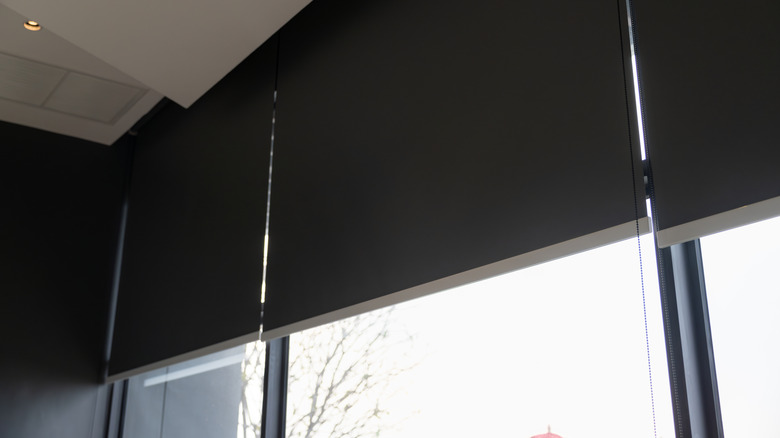
Ambient light is the worst enemy of every projector, blowing out the black levels and mushing contrast. However, your movies don't need to be limited to nighttime viewings only, as you can include 100% blackout shades in your home theater setup. These motorized shades aren't just practical; they add an element of theatrics when everyone has taken their seats, the lights dim, shades draw, and the movie starts — all via a few button taps on your remote control.
SmartWings offers highly-customizable motorized blackout shades from $179.99, with home automation options provided by Zigbee, Z-Wave, or Matter-over-Thread — though all will need a compatible automation hub for anything beyond basic remote control. Matter is a cross-compatible smart home protocol designed to prevent vendor lock-in and reliance on manufacturer's own apps. You might already have a compatible Matter hub if you use a Google, Amazon Alexa, or Apple voice assistant at home, with all the recent options including a Matter-over-Thread chip.
How we chose these home theater upgrades
This buying guide was focused on improvements to your home theater with an obvious and immediate impact. These aren't cheap upgrades, generally — there's a lot you can do on a budget, but you'll find that elsewhere. That doesn't mean we've ignored the cost element, of course. You can throw infinite amounts of money at a home theater, but the returns are diminishing. Instead, we've drawn upon decades of personal experience combined with expert reviews to select products that are widely available at retailers like Amazon. All the products we've mentioned have an average rating of four stars or more, and offer, on balance, the highest impact for the price.