

Which Motorola Phone Is Equivalent To The Galaxy S26?
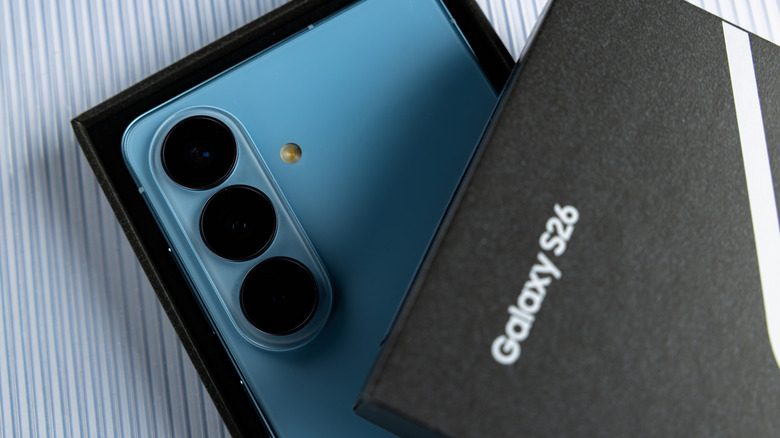
The Samsung Galaxy S26 is the entry device in the company's flagship series of Android phones, but don't be fooled into thinking it's just a doormat. In the United States, it features a Qualcomm Snapdragon 8 Elite Gen 5 chipset, one of the top processors for mobile devices in 2026. When it comes to finding an equivalent to the Galaxy S26 from Motorola, diverging paths form. The Motorola Edge is the closest we get in terms of comparing slab phone to slab phone, but it's also a major departure in price and specs. Meanwhile, this year's Razr Ultra gives us a closer but not equal match-up on silicon in a foldable form factor.
There is a somewhat painful irony in seeing S26, a widely available phone across AT&T, T-Mobile, and Verizon, separated from the two by about an order of magnitude on price: at $1,000, it sits between the $1,500 Razr and the Edge for $500. Both Moto devices come against the Galaxy with an astounding handful of surprising trade-offs, however, and they're worth diving into.
Motorola Edge (2026) vs. Samsung Galaxy S26
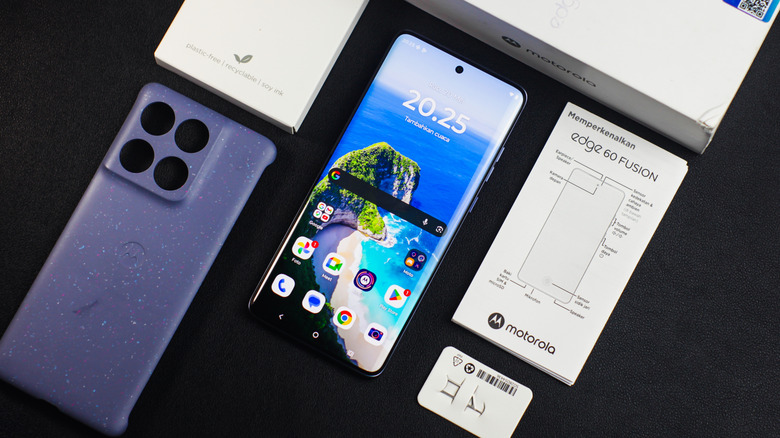
The Edge is Motorola's best slab smartphone on offer right now, and it's available from AT&T and Verizon. T-Mobile customers will need to finance an unlocked unit separately from Motorola or other retailers. You'd be surprised to hear that it actually outdoes the S26 in several areas in spite of being half its price. Both have 6.3-inch 120 Hz AMOLED displays, but Motorola's beats Samsung's on sharpness with a somewhat unorthodox 2640×1216 resolution; battery capacity is up 16% to 5,000 mAh; wired charging speeds are boosted from 25 watts to 60 watts; and Motorola also packs in the pixels with three 50MP cameras (main wide-angle and ultra-wide on the rear plus the selfie) to the Samsung's one. The Edge and S26 go toe-to-toe on the 10MP telephoto camera at 3x zoom, though Motorola's is faster with an f/2 aperture versus an f/2.4. They also both come with IP68 endurance ratings, in-display fingerprint sensors, and Android 16 — albeit with completely different interpretations.
All that said, the Galaxy S26 takes the lead with its core processor and memory specs. Samsung uses both the Snapdragon 8 Elite Gen 5 as well as its own Exynos 2600 chipset on the phone, both of which outdo the Edge's MediaTek Dimensity 7450 chipset by three or four times in benchmarks. The S26 also has 50% more RAM at 12GB and at least double the storage with a starting configuration of 256GB. It also supports USB 3.2 Gen 1 connections via its USB-C port, a faster standard than Motorola's USB 2.0. Quite importantly, the S26 gets seven years of software support compared to its counterpart's three years maximum, which is about as long as many Motorola owners say their devices last.
Motorola Razr Ultra vs. Galaxy S26
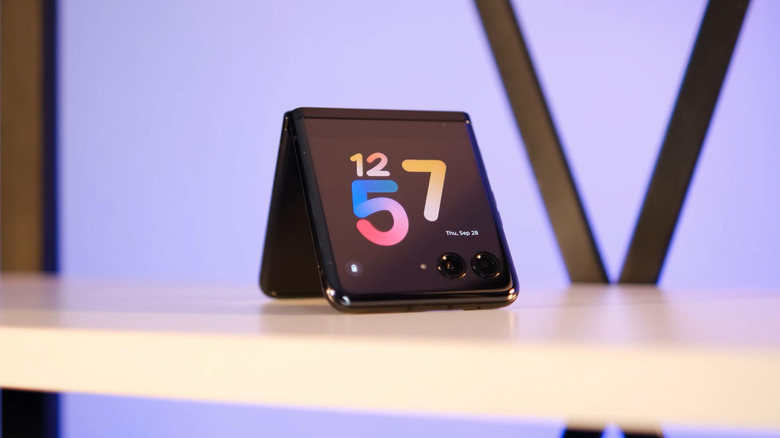
Motorola's most powerful phones for 2026 so far are in its foldable Razr series. While the company's first booklet-style device, the Razr Fold, has a Snapdragon 8 Gen 5 chipset, we've found that the current clamshell Razr Ultra fares better as a performance-based rival with the original Snapdragon 8 Elite, one generation behind the S26's Snapdragon 8 Elite Gen 5. That generational gap, plus what we presume are some physical thermal design limitations, contributes to a 30% gap in Geekbench scores favoring Samsung.
Funnily, the Razr Ultra has a leading edge against the S26 in many of the same areas the Edge had its best showing: the same 5,000 mAh battery means the same 16% advantage; an even faster 68W wired charge rate; double the wireless charging rate at 30W; 16GB of RAM; 512GB of storage; and three 50MP cameras, but no telephoto shooter. Oh, and the obvious dual AMOLED displays, of course — the 7-inch interior display and 4-inch exterior display — both support 10-bit HDR viewing and are somehow more pixel-dense than the Galaxy S26. You do gain a lot with features exclusive to foldable phones, but it can be a more unwieldy carry for some out there. The design of the Razr Ultra also only garners an IP48 rating, indicating it is more susceptible to failure from intaking particulate matter. USB 2.0 support is also a straight-up crime on a $1,500 device that's only available unlocked in the U.S.
You might not even call the Edge and Razr Ultra fair equivalents to the Galaxy S26, which is fair enough given their different form factors. There's another Motorola vs. Samsung duel we're awaiting, though, as the Snapdragon 8 Elite Extreme Gen 6 will launch on the upcoming Motorola Signature 27 and (most likely) the Galaxy S27 series.