

Motorola Razr Ultra (2026) Review: The Best Flip Phone (A Lot Of) Money Can Buy
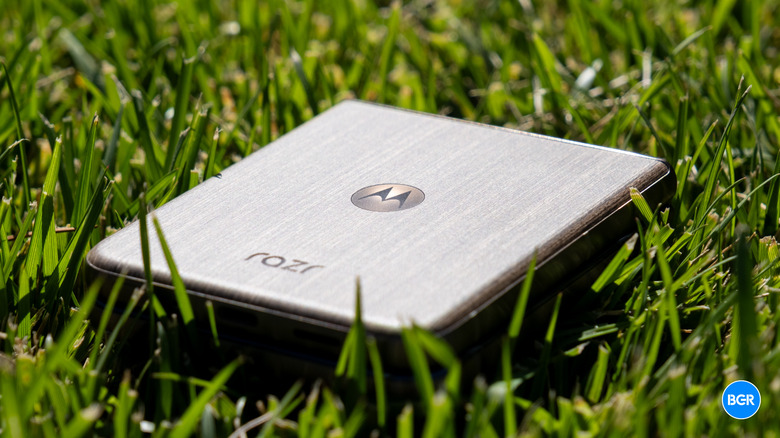
Motorola has been plugging away at flip-style foldables for years. In 2026, it expanded its foldable lineup to leverage its expertise for book-style devices, but that doesn't mean it's taking a break from flip-style phones. Alongside the new Razr Fold, Motorola has also released 2026 iterations of its other foldables, including the Razr Ultra (2026).
Now, while Motorola isn't taking a break from releasing flip phones, the spec sheets make it clear that the company isn't currently dedicating many resources to them. The devices are only minorly changed compared to last year's models, and you could argue that the changes aren't very meaningful.
Despite the lack of upgrades, the phones are even more expensive. The Motorola Razr Ultra (2026) costs $1,499.99, which is a hefty $200 more expensive than the 2025 model. To add insult to injury, the phone keeps the same chip as last year -– it doesn't even have a chip bump, which many would consider to be the bare minimum for yearly upgrades. So, what does it do to justify the higher price? Or has Motorola fumbled the ball for its 2026 flip phones?
Design
I'm going to play a game in this review. It's called new or not. Ok, "game" is a stretch, but play along.
The Razr Ultra (2026) has a folded footprint of 88.1 x 74 x 15.7mm, and measures 171.5 x 74.0 x 7.2mm unfolded. That's identical to last year. It gets pretty compact, and while it's heavier than the other devices in the 2026 Razr lineup, you probably won't notice it in your pocket.
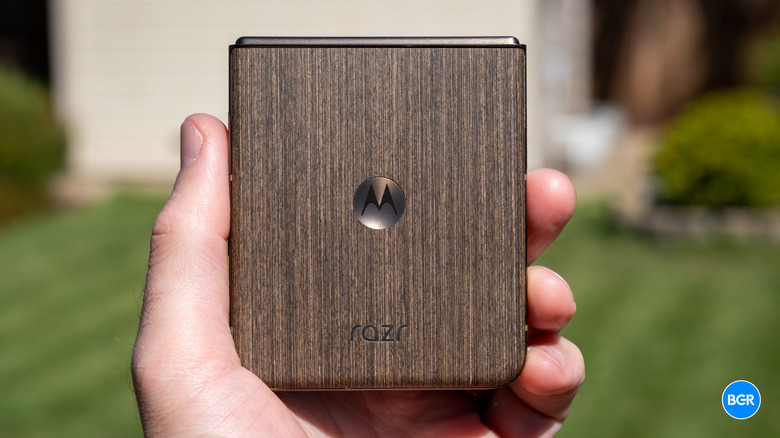
While the Razr+ gets a titanium frame, Motorola has stuck with aluminum for the higher-end device. That's not a huge deal, especially on a device that's already heavier than the others in the lineup. On the back, you'll get different materials depending on the colorway. I'm reviewing the wood veneer model, which I think looks great — it's premium in feel too.
The cover screen now sits behind Gorilla Glass Ceramic 3, an upgrade from the previous generation's Ceramic glass. In practice, the original cover glass on the 2025 model was already resilient, so this is more of a quiet confidence boost than something you'll notice day-to-day. Worth having, though.
Durability is rated IP48, the same as last year. That means full dust resistance and the ability to handle being submerged in fresh water, which is genuinely good for a folding phone — but it's identical to what the 2025 offered, and it's an area where an upgrade would be nice.
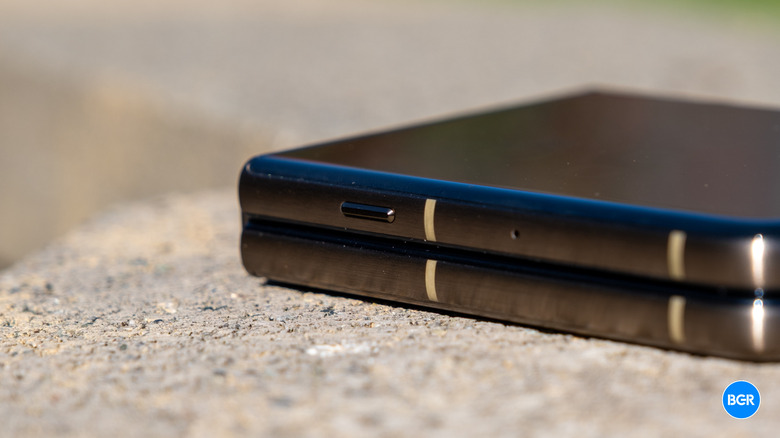
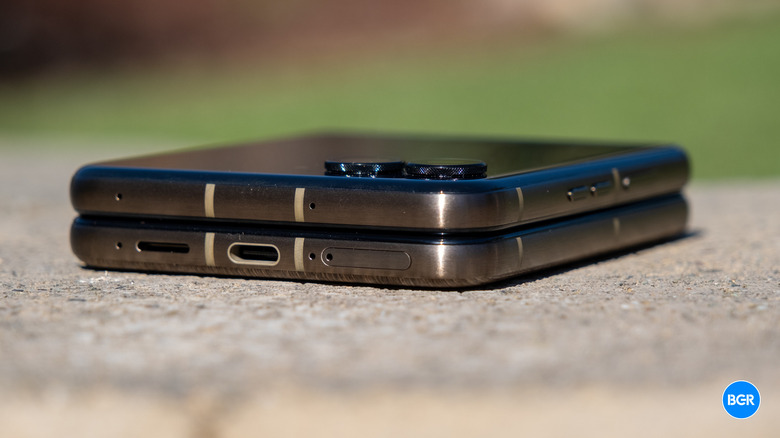
The rest of the design is more or less to be expected. There's a USB-C port on the bottom, along with a volume rocker and power button on the right side. The power button houses a fingerprint sensor, which I found to be relatively fast and accurate.
So, to our game. New or not? A pretty definitive "not" on the design front. Ceramic Glass 3 is nice, but you'd be hard-pressed to call that a design change.
Display
On the inside of the phone, you'll find a 7-inch LTPO AMOLED display with a 1224 x 2992 resolution and 462 pixel-per-inch pixel density. The refresh rate goes up to 165Hz, and it ranges all the way down to 1Hz to conserve energy.
While not a massive upgrade, the display is indeed new. According to Motorola, brightness has jumped to 5,000 nits, up from 4,500 nits last year. I was actually able to beat Motorola's rated brightness on the base Razr (2026) by a fair bit. But I couldn't get anywhere near the 5,000 nit rating in my testing on the Razr Ultra. The fact is that these metrics are usually only real in very, very specific scenarios, so the fact that I wasn't able to hit 5,000 nits doesn't mean that the screen isn't capable of it, but it does mean that you're unlikely to experience it yourself. For reference, the peak brightness I measured was only around 3,000 nits, which is decently bright but not class-leading. The screen is pretty accurate in terms of color reproduction, which is nice.
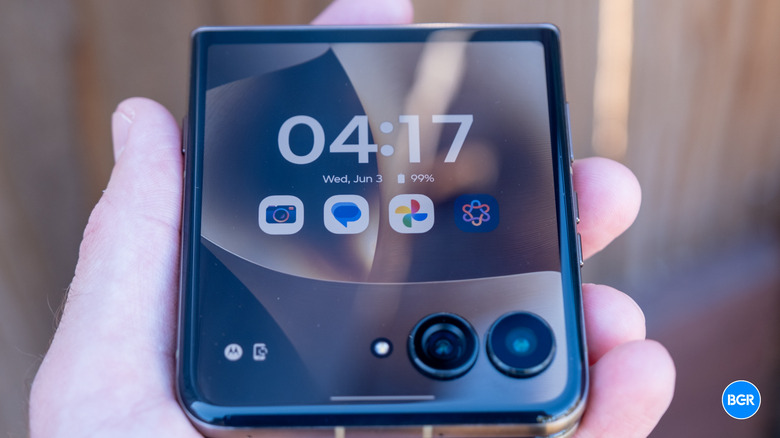
On the outside of the device can be found a 4-inch screen with a 1080 x 1272 resolution and a pixel density of 417 PPI. It's a solid screen -– it also ranges up to 165Hz and gets bright enough for outdoor viewing. Colors are just as accurate as the inner panel, so flipping between the two is seamless.
So, is the display new? Technically, it is an upgrade over last year's model -– it has a higher resolution and gets a little brighter. It's not significant enough on its own to warrant spending $1,500, but it's enough of an upgrade to get the "new" label in this category.
Performance
The Motorola Razr (2026) is powered by the Qualcomm Snapdragon 8 Elite, coupled with 16GB of RAM. Unfortunately, it's the same chip as in the 2025 model, not the newer Snapdragon 8 Elite Gen 5. In a phone this expensive, that's pretty disappointing.
Of course, you probably won't have issues with the performance day to day. It still loads apps quickly and multitasks with ease. You'll have no problem throwing anything you want at it in 2026, including mobile gaming. The downside to an older chip is likely to come towards the end of the lifespan of the phone, when it's lagging devices that did get an upgrade to a newer chip.
In benchmarks, of course, the phone performs mostly the same as last year. That's not necessarily a bad thing. Last year's device performed decently well, but one year later, the numbers can't compete with phones that have more modern chips powering them. In benchmarks, the Razr Ultra performed dramatically better than the base Razr and Razr+, which is unsurprising. In practice, most activities and apps will run just as fast on the Razr Ultra as on the Razr+, though the base Razr does lag behind due to its worse chipset.
New or not? Definitely not, and at this price, with a $200 price bump over last year's entry, that's pretty disappointing.
Battery and charging
The Motorola Razr Ultra (2026) has a 5,000mAh battery, up from the 4,700mAh battery on the 2025 model. That's thanks to the silicon-carbon battery tech that Motorola has adopted, and while it's certainly not a dramatic change, any upgrade in battery life is worth highlighting.
The device will get through a full day of moderate use pretty easily, and while you may need to top up by the end of the day after streaming video or browsing the web for hours, the majority of users will most likely get through a day, and maybe a little more, with ease. I found the battery life on the Razr Ultra to be the best of any of the three new Razr flip phones, which isn't very surprising, given the fact that it has the largest battery. In a video playback test, I hit around 31 hours, which is ahead of the other Razr models by a decent amount.
Charging speeds are unchanged compared to last year. The device hits 68W in wired charging speeds and 30W wireless. One problem: there are zero chargers that actually allow you to take advantage of that wireless charging speed. Motorola is marketing the charging speed because it was able to hit it in lab tests, but until it actually sells a wireless charger that supports those charging speeds, customers won't be able to take advantage of them.
I was able to charge to full in around 50 minutes — roughly 70% in the first half hour. That's decently quick, especially given it contains a bigger battery than the rest of the lineup. For reference, Samsung's Galaxy Z Flip 7 took closer to an hour and a half.
Is the battery upgraded enough to get our prestigious "new" award? Yes. The charging speeds haven't budged, but the bigger cell delivers genuinely the best endurance in the 2026 Razr lineup, and that's enough to earn the label.
Camera
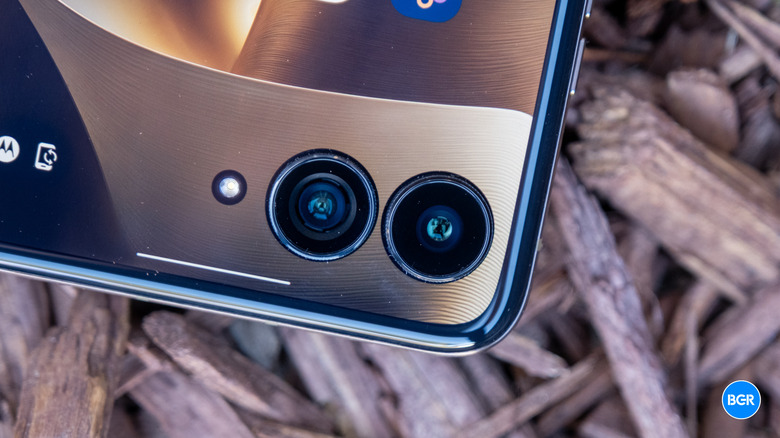
On the back of the Motorola Razr Ultra is a dual camera system, made up of a 50-megapixel main camera and a 50-megapixel ultrawide camera. At this price, it would be nice to have a telephoto camera, but that's perhaps a limitation of the flip phone form factor. Frankly, I'd prefer to have a telephoto camera than a large cover screen -– or frankly any cover screen. But that's a personal preference.
The headline change on the main camera is the new LOFIC sensor (Lateral Overflow Integration Capacitor, if you want the full name), which Motorola claims delivers up to 6x more dynamic range. That's a big claim, and while the "6x" is marketing rather than anything you'll measure in the real world, dynamic range is a genuine strength here. The main camera held onto highlights and shadows in high-contrast scenes better than most flip phones I've tested — clearly better than the Z Flip 7 — so bright skies behind a shaded subject hold together instead of blowing out.
The main camera is sharp and detailed, and it holds up well in low light where a lot of phones fall apart. The ultrawide is softer, especially toward the edges and in dim conditions, which is unsurprising for a small ultrawide sensor. I do wish flip phones started getting better ultrawide cameras, even if it means taking up a little more space on the back of a device.
The front camera sits in at 50 megapixels, and it's a pretty good one — sharp, accurate, and with strong dynamic range, so selfies hold up nicely whether or not the light is cooperating.
If you're used to a phone with a telephoto lens, though, you'll miss it here. I really wish flip phones started shipping with telephoto cameras, especially those at this price range. It's a pretty major compromise for the flip form factor, and I think there are plenty of people who would forego the cover display entirely in favor of a significantly better camera. If the phone was still able to fold in half, I'd be perfectly happy with a much smaller cover screen that really only serves as a camera viewfinder if the camera was much better, as I don't really use the cover screen for much more than checking notifications.
But I digress. Is the camera new? Yes. There's no telephoto, but the LOFIC main sensor is a real change, and the jump in dynamic range is something you'll actually notice. It earns the label.
Software
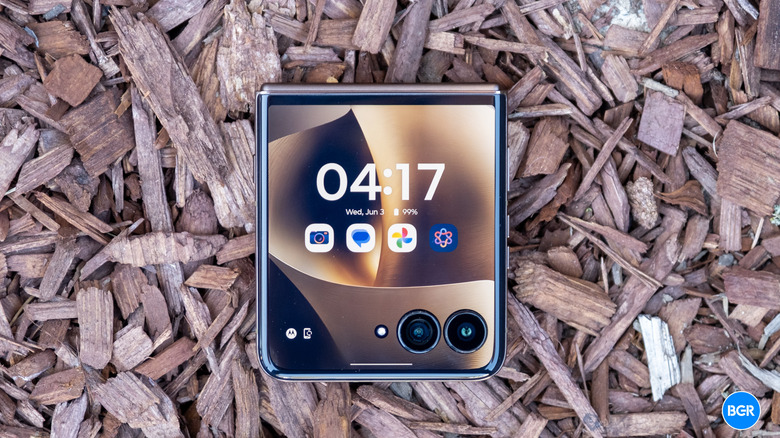
The Motorola Razr Ultra (2026) offers Motorola's Hello UI, which is a solid Android skin. It's stripped-back enough to feel like "stock" Android, though the term stock Android has virtually no meaning now. Essentially, everything is more or less where you expect it to be, and anyone who has used an Android phone before will have no problem navigating the interface.
The Razr Ultra leans fully into AI, and unlike the cheaper models, it has a dedicated hardware button for AI. In practice, that button is fairly limited in what it actually does, so I didn't find myself using it much — Moto AI is the hub for Motorola's features, but Gemini sits alongside it and is the more useful of the two.
There's some bloatware, as usual, including Perplexity, WhatsApp, Adobe Scan, and a set of Motorola's own apps. It's not too over the top, but I still would prefer to not have these apps installed. The non-Motorola apps can be removed, but the Motorola ones largely can't.
The software experience on the Motorola Razr Ultra (2026) isn't really new –- there are some features that have been changed over the past year, but other Motorola phones will get those features through a software update anyway.
Conclusions
Unsurprisingly, the Razr Ultra is the best flip phone in Motorola's lineup, and the best-performing — it has the strongest chip, the best battery life of the three, fast charging, and a camera that's genuinely improved thanks to the new main sensor.
The problem is the price. A $200 increase is a lot to ask for a phone running last year's chip, and the headline 5,000-nit display claim didn't hold up in my testing. If you want the most capable flip phone money can buy, this is it. If you're looking for value, it's a much harder sell, especially when you can get a phone that performs better and has a significantly better camera at a much lower price.
The competition
The Razr Ultra's closest flip rival is the Samsung Galaxy Z Flip 7, which is $400 cheaper at $1,099.99 — but the Ultra outperforms it on nearly every front, so you're paying for that gap. The more imposing competition comes from outside the flip category entirely.
At this price, you can get a device like the Samsung Galaxy S26 Ultra, Google Pixel 10 Pro, or iPhone 17 Pro. These all perform substantially better, have better cameras and displays, and will last much longer if you plan on sticking with a phone for a few years.
Should I buy the Motorola Razr Ultra (2026)?
Yes, if you're looking for the best flip phone, no matter the cost.