

6 Essential Gadgets For Learning To Play Guitar
We may receive a commission on purchases made from links.
Picking up an instrument for the first time can be equal parts daunting and exciting, especially if you've got no background in music. But when it comes to learning anything at all, reducing friction points will help streamline your process and keep you motivated throughout. If you've resolved to take up the guitar, you can invest in a few choice gadgets that can support your learning experience. If you've already gone and bought your first guitar and some basic accessories like picks and cables, then you're set to explore more options. Just don't try practicing with a keytar from the '80s or that one stringless guitar you can only get in China. Fun, but not ideal for learning guitar.
Plenty of free learning resources are available through institutions like the esteemed YouTube University, but nothing compares to cold, hard practice, which you unfortunately can't binge watch your way through. That said, you can use a variety of specialized equipment to get the most out of your hours spent practicing. Examples include an honest-to-goodness metronome — yes, a real one that doesn't live inside your phone — and a headphone amp that allows you to practice quietly while enjoying some of the benefits of a typical guitar amp.
We've picked out some of the best gadgets that can help you out with timing, ear training, song practice, and beyond. Product types were selected based on their ability to support the learning process either directly or indirectly, and individual product recommendations had to meet a small set of criteria. Namely, each gadget had to have been recommended by well-known, reputable publications, and each one required an average Amazon user review score of 4.3 stars or greater from over 750 reviews.
Clip-on guitar tuner
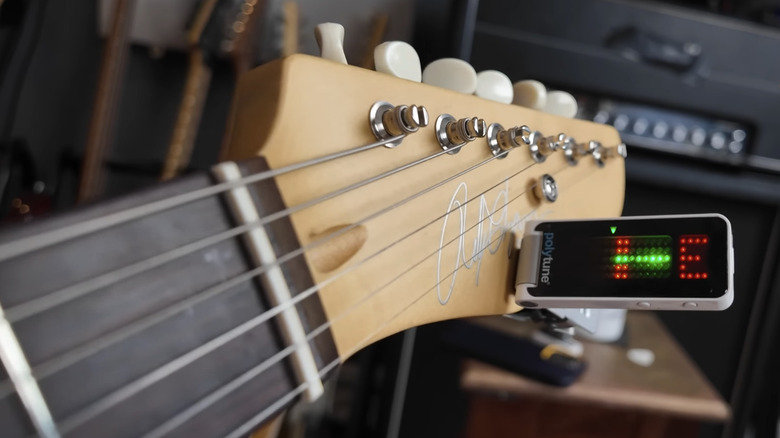
Playing guitar is loads of fun. What's even more fun is playing a guitar that's in tune. Otherwise, you're in for an earful of dissonant chords and notes that sound nothing like they're supposed to. Over time, you may learn to rely on your ear to tune your guitar properly, but at first it's wise to keep a humble electronic tuner at hand.
Generally, electronic tuners pick up analog frequencies, convert them to digital information, then translate that data into notes, to display on the tuner's interface. Clip-on tuners clip to a guitar's headstock picking up vibrations to parse into notes. These clip-on options are great for beginners because of their low cost, portability, and ease of use. Smartphone tuners work well in quiet environments, but they aren't as useful as clip-on tuners in noisy settings.
One reliable choice is the $38 TC Electronic Polytune Clip, which Guitar World describes as both "accurate" and "incredibly well-made." The tuner is chromatic, meaning it's capable of recognizing all 12 notes in an octave, and it also has a polyphonic mode that gives you a readout for all of your strings at once after a single strum. Its strobe mode is accurate to ±0.02 cents. For context, a cent is one twelve hundredth of an octave. That's fine tuning, all right.
Metronome
In your learning stages, it's normal to have to pause often when you adjust your fingering, switch chords, or hit the wrong note (it happens to the best of us). Veering off time is only natural as a result of these interruptions. That said, it can still be difficult to keep time even when you've got all your notes down, and that's where metronomes really help. They may seem like redundant gadgets, but they're genuinely important for training your timekeeping skills. According to popular guitar YouTuber JustinGuitar, metronome use is a key factor in developing timekeeping skills, and players who use them tend to play better than those who don't.
Metronomes produce a steady pulse at varying tempos — measured in beats per minute, or BPM — to help musicians improve their sense of timing. Using one is extremely easy. Simply set your metronome to the BPM of the song you're practicing and let its rhythmic ticking sounds guide your hand. If you're struggling with your chosen song's pace, you can always turn the tempo down to something more manageable to you, and then you'll know the exact tempos you can swing on the guitar.
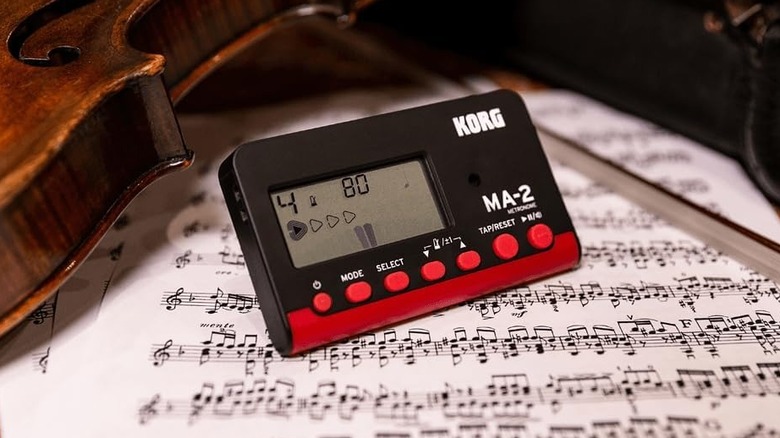
As with tuners, opting for a metronome app is an option, but using one isn't ideal if you're trying to keep distractions at bay. MusicRadar pointed to the Korg MA-2 Digital Metronome as the best budget option, describing it as both "portable and affordable." Given its $19 price tag and its credit card-like form factor, we'd certainly agree. The unit can operate for about 400 hours on a single battery, comes in two different colorways, and allows for adjustable time signatures.
Capo
We already know that most of you are going to try playing "Wonderwall" at some point. It's inevitable. Whether that's a good or bad thing depends on who you ask. Regardless, Noel Gallagher plays the song with a capo on the second fret, so you're going to need one eventually if you're keen on seriously (or ironically) learning the song.
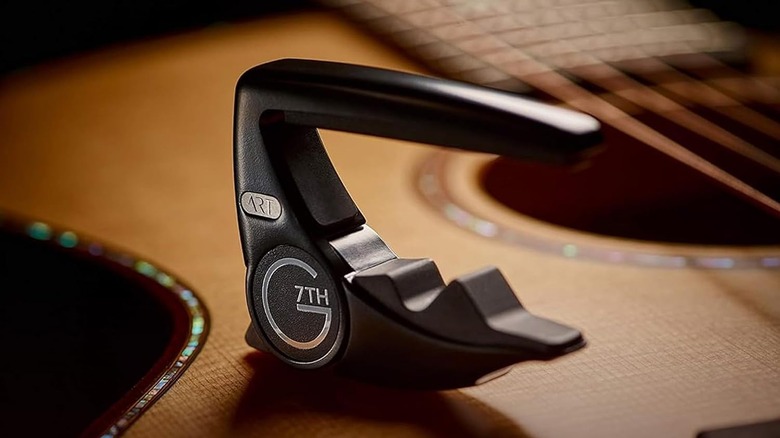
Capos help guitarists practice specific songs faithfully, and they introduce an easy way for guitarists to put their instrument in another register, which is particularly valuable in jam sessions. Capos work by pressing down on every single guitar string along a single fret to alter the key or simply heighten the pitch of the strings. These simple gadgets differ in a number of ways, including build quality, weight, and adjustability.
One capo that excels in each of those departments is the G7th Performance 3, which is exceptionally well reviewed among buyers. It's also Guitar World's top capo pick. This capo isn't "adjustable," but it doesn't need to be, because it leverages proprietary Adaptive Radius Technology to adjust to any guitar neck. However, that feature is what makes it expensive to the tune of $70. For a more affordable option, consider the Dunlop Trigger ($16), which Guitar World also included in its roundup of guitar essentials and described it as "built to last." Guitar YouTuber Jo Bywater also stands by both, showing they're tried-and-tested options among players, too.
Looper pedal
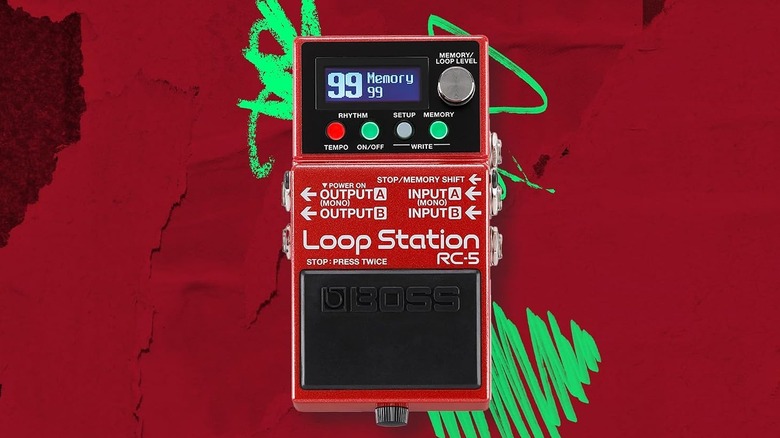
Looper pedals are useful for learners in a few key ways: adding variety to practice sessions, enabling experimentation, and granting "the ability to loop chord progressions and riffs so you can practice soloing" over them, which helps improve "timing, sense of harmony, and feel," according to Guitar World. They're also darn fun.
Looper pedals allow you to record your very own motifs, chord progressions, and rhythms as backing tracks that you can play over in real time. Using looper pedals, you can layer multiple audio snippets to create overdubs, going from simple solos to tracks that sound like fleshed-out songs. Compared to playing over a backing track you'd find online, looper pedals are faster to work with, enable greater creativity, and foster independent songwriting skills.
For beginners, keeping it simple is ideal, so we don't recommend opting for fancy multi-effects pedals for your first purchase. Instead, go for the $219 Boss RC-5 Loop Station, which has been backed by Guitar Player, Guitar World, Popular Science, and others. It's both feature-rich and easy to use. The pedal can store and recall up to 99 musical phrases you've loaded into it, but it also comes with 57 tracks and seven drum kit styles for immediate use out of the box. It captures 32-bit audio quality, as well as 13 hours worth of stereo recording time.
Headphone amplifier
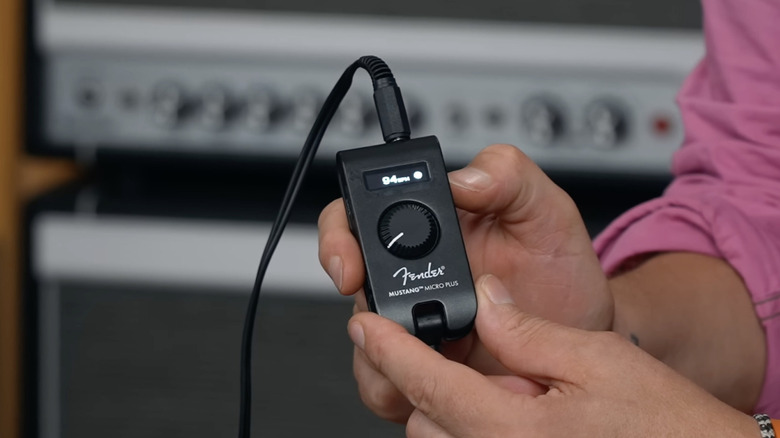
In many cases, it's not feasible to blast your guitar practice on an amp without getting yelled at (or worse, getting the cops called on you). Whether you're living in a thin-walled condo, an apartment complex, or a multi-person home, noise levels are almost always a consideration when you're practicing your instrument aloud — or at least, they should be. No matter your circumstances, though, headphone amps allow you to practice guitar quietly and without interruption, but with the added amplification features you'd get from actual amps — more than what a regular set of good old wired headphones can boast.
Headphone amplifiers crank up and process audio signals before routing them to your headphones. They do come in large, AVR-like form factors for music listening, but pocket-sized headphone amps are designed to be plugged directly into your guitar. They simulate tones found on many guitar amps and often come with a number of audio effects that allow you to fine-tune your desired sound, whether you're after clean, shiny chords or crunchy, lo-fi distortion.
Both Guitar World and MusicRadar cited the $130 Fender Mustang Micro Plus as their top headphone amp pick, and Andertons Music Co praised it for having "so much good tone" despite being the size of "a box of matches," also noting that Fender couldn't have made using the device any easier than they did. The Mustang Micro features 25 pre-packaged amp and effect models, as well as 100 preset slots for you to modify as you wish. It supports audio playback as you use the device, making it quite easy to practice along with songs. You can also use it to record your playing directly to your computer, whether Mac or PC.
Audio interface
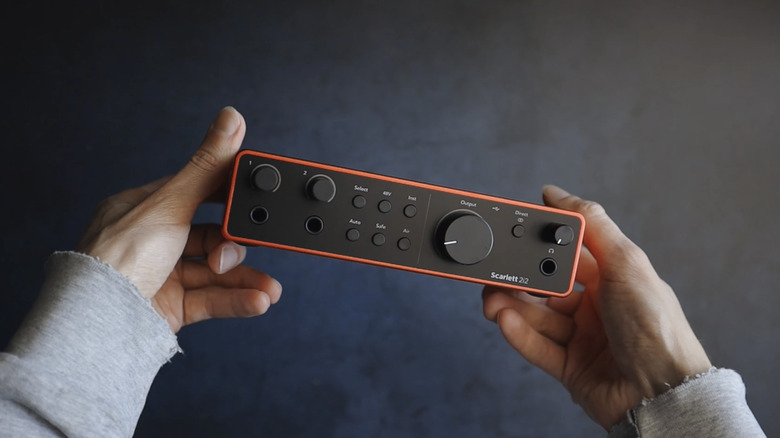
Audio interfaces are the bridges that connect your real-world instruments to your computer using analog to digital conversion (ADC), the inverse of what you might already know as digital to analog conversion (DAC), the tech that allows you to hear reliable reproductions of sound from digital audio sources on speakers (even including your phone's built-in speakers). Interfaces aren't explicitly for learning, but the affordances they provide are useful when you're learning any instrument, not just the guitar.
With an audio interface, you can record your practice sessions into the software of your choice, then play back the audio to monitor your performance and identify errors. You could keep these practice recordings for historical record, but you might also land a useable improvised riff or a singular sample of a seventh chord. Audio interfaces are also essential in a standard music production starter setup, so if the production space also interests you, this is a no-brainer purchase.
If learning guitar isn't your first foray into the world of music, there's a good chance you've seen an audio interface before. And, if so, there's an even better chance the interface in question was a cherry-red Focusrite Scarlett of some kind. Scarletts are among the most popular audio interfaces out there, in part because they're affordable and easy to use. MusicRadar labeled the USB-C Scarlett 2i2 Fourth Gen ($225) as the best option for beginners in general and for guitarists specifically. How-To Geek described this model as "better sounding than ever." The unit can prevent clipping and adjust input gain automatically, and it even includes light versions of multiple DAWs. Given it's a class-compliant USB-C device, you could run this interface to a Linux-based Steam Deck, then use it to record music with your guitar. Neat, eh?
How we drew up this list of guitar learning gadgets
Only mechanical or electrical gadgets that support the learning process were selected for this list. All products have been recommended by reputable authorities in the music or tech sphere, including MusicRadar, Guitar World, How-To Geek, and a number of well-established YouTube channels. On top of that, each item also had to be well rated on the consumer side, with average Amazon user ratings of 4.3 stars or greater from at least 750 reviews.