

How To Pick The Best Anker Power Bank To Charge Your Devices
We may receive a commission on purchases made from links.
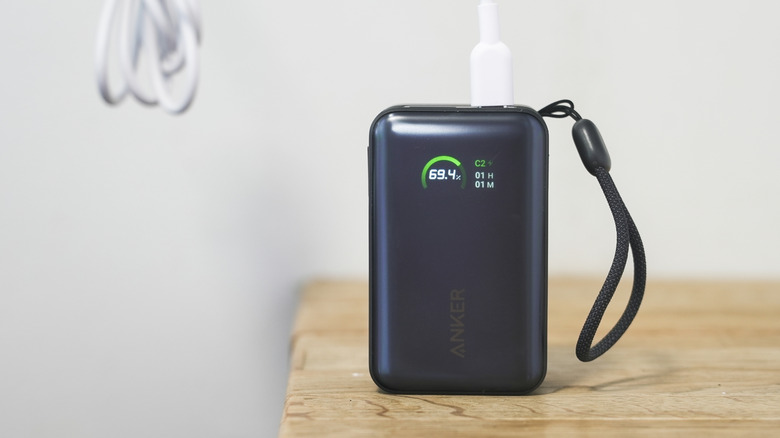
The reputable mobile accessory brand Anker offers several power banks in its portfolio. These power banks can be an excellent option to juice up your mobile devices when you're away from an outlet or simply don't have your wall adapter or wireless charger on hand. Depending on the power bank, you can top up everything from your phone to your laptop. However, there are several key factors that you should consider before picking an Anker power bank to get the best experience and most use for your needs. Fortunately, Anker's expansive portable charger selection has dozens of options to cater to different use cases.
One of the most important considerations while picking any power bank is the battery capacity. You have to think about how many devices or how many times you might have to charge a particular device when you're using the power bank. More importantly, higher capacity power banks are bulkier, which is something to keep in mind, as it impacts portability. A balanced approach between the battery capacity and overall size is typically a good idea.
It's also critical to remember that Anker, like other power bank brands, has two battery capacities listed on its offerings: marketed capacity and rated capacity. While both are technically accurate, the actual battery backup of a power bank depends on the rated capacity, which is around 60% of the marketed capacity. For example, if you're buying a 10,000 mAh power bank, you can only expect around 6,000 mAh of battery to be used for charging. This is one of the reasons why uninformed buyers often end up feeling disappointed when their power bank doesn't deliver on the marketed capacity.
Charging speed and port selection
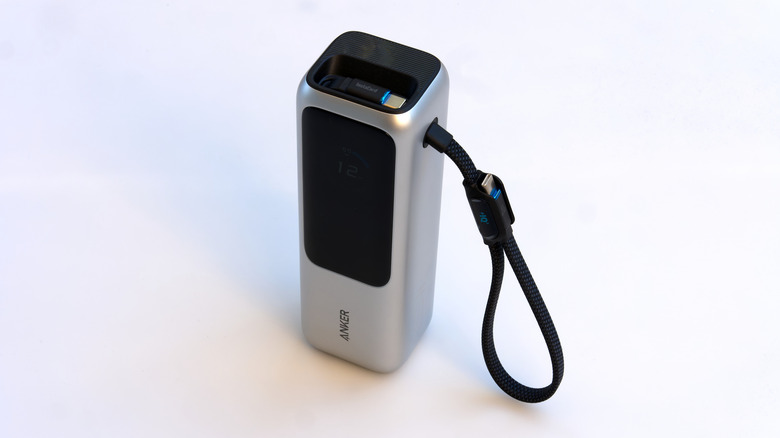
Besides the battery capacity, the most essential bit to be on the lookout for is the charging speed of your Anker power bank, as it varies by model. Unless you are okay leaving your phone plugged into a power bank for hours, it's helpful to look for a model that can top up your phone or tablet quickly while supporting a compatible fast-charging technology for your devices. USB Power Delivery (USB PD) is the most common standard and is used on iPhones, Google Pixels, Samsung Galaxys, and some Motorola phones. Programmable Power Supply, or PPS, is another technology that Google and Samsung devices use. A charging speed of 25W or higher is often a good starting point for modern smartphones and tablets. For laptops, it's best to go with 45W or higher. You can decide on the exact figure based on your individual devices.
Another feature that differs based on models is the available port selection. It doesn't hurt to have a power bank with multiple charging ports and a combination of both USB-C and USB-A, as it gives you the freedom to charge multiple devices simultaneously. Do keep in mind that the overall output of a power bank will be divided between different ports when you're juicing up more than one device at a time, which is something you should be mindful of when you're looking at a power bank's output and charging speed.
Some Anker power banks also come with a built-in cable, Qi charging spots, or MagSafe support, which can be useful in some situations and for individual needs. However, all of these features also add to the overall size of a power bank. Additionally, Qi and MagSafe charging are not the fastest when it comes to overall speed.
Input charging, TSA guidelines, and pass-through charging
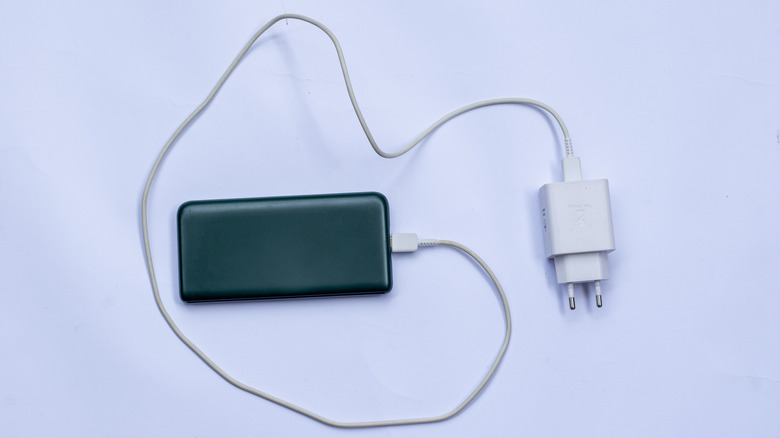
Some other features to keep an eye out for are the input charging speed, compliance with TSA's battery restrictions for carry-ons, and support for pass-through charging. Input charging speed is what determines how fast the power bank itself will charge when you connect it to a wall adapter. Faster input charging speed is helpful in situations when you don't have much time to juice up the power bank before you head out.
Although Anker's current power bank lineup doesn't include any power banks that exceed TSA's battery restrictions, it's something to remember in case the company launches a bigger model in the future or you're thinking of getting a small portable power station as part of Anker's Solix brand, such as the Anker Solix C200 DC. TSA only allows up to 100Wh capacity power banks on flights, and that too only in your carry-on luggage. One well-rated high-capacity Anker power bank that meets TSA restrictions and is suitable for topping up multiple devices simultaneously, including laptops, is the Prime Power Bank 26K.
Another nifty feature to look for in an Anker power bank is pass-through charging. It allows you to charge your devices while juicing up the power bank itself. This can be helpful when you either only have a single wall outlet or a single power brick but want to top up both the power bank and your device.