

5 Android Phones More Powerful Than The iPhone 17e

We may receive a commission on purchases made from links.
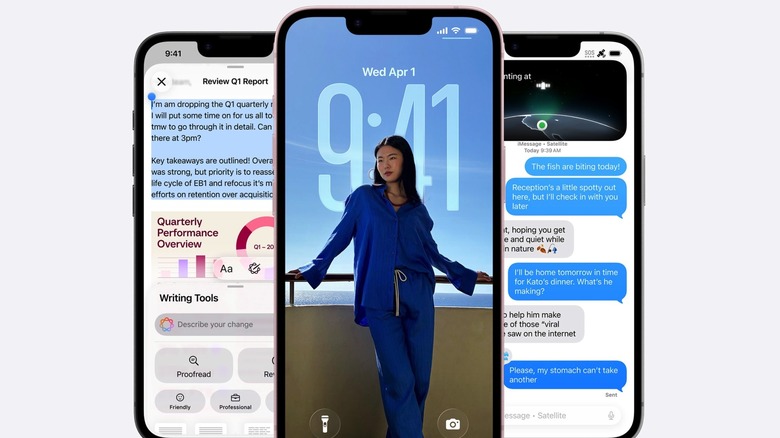
There's no question the new budget-friendly iPhone 17e that Apple introduced in March 2026 offers tremendous value for buyers. The handset may recycle the iPhone 16e's design, but it features almost the same chip as the $799 iPhone 17, a lower-binned version of the A19 that has one fewer graphics core. The iPhone 17e comes with double the storage (256 GB instead of 128 GB), matching the rest of the iPhone 17 series. The budget handset also corrects one of the biggest issues with its predecessor, the absence of MagSafe support. The iPhone 17e has a magnetic ring on the back, which will enable full MagSafe wireless charging speeds. But the iPhone 17e also inherits the same 60 Hz display as its predecessor and still features a single-lens rear camera setup.
The real strength of the iPhone 17e is the A19 chip, which ensures the handset will offer a decent iOS experience for years to come. Even though it features a 4-core GPU compared to the 5-core GPU of the iPhone 17's A19 chip, the iPhone 17e's chip still scores highly in Geekbench 6 tests. The 3,654 (single-core) and 9,192 (multi-core) results are similar to the base iPhone 17 model. It's only the graphics score that suffers, with the iPhone 17e reaching about 31,000 points in Geekbench results compared to 37,000 for the $799 phone.
As compelling as the iPhone 17e might be despite the compromises, smartphone buyers who want a powerful new device and don't necessarily need an iPhone can purchase an Android handset that may offer an even more useful overall package. That's because the following devices address some of the weaknesses of the iPhone 17e while offering a high-end smartphone experience.
Xiaomi Poco F7
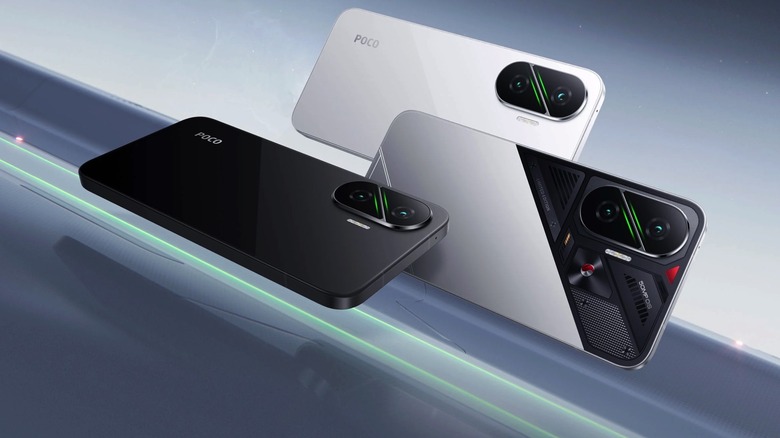
Announced in June 2025, Xiaomi's Poco F7 is an affordable mid-range Android phone that retails for $499.99 on Amazon, $100 cheaper than the iPhone 17e for the 12 GB / 256 GB variant. That gives the Poco F7 its first advantage over Apple's budget handset: It has 50% more memory than the iPhone 17e's 8 GB of RAM. The Poco F7 also features a larger 6.83-inch 120 Hz AMOLED hole-punch display with 3,200 nits peak brightness compared to the 6.1-inch 60 Hz OLED notched screen of the iPhone and its 1,200-nit peak brightness. The Xiaomi handset offers a larger battery (6,500 mAh vs. 4,005 mAh for the iPhone 17e), which supports 90 W charging speeds. The iPhone 17e supports 20 W wired and 15 W MagSafe charging speeds. Finally, the Poco phone has two rear cameras, including a 50-megapixel wide sensor and an 8-megapixel ultra-wide camera.
The one hardware detail that doesn't work in the Poco F7's favor is the chip. The handset runs on the Snapdragon 8S Gen 4 SoC, which isn't Qualcomm's 2025 flagship. It's still a 4 nm chip that clocks at 3.21 GHz and should offer great performance. But it can't beat the iPhone 17e in Geekbench 6 tests: 1,974 (single-core) and 6,212 (multi-core). The Poco F7 does feature a component that will help with performance, a cooling system that isn't available on the budget iPhone.
Still, the Poco F7 is a relatively new Android handset that offers broadly better specs at a lower price. These include a few key "fixes" the iPhone 17e needs, like a high-refresh display and a dual-lens camera setup.
RedMagic 11 Pro

The RedMagic 11 Pro is another Chinese smartphone that is a strong alternative to the iPhone 17e. Released in November 2025, the handset is a gaming-focused phone that packs high-end specs. The RedMagic 11 Pro features a Snapdragon 8 Elite Gen 5 chip that outscores the iPhone 17e in multi-core Geekbench 6 tests, hitting 11,122 points. The single-core result is 3,619, on par with the iPhone 17e's A19 chip. The handset also features an extra RedMagic RedCore R4 chip and a "flowing liquid-cooling" system that RedMagic advertises as the world's first. In addition, the handset has a built-in fan for cooling.
The RedMagic 11 Pro offers several memory options, including 12 GB, 16 GB, and 24 GB configurations. Storage tiers include 256 GB, 512 GB, and 1 TB. The cheapest model (12 GB / 256 GB) is more expensive than the iPhone 17e, priced at $749 before any discounts. The 7,500 mAh battery is also a highlight, supporting 80 W wired and wireless charging. The 6.85-inch display offers an even higher refresh rate than the Poco F7 at 144 Hz, supporting a 2,688 by 1,216 resolution and an 1,800-nit peak brightness. The rear camera module features three sensors, a 50-megapixel main camera, a 50-megapixel ultra-wide, and a third 2-megapixel sensor, though camera performance isn't a highlight for the RedMagic 11 Pro, according to TechRadar's review.
The iPhone 17e may feature an Action button, but the RedMagic 11 Pro has shoulder buttons, which can be used for gaming in portrait mode. Unlike all iPhones and most Android devices, the RedMagic 11 Pro also has a 3.5 mm headphone jack. The gaming phone even has room inside for two physical SIM cards, while the U.S. version of the iPhone 17e only works with eSIMs, the digital SIM cards.
OnePlus 15

Like the RedMagic 11 Pro, the OnePlus 15 Android flagship came out in November 2025, featuring the same Snapdragon 8 Elite Gen 5 flagship processor from Qualcomm. This means the Geekbench 6 scores are in line with the RedMagic 11 Pro: 3,461 (single-core) and 10,252 (multi-core), which makes this Chinese Android handset another good alternative to the iPhone 17e. The OnePlus 15 doesn't target gamers, but its high-end specs should ensure smooth gaming experiences. The phone features a 6.78-inch OLED display that supports a 165 Hz refresh rate, peak brightness of 1,800 nits, and a resolution of 2,772 by 1,272. The cheapest OnePlus 15 costs $899, offering 12 GB of RAM and 256 GB of storage, but buyers can choose more expensive models with 16 GB of memory and up to 1 TB of storage.
Our OnePlus 15 review highlighted the handset's battery life but found the triple 50-megapixel rear camera system to be lacking. On the battery side, the OnePlus 15 features a 7,300 mAh silicon-carbon battery that supports 80 W wired charging and 50 W wireless charging in the U.S. and Canada. As for the triple-lens camera system, the OnePlus 15 offers two cameras the iPhone 17e lacks, a periscope zoom lens and an ultra-wide sensor.
Unlike the next Android flagships on this list, which offer seven years of updates for both major Android releases and security updates, the OnePlus 15 may only offer four years of Android updates and six years of security updates. The iPhone 17e should see at least six years of iOS releases, considering Apple's history. For example, the 2019 iPhone 11 is the oldest iPhone that can run iOS 26, an operating system that was launched in 2025.
Google Pixel 10 Pro XL
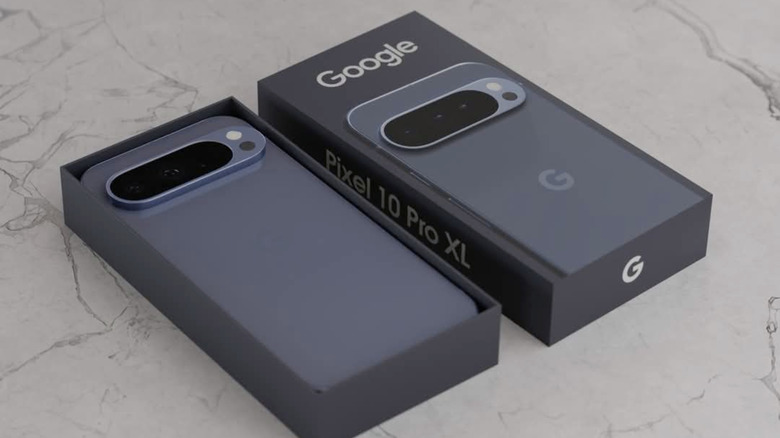
Of the Android flagships on this list, Google's Pixel 10 Pro XL offers the worst Geekbench 6 scores (2,287 single-core and 6,136 multi-core), which are slightly better than the mid-range Poco F7's results. That's because Google's 3 nm Tensor G5 chip is hardly on par with the A19 chips or Qualcomm's Snapdragon 8 Elite Gen 5 for raw performance. However, the Pixel 10 Pro XL is one of the best iPhone 17e contenders money can buy, given that Pixels can be considered the Android phones most comparable to iPhones. Google's flagships are the first to receive the latest Android updates, they routinely offer exclusive features including unique camera capabilities, and they're guaranteed seven years of OS and security updates.
The cheapest Pixel 10 Pro XL ($1,199 before any discounts) features 16 GB of RAM paired with 256 GB of storage, though buyers can also choose 512 GB and 1 TB storage options. The phone has a 6.8-inch OLED screen that supports a 120 Hz refresh rate and 3,300 nits of peak brightness. The Pixel 10 Pro XL offers a high-end camera experience that should exceed the iPhone 17e's capabilities thanks to several features built into the Pixel camera, including Gemini-enhanced capabilities like Camera Coach and support for editing photos via natural-language commands. The rear camera hardware includes a 50-megapixel main camera, a 48-megapixel ultra-wide camera, and a 48-megapixel periscope (zoom) lens.
Finally, Google's flagship handset may offer a better battery experience than the iPhone 17e. The phone features a larger 5,200 mAh battery that supports 45 W (wired) and 25 W (wireless) charging speeds, including magnetic charging via Google's Pixelsnap feature, similar to and compatible with many MagSafe accessories.
Galaxy S26 Ultra
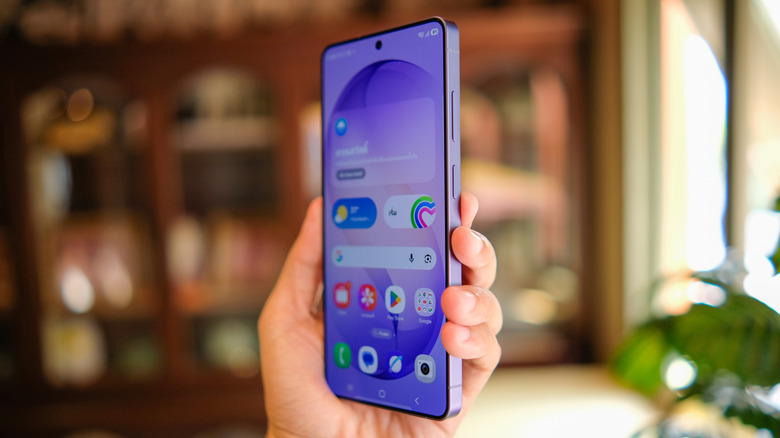
Samsung's latest flagship Android phone, the Galaxy S26 Ultra, was unveiled in February 2026. Starting at $1,299.99, the Galaxy S26 Ultra is the most expensive iPhone 17e alternative on this list. The phone features an exclusive version of the Snapdragon 8 Elite Gen 5 chip made for Galaxy devices, but Geekbench 6 scores are in line with other Android flagships on this list: 3,633 (single-core) and 11,098 (multi-core). This means the handset matches the iPhone 17e in single-core performance and exceeds it in multi-core tests. The Snapdragon chip is paired with 12 GB or 16 GB of RAM and 256 GB, 512 GB, or 1 TB of storage.
The Galaxy S26 Ultra's camera is a big advantage over the iPhone 17e. The Samsung phone features a 200-megapixel wide lens, 50-megapixel ultra-wide lens, and two zoom cameras (50-megapixel periscope and 10-megapixel telephoto). Samsung used AI to enhance the Galaxy S26 Ultra's camera capabilities. The phone offers an AI image signal processor for selfies, 100x AI-powered zoom, and support for editing photos via voice (natural language). The Galaxy S26 Ultra also promises to shoot better photos and videos at night than its predecessors.
The Galaxy S26 Ultra features a smaller battery than the other Android phones on this list, at 5,000 mAh, and slower charging speeds than Chinese rivals. But the handset supports 60 W wired charging and 25 W wireless charging, which is faster overall than the iPhone 17e. Other highlights include a built-in S Pen stylus and support for Samsung's DeX platform that allows users to turn the Android phone into a desktop computer by connecting to a display and peripherals. The Galaxy S26 Ultra will also get seven years of Android and security updates.
How we chose the iPhone 17e's Android alternatives
To compile this list, we looked at some of the most recent Android phone releases across different price points that can offer a good alternative to the budget-friendly iPhone 17e. We prioritized phones that are easy to purchase in the U.S. as of this writing, but included handsets that might be harder to find when the price-to-performance ratio was too similar to the iPhone 17e to exclude them.
While not all five phones in the list will beat Apple's cheapest iPhone in benchmarks, most users should not experience speed issues. For example, the iPhone 14 (2022) offers similar Geekbench 6 scores to the Poco F7, while the iPhone 13 Pro Max (2021) has similar Geekbench 6 scores to the Pixel 10 Pro XL. These iPhone models support iOS 26 and can still offer a good experience years after their releases.
Instead of theoretical performance alone, the comparisons above are meant to highlight the complete smartphone package, and how these Android devices may offer users better experiences than the iPhone 17e, depending on their priorities. The Galaxy S26 Ultra and Pixel 10 Pro XL offer high-end cameras, AI features, and extended software support. Phones like the OnePlus 15, Poco F7, and RedMagic 11 Pro feature massive batteries and strong overall specs, including a focus on gaming for the latter.