

12 Of The Weirdest Gadgets Sony Has Ever Made
We may receive a commission on purchases made from links.
It's hard to believe that a rice cooker company with no foothold in the tech industry back when it was founded has grown to become one of the biggest players in the realm of consumer electronics. From the PlayStation 5 and the things you never knew it could do, to its amazing lineup of consoles, to the numerous TVs, speakers, and phones released by this company, Sony has made an indelible mark on the industry that becomes more pronounced with each new product it releases. Seriously, you have no idea just how many major brands and apps are owned by Sony.
For the most part, the products released by this company are practical and go on to receive rave reviews and massive sales across the board. However, this isn't an absolute truth — there are moments when Sony has greenlit the development of release and gadgets that comfortably fall into the weird category. A lack of practical use, over-the-top designs, and an overt reliance on gimmicks meant these products became some of Sony's oddest consumer tech ever made.
Sony Rolly
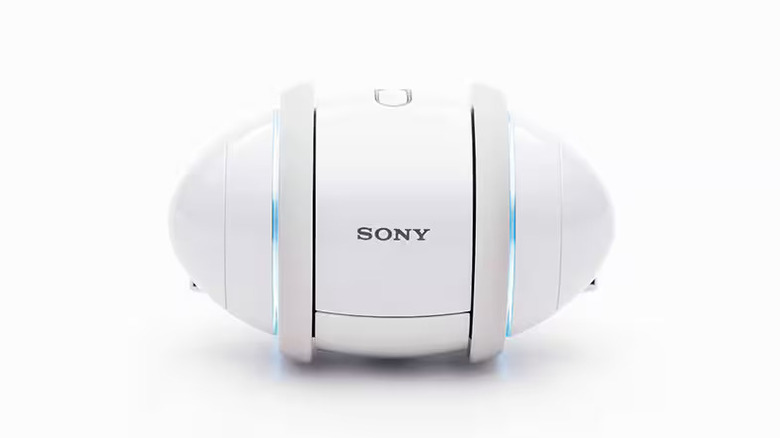
There's no shortage of odd speakers in the market, and Sony didn't stop itself from throwing its hat in this ring, either. In 2008, it released the Sony Rolly — a cute, robotic speaker that could move around, light up, and even dance to the tune of your favorite music. It was a quirky offering that added some personality to your music-listening sessions.
Since streaming services were far from the norm at that time, the Sony Rolly was marketed as an MP3 player with 2GB of internal memory. The five-hour battery life wasn't anything to write home about, and the lack of a headphone jack could also be an annoyance for some. It was clear that Sony was going all in on the gimmick here, with motion sensors letting you switch between tracks or control the volume by moving the speaker itself.
You could also configure the device's movement by tweaking one of three motion function settings to make the two arms, shoulders, and wheels move exactly how you wanted. With the Self Motion Function, the Rolly analyzed the music in its internal memory and automatically decided the best motion to accompany these tunes. Auto Motion Function used the Motion Editor application on your PC to create better, more sophisticated motion controls to go with your favorite tunes. Finally, the Custom Motion Function lets you use the Motion Editor to manually govern the movement of this quirky speaker for every song in its storage.
Sony eMarker
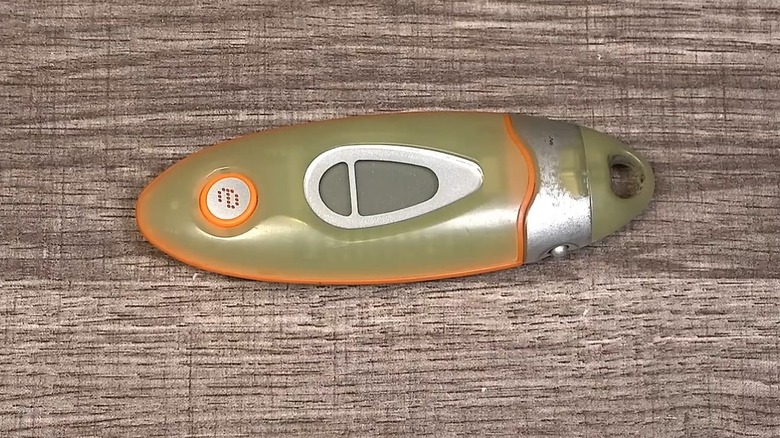
With apps like Shazam – a major brand that is actually owned by Apple — and Pixel's in-built Now Playing feature that makes it easier than ever to figure out what song is playing in your favorite club or cafe, it's hard to imagine a time when an external device was required to enjoy the same convenience. However, what made the Sony eMarker such a fascinatingly weird piece of tech was the way it let users identify songs that played on their favorite radio stations. It was a $20 USB keychain attachment with a button you could press when you heard a catchy song on the radio, letting you store up to 10 eMarks — basically, bookmarks that saved the time and date. This was conveyed by the small LCD panel on this device.
Once you'd made all the eMarks you need, it was time for Sony's amazing partnership with Broadcast Data Systems (BDS) to work its magic. This organization could track the music of over 1,000 stations all over the United States, with the timestamp on the eMarker being used as a reference point to bring up a list of all songs playing on these radio stations. This was achieved courtesy of a nifty Flash app, which also generated a link to let you purchase a CD of a song you'd triangulated. It was most definitely a time-consuming process — this app took anywhere from just 10 minutes to an entire day to generate these results. However, given the tech limitations of the time, the eMarker was far ahead of its time.
Aibo

Given that commercial robots still seem a long way off from becoming commonplace in the market, it's amazing to see that Sony has been developing a robot dog for commercial use since 1999! They produced 5,000 of these robots — called Aibo — which were priced at around $3,000. Despite selling only 2,000 of these units in the United States, Sony kept the product alive until 2006, ultimately selling 150,000 Aibos during that period. After a lengthy hiatus, this robot pooch was brought back in 2018 and hasn't stopped since.
The current iteration of Aibo is the most advanced version by quite some margin. The Aibo v8.00 software update added different noises that this robot will generate based on the toy it's playing with. The My Aibo app that comes with this robot dog has, among other things, a better UI than before, along with "Aibo Memories," which can use generative AI to create content based on the audio recordings of any play sessions you've enjoyed with the robot. There's even a special Party mode on the app that lets you show off the aibo and its various tricks in a social setting!
Given how advanced the Aibo has become since its early interaction, it's a shame that another Sony robot didn't receive the same care. The QRIO looked promising in Sony's presentations, with this two-foot bipedal robot being able to recreate several popular dances, recognize faces, grab objects, and stand up if it lost its footing. The project started out as SDR in 2000, unveiled the SDR-3X in 2001, and revealed the SDR-4X in 2003. While 2006 should've seen the commercial release of its fifth-generation model, the product was discontinued before a fully fleshed-out launch could take place.
Sony eVilla
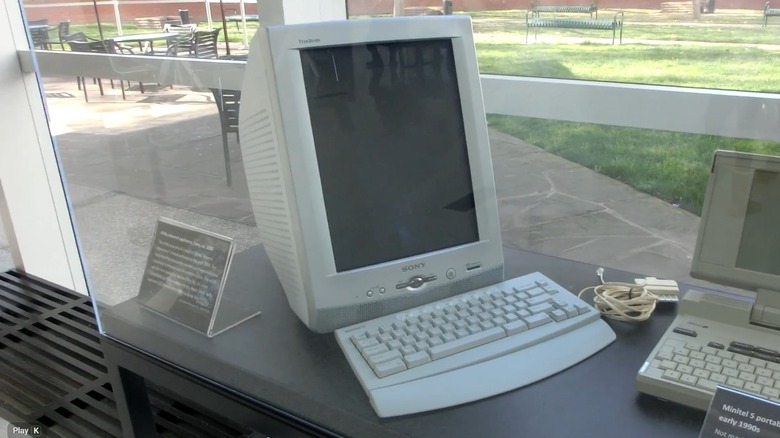
With the slow yet steady rise of the World Wide Web at the turn of the millennium, many companies were scrambling to create reliable devices that could connect to the internet quickly. Sony didn't want to be late to the party and teamed up with Be Inc. to release the eVilla Network Entertainment Center. It was essentially a computer — even though Sony marketed it as an Internet Appliance Platform — running on the BeIA OS, which could connect to the internet and required a memory stick to download and store files.
However, despite being a decent device, some issues held the eVilla back from living up to its potential. The portrait screen was a novel idea and let users stack multiple programs, but modern computers have made it clear that a landscape orientation is the way to go. However, what ultimately served as the nail in this device's coffin was the $22 monthly fee to use the internet, which was already a huge ask on top of the product's $499 asking price. As a result, this device flopped and was discontinued just two months after launch, despite receiving a nomination in the best-of-show category at CES 2001!
LSPX-S2
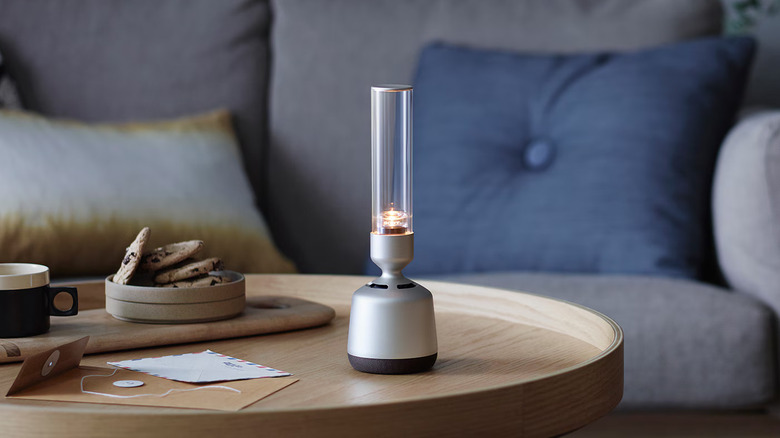
The LSPX-S2 is a gorgeous speaker that can easily double as a unique piece of home decor. The organic glass cylinder tweeter vibrates when playing music, with its 360-degree design ensuring that it provides room-filling, high-resolution audio. Sony referred to the tech as Advanced Vertical Drive, and users can choose from three audio modes to enjoy detailed sound.
Along with this, the LSPX-S2 has enough perks to make it a wireless speaker worth $450. A power output of 11 watts, support for Wi-Fi, NFC, Spotify Connect, a frequency range of 20Hz to 20,000Hz, and a decent battery life of eight hours make this a competent wireless speaker in every way. Also, true to its looks, you can even enable a candlelight mode to make this device look aesthetic at night.
This isn't the only time Sony has developed a speaker that resembles a light source. The LSPX-100E26J is a smart bulb that can be connected just like a normal light fixture, but it also doubles as a wireless speaker! The sound quality is serviceable, and the physical remote that comes with it is a nice touch, but the expensive price tag of $239.99, a light that is nowhere near as bright as you would see from a regular bulb, and distorted sound at higher volumes make it far less appealing than the LSPX-S2.
Sony Aromastic Mobile Scent Dispenser
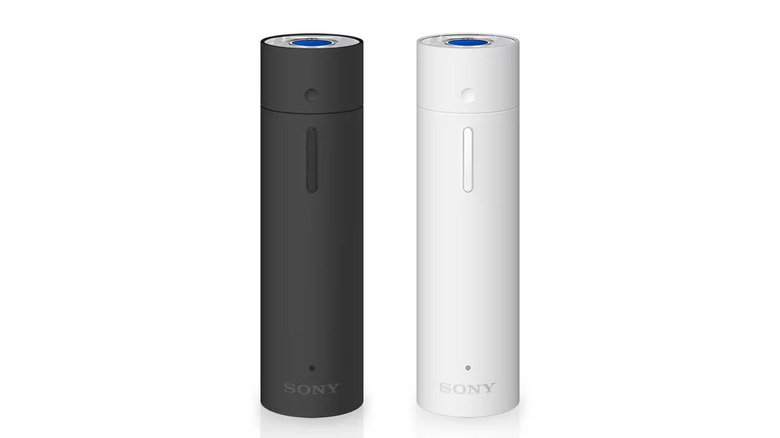
Ever wanted to carry a private, portable scent diffuser that can fit easily in your bag? No? Well, Sony released such a product anyway, making it one of the weirdest battery-powered gadgets they've made available to the general public. It's a part of Sony's crowdfunded First Flight project that promotes unique designs, although one has to wonder just how useful this portable scent diffuser is when it's far easier for people to carry deodorants or perfumes to combat the problem of bad smells instead.
For what it's worth, the Aromastic is easy to use and designed to be as practical as it possibly can be. It comes in white or black, lasts for a month on a full charge after two hours of charging, and uses scent cartridges from Neal's Yard Remedies — one of which comes bundled with your purchase. The cartridges come under the Basic, Business, or Beauty categories, making it clear exactly when and where they should be used. Still, it's a very weird product and not one that most people will be seeking out.
Reon Pocket Pro Plus
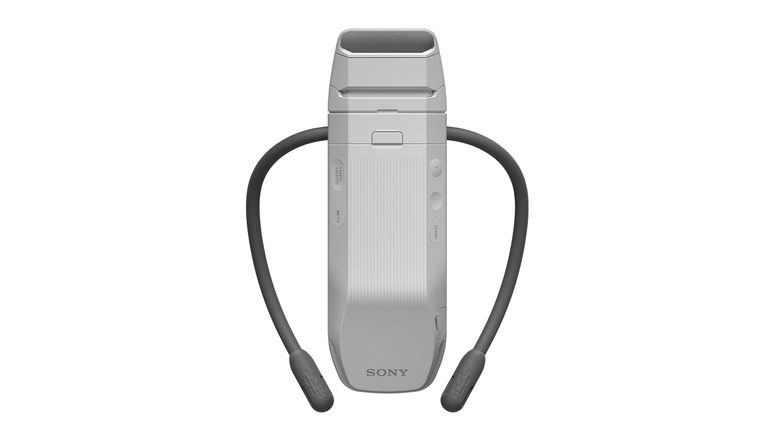
A hilarious, out-of-pocket device — and no, that pun isn't intentional — that is easily one of Sony's oddest product offerings, the Reon Pocket Pro Plus is a portable, wearable air conditioner that costs around $270 and can be placed on the base of your neck to help you remain cool at all times. It might seem practical for people living in hot climates, but most people will find it hard to push themselves to get such an experimental piece of tech.
Despite being marketed as a cooling device, it has both cool and warm modes for varying temperatures. The former relies on two alternating thermo modules for effective cooling, while the latter has four adjustable modes based on the level of warmth you desire. If you don't want to pull out this device from behind your neck all the time when you need to turn it off or change modes, the Reon Pocket app will take care of this issue for you. Sony confidently states that this device runs very quietly, has a stealth-focused design to prevent it from standing out, and runs for up to 15 hours when fully charged. While this device aims to mitigate sweating in hot temperatures, it has a water-resistant design to prevent errant sweat drops or rain splashes from damaging the device.
SRS-LSR100
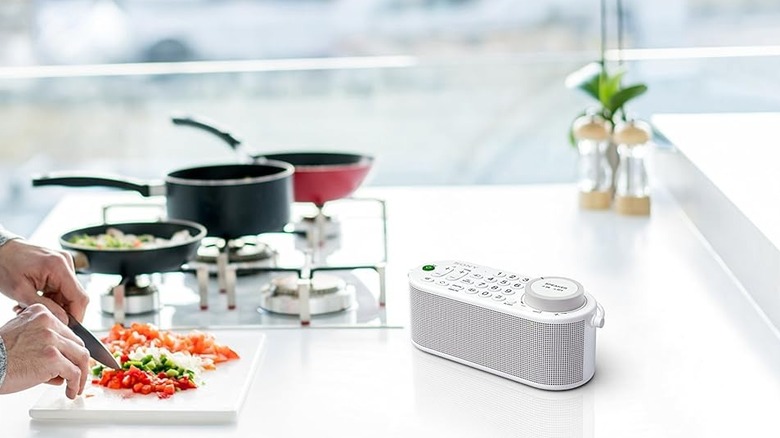
If anyone owns a television with poor sound, the most obvious solution they'll settle on is a separate soundbar or speakers to improve their TV's audio. While Sony definitely provides for this in spades, it also developed one of their weirdest products, which doubles as both a TV remote and a wireless speaker. What is the use case for this 2-in-1 device, you may ask? Well, if you have to do something in a different room but don't want to turn off the TV, then you can carry this remote around with you to hear the audio clearly, at the very least.
Yes, we know this is a very specific scenario and makes the SRS-LSR100 seem like a gimmick, but people may still want this product if their TV remote and audio system are both on the fritz. It costs somewhere around $167 and comes bundled with a charging cradle, AC adapter, and three cables — an audio cable, a micro USB, and an optical cable. As these components would suggest, the SRS-LSR100 has both a 3.5mm and an optical jack, with the former being pretty useful if you want to plug in your old wired headphones and listen to your TV's audio. Battery life is also nothing to scoff at, with Sony stating that this device can run for 16 hours on a full charge, which typically takes around three hours.
Sony Wena Wrist Pro

As enticing as a smartwatch may be, people who've saved up to buy their precious Seiko, TAG Heuer, or Rolex watches may not be into the idea of making their traditional watch obsolete with a smartwatch. As a roundabout solution to this, Sony decided to develop and launch a smart wristband that could replace the strap of a regular watch and smarten it up. It's beautifully designed and will look like a natural addition to your premium watch, boasting an OLED display on the underside that lets you peruse all the data it collects. It takes 90 minutes to charge to full and can last for an entire week, according to Sony's claims, which is pretty impressive. It also has water resistance of up to 5 bars, meaning that you don't have to worry about dunking this smart wrist strap in water as long as the depth doesn't exceed 50 meters.
It comes in stainless steel or pure black, with 18, 20, and 22-millimeter lug attachments to help it slot in naturally with pretty much any watch you can get your hands on. As one would expect, this smart wrist strap tracks your steps and lets you view your notifications, which is the norm across most smartwatches. The Wena Wrist Pro also lets you carry out contactless payments ... but there's a catch. At launch, this product only supported Boon for NFC payments. This company closed its doors in 2020, just a year after the Wena Wrist Pro's launch. So, it's entirely possible that this product has dropped contactless payments altogether.
Sony Vaio Mouse Talk
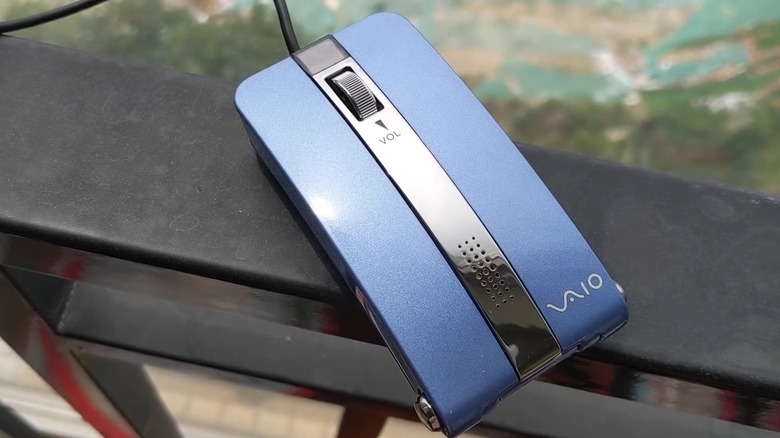
Regardless of whether Sony's experimental products ended up failing or not, props should be given to the company for even bothering to try. The Sony Vaio Mouse Talk is one such example of an interesting piece of tech that could've been a unique two-in-one solution for working professionals, but providing the solution to a problem that didn't exist and being subpar in its approach led to the VAIO Mouse Talk failing less than a year after its launch.
At a glance, this $79.99 mouse is competently made and looks pretty useful. When folded, it took on the role of an optical mouse. However, if a call came through, then you could turn it into a flip phone that was pretty decent at taking Skype calls. However, people soon realized that it was inconvenient to lose mouse functionality whenever they got a call, which was easily the product's biggest flaw and made it undesirable in no time.
Magic Link
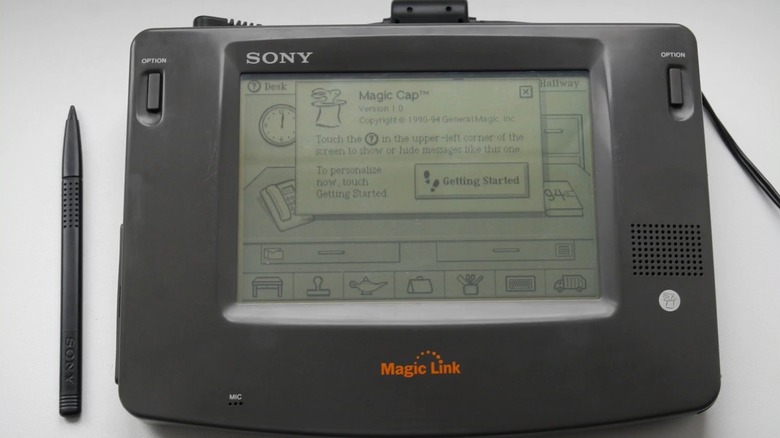
Back in the day, when Sony predicted that Personal Digital Assistants would become all the rage, they decided to collaborate with General Magic to release a PDA that used the Magic Cap OS. Fittingly named the Magic Link, this device had a rubber coating and let users interact with its 480x320 reflective LCD touchscreen via a stylus. It also had a ton of useful applications, including, but not limited to, apps that let you check the clock, create spreadsheets, check your emails, open a virtual notebook, manage a calendar, use a calculator, use the telephone, and even send a fax!
Clearly, this product was ahead of its time, and the hardware couldn't do justice to the Magic Link's software offering. A 16MHz Motorola Dragon 68349 CPU, 4MB ROM, and 1MB RAM made for a woefully underpowered device that lagged all the time. The internet connection was also pretty slow, and the lack of a backlight meant that the LCD was hard to look at in the day. Andy Hertzfeld, the co-founder of General Magic, has gone on record to state that the Magic Link underperformed quite a bit. He expected sales of up to 100,000 units, but only a paltry 15,000 units were shipped by the time this product was discontinued.
Sony Ericsson Xperia Pureness
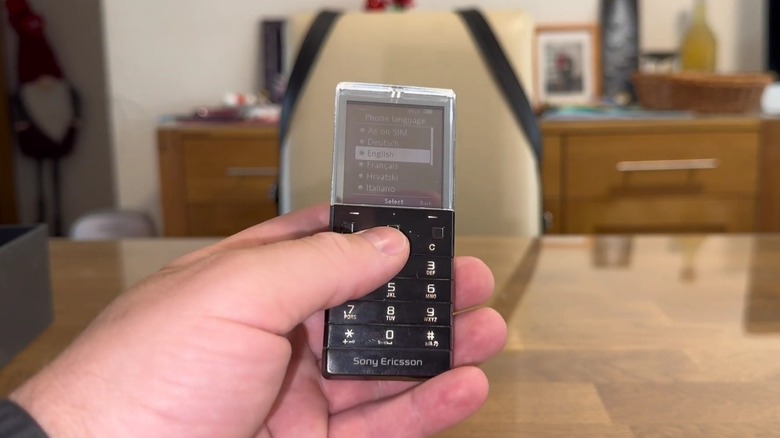
While the idea of using a transparent phone may be plucked straight out of a tech fan's wildest fantasies, the practicality of such a device is an entirely different conversation. It seems that nobody gave Sony this memo, which went all-out with this design concept and developed the Sony Ericsson Xperia Pureness. As cool as the device's see-through screen was, the problems that accompanied it were multifold and made it hard to justify a purchase. For starters, any screen that can be seen from the back flushes any semblance of privacy down the toilet. This translucency also made it very hard to look at the screen in bright environments, although Sony did include LEDs around the screen to make it easier to use at night.
The need for a translucent screen also led to this device lacking a camera. Sure, it's not like phones in 2009 had amazing cameras, but it was still the norm in most phones and sorely missed in the Xperia Pureness. The fact that this phone came with a 24-hour concierge service and cost a whopping $990 — in 2009, mind you — makes it clear that the Xperia Pureness was tapping into the luxury market. So, it's puzzling that the see-through screen is the only part of the device that looks premium, with the rest of the design being fairly unremarkable. The 1.8-inch screen with a 240x320 resolution was also sorely lacking, making this so-called premium phone undesirable in the eyes of many.