

13 Of The Most Beloved Retro Game Controllers Of All Time
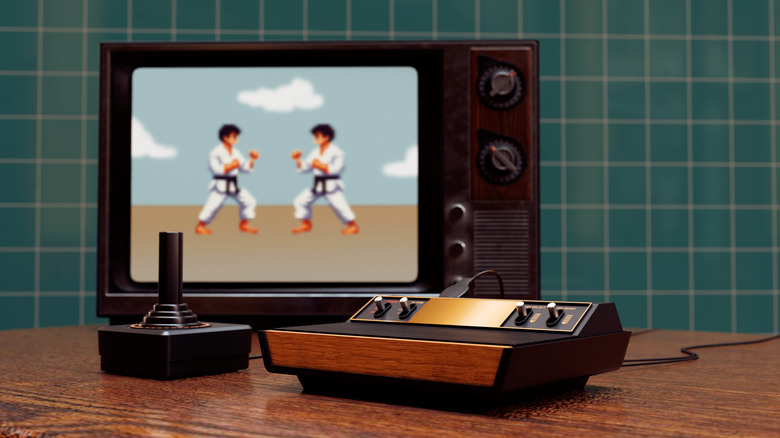
The golden age of gaming was beautiful to behold, with Nintendo bursting onto the scene and helping the industry bounce back after the disastrous video game crash of 1983. Sega soon joined the at-home gaming ranks and engaged in a console war for the ages with Nintendo, but couldn't quite topple the giant — Sega exited the console market in 2001. During this time, the Sony PlayStation also made its debut, marketing itself as a console made for mature gamers. No matter what kind of titles players enjoyed, though, everything was covered by these consoles and the slew of video games they offered.
Today, with gaming turning into one of the most valuable industries in the entertainment sector, most console manufacturers are largely risk-averse, even if Nintendo does show off its ingenuity on the hardware side of things from time to time. Thanks to that conservative approach, the design of a controller has turned into a universal template across manufacturers. That's why many long-time gamers can't help but remember the time when controllers used to be more experimental. Their unique control schemes and looks helped them stand out and become favorites in the eyes of ardent gamers who still love the nostalgic feel of these retro controllers.
Super Nintendo Entertainment System Controller
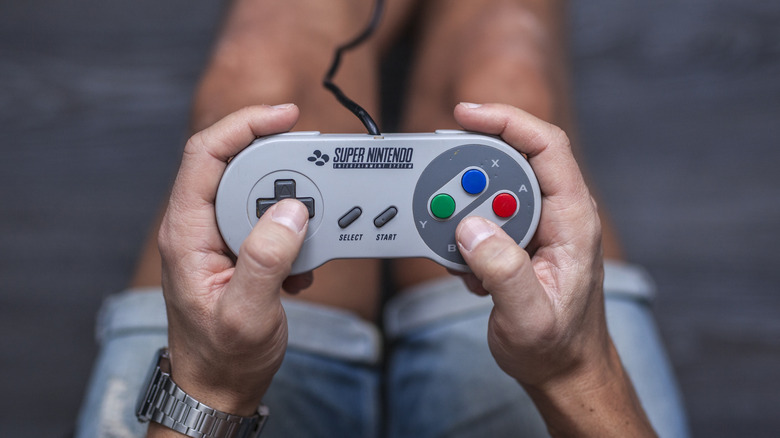
Nintendo got a lot of things right with the NES (Nintendo Entertainment System) controller. This simple device, boasting a directional pad (D-pad) and two face buttons, was more than competent enough at playing a vast array of imaginative games. With the SNES (Super Nintendo Entertainment System) ushering in the 16-bit era, Nintendo realized that games were going to look more impressive, and they needed to make advancements on the gameplay side of things too to match this visual leap. One very direct way to do this was to add more buttons to the SNES controller, which turned out to be a very smart idea.
The SNES controller boasts a slightly more rounded dog bone design as compared to its rectangular NES counterpart, making it more comfortable to hold. Aside from the D-pad and the two A and B face buttons, Nintendo also included two additional X and Y face buttons, along with the legendary L and R shoulder buttons that have become a gaming staple. Couple that with an iconic grey body and multicolored buttons, and this was a recipe for instant — and lasting — success. Playing iconic games like Super Mario World, The Legend of Zelda: A Link to the Past, Chrono Trigger, and Super Metroid felt amazing on this controller. If you want to enjoy the authentic experience, then you can buy a retro SNES console for less than $150 as long as you seek out a good deal.
DualShock
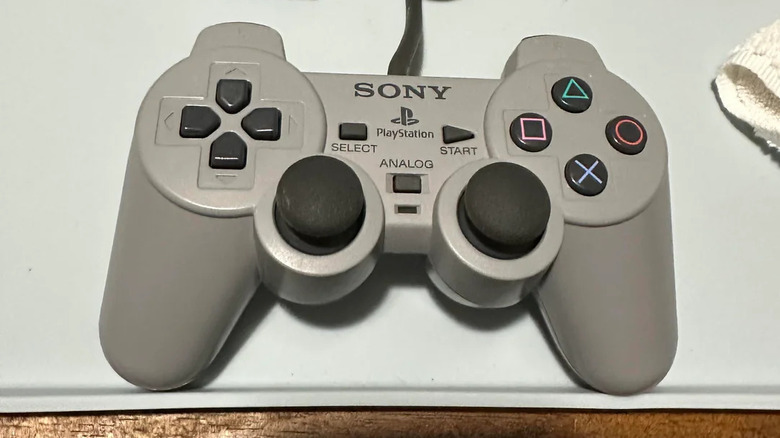
The history of how the DualShock came to be is a fascinating one, given how it's arguably the most impactful PlayStation controller made by Sony. After Sony set the stage ablaze with their affordable PlayStation in 1994, they got to work on a controller that would help players enjoy modern gaming experiences. Sure, the original PS controller was great, but it became clear later on that relying on a static D-pad wasn't the best way to enjoy 3D gaming, a technology that Sony was pushing on this console. Eventually, the Dual Analog controller arrived three years later, adding two joysticks to the controller and making it look like the modern devices we're familiar with.
However, Sony wasn't done yet. They took one additional step to enhance player immersion in the same year — 1997– by adding two rumble motors with varying vibration strengths to this controller. The overall design was slightly altered, with shorter grips and flat L2 and R2 buttons, and the DualShock came to be. This amazing controller replicated the vibration feedback of the Nintendo 64's Rumble Pak without relying on external attachments or batteries, setting the foundation that future Sony controllers would emulate with a few variations added to the mix.
Nintendo 64 Controller
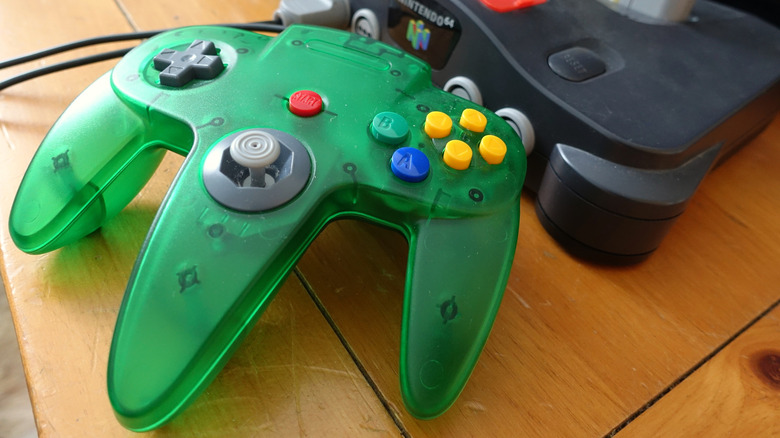
The Nintendo 64 (N64) controller is a history-making piece of technology, serving as the first gaming peripheral to include an analog stick and a trigger button on the back. These aren't the only milestones it achieved — the Rumble Pak that could be connected to this controller is also the first time that vibration feedback was added to an at-home video game controller, making this old-school gaming accessory essential for many. Clearly, the N64 controller was responsible for many of gaming's firsts, further hammering in the impact that Nintendo has had on the gaming industry's evolution.
This design wasn't the only way that the N64 controller changed how gaming worked. The console itself could support up to four connected controllers at once — another thing that Nintendo achieved for the first time in the video game industry — which is why GoldenEye 007 became such a legendary title. Players loved using this iconic, M-shaped three-pronged controller to try and mow down their friends, cursing anyone unsportsmanlike enough to get an unfair advantage by choosing Oddjob.
Sega Genesis Six Button Control Pad
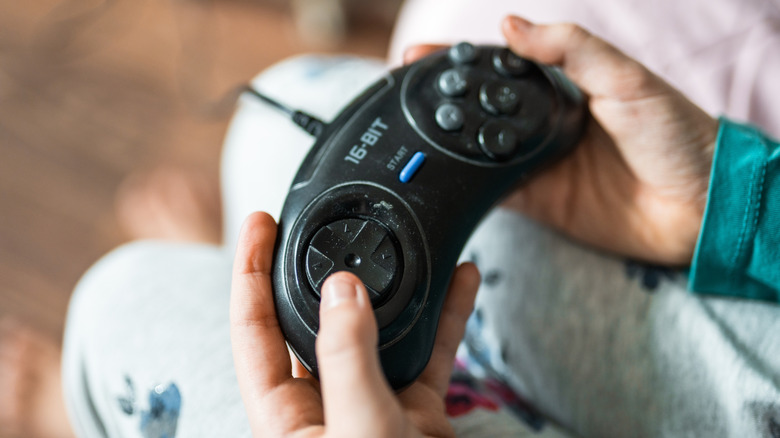
There's no denying that the Genesis/Mega Drive era was Sega at its very peak. An edgy marketing strategy and the success of games like the Sonic the Hedgehog titles, Streets of Rage 2, Comix Zone, and Phantasy Star IV: The End of the Millennium helped propel this console's sales to new heights. The appeal of the Genesis was further bolstered with the release of the iconic Six Button Control Pad that allowed games to offer up more complex control schemes.
This controller was predominantly designed to make fighting games more playable on Genesis, as evidenced by how it was released alongside Street Fighter II: Special Champion Edition. This title, coupled with other games in the genre, like Fatal Fury 2 and the Mortal Kombat series, felt a whole lot better with the six-button design of this updated controller. In case older Sega Genesis games were stubborn about sticking to the three-button control scheme, players could always press the Mode button to make the new model compatible with such titles.
Nintendo GameCube Controller
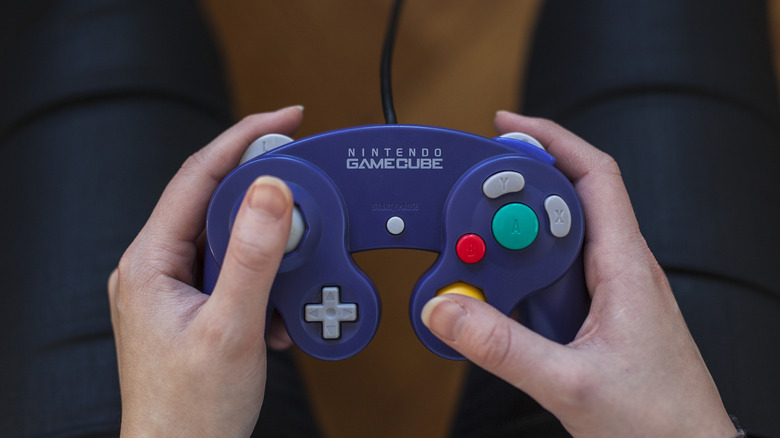
While the GameCube may not have reached the astronomical heights of the PS2, that should take nothing away from this home console. It had its fair share of amazing games — Eternal Darkness: Sanity's Requiem, Metroid Prime, and The Legend of Zelda: The Wind Waker come to mind — and the controller was a bright, quirky part of the console that felt great to use. Taking a page from the controllers Sony designed for the PS1, the analog sticks and button layout were altered accordingly to conform to the evolving universal control scheme, with the GameCube version using three shoulder buttons instead of four. It also integrated the vibration feedback from the N64's Rumble Pak into this controller.
Every version of the GameCube came with a controller that matched its color. If you still own one of these today, then you can use your GameCube controller on your PC with a bit of technical sorcery. Nintendo also released a version of the controller that could connect wirelessly to the console, named the Wavebird. While this was a slightly bulkier model, future console generations made full use of wireless controllers ... much to the chagrin of wired controller enthusiasts who would have to deal with latency and input lag as a result of this change.
Atari 2600 Joystick
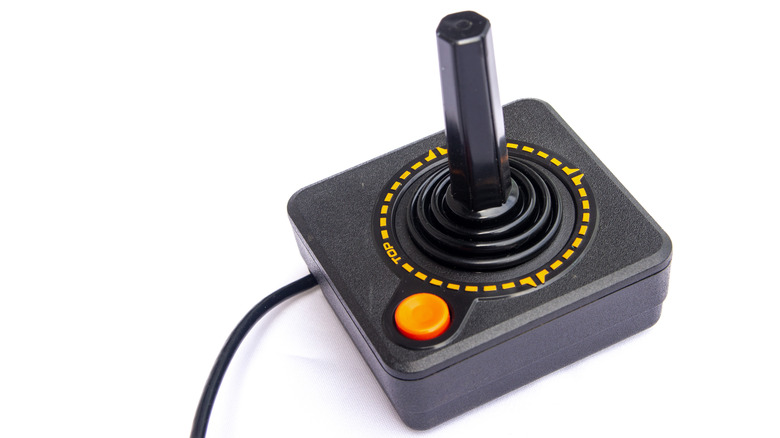
It's easy to say that Atari's presence in the industry was very damaging for gaming as a whole, but that would be doing a huge disservice to the impact they had on consoles. Sure, the '83 video game crash was disastrous, but Atari's efforts established that there was a market ripe for home consoles in the first place. In a way, Atari walked — and stumbled before falling flat on its face — so that Nintendo could run. The Atari 2600 is easily the company's most successful console by a country mile, with around 30 million units sold, and the controller that came with this device is just as iconic.
All it has is a joystick and a single button, which was more than enough to play most of the basic games that were released for this console. The best part about this controller is its widespread support for other systems at the time — aside from working on the Atari 7800, the Atari XE Game System, and their 8-bit computers in addition to the 2600, it could also connect to the Commodore VIC-20, Commodore 64, and the ColecoVision. A wireless variant of this controller was also released that was based on the design of the Cynex Game Mate 2 and used radio signals to transmit any input to the console. However, the high input lag and bulky design — made worse by a distracting antenna jutting out from the front — made it a pretty unappealing prospect despite the allure of gaming without wires.
NES Controller
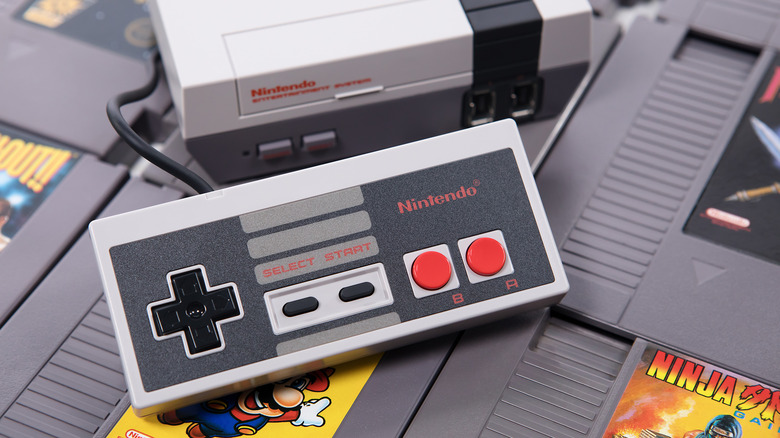
The Nintendo Entertainment System is one of the most important video game consoles of all time, in no small part because of how it rejuvenated the home console industry in the West after everyone had lost hope in it. Legendary titles like Super Mario Bros., The Legend of Zelda, and Mike Tyson's Punch-Out!! made a huge mark in the industry, with Nintendo's high-quality games making up for the problem of diluted, subpar cartridge experiences that marred Atari consoles. Of course, one of the biggest reasons why people were able to enjoy these consoles was because of a deftly designed controller that has become an iconic mainstay of retro gaming.
At a glance, this controller is very simple. The black, white, and gray palette of the body looks great, as do the two red A and B buttons that stand out. This layout, coupled with the two Start and Select buttons along with a D-pad, made for an easy-to-understand control scheme that helped a new audience get into the magic of video games and become totally absorbed by the titles Nintendo had to offer.
Guitar Hero SG Controller
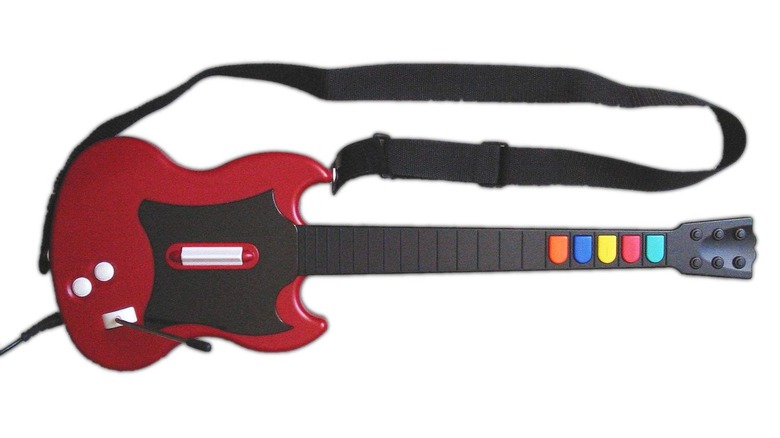
Gimmick controllers can be pretty hit-or-miss, but in the case of Guitar Hero, the accompanying guitar controllers were undoubtedly a major hit. Out of all these special controllers the franchise produced, the special SG Controller — modeled after the iconic design of the Gibson SG guitar — was the most well-known of the lot, packaged with copies of the first three Guitar Hero games released for the PS2. Depending on which copy you picked up, you could get a black Guitar Hero SG Controller that came with the first game, a red one that was bundled with Guitar Hero II, or a controller with either a white body or wooden finish with Guitar Hero III.
Sure, the controller's strum bar was noisier than future controllers, but people who were getting into Guitar Hero and weren't hardcore about owning every niche guitar controller under the sun found the SG Controller to be perfectly viable. The massive wave of popularity that Guitar Hero enjoyed during the sixth generation of gaming compelled Activision to release a slew of gimmick controllers, including guitars based on other models — such as the Gibson Explorer, Kramer Striker, Fender Stratocaster, Gibson Les Paul, and the Yamaha EZ-AG — along with drums and microphones, too!
Wii Remote (and the Nunchuck)
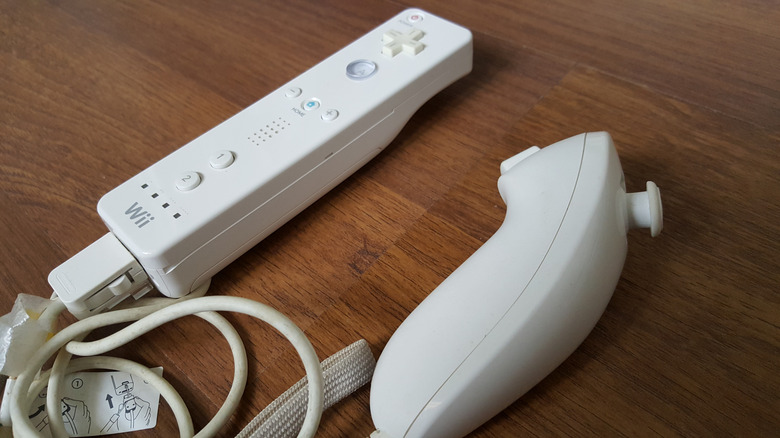
With the Wii, Nintendo's approach was clear — instead of trying to push the boundaries of graphical technology to new heights and cater to a hardcore market, they decided to capture an entirely different consumer segment. By crafting a console with a focus on motion controls and family-friendly games, they made this device appealing to casuals. Even the Wii Remote was designed to look like a regular TV remote — hence the name — with its motion-sensing capabilities being genuinely impressive at the time. All of this combined to help the Wii sell upwards of 100 million units and become one of the best-selling home consoles of all time.
The Wiimote's accurate motion sensing technology, powered by infrared sensors and accelerometers, worked in tandem with a separate sensor bar to register a user's motion. Wii Sports and Wii Sports Resort made the most of this tech, although other titles like WarioWare: Smooth Moves and the Red Steel games also did justice to the Wiimote's amazing motion sensors.
Still, playing regular games on a controller shaped like a remote was challenging at times. That's why the Nunchuk — a Nintendo Wii accessory owners loved — was also packaged with the console, attaching to the Wiimote to unlock a regular control scheme. With its analog stick and two trigger buttons, games like Super Mario Galaxy and its sequel, The Legend of Zelda: Twilight Princess, as well as Skyward Sword, Super Smash Bros. Brawl, and Xenoblade Chronicles could be enjoyed by people who didn't buy the Wii just to turn it into a party machine.
NES Zapper
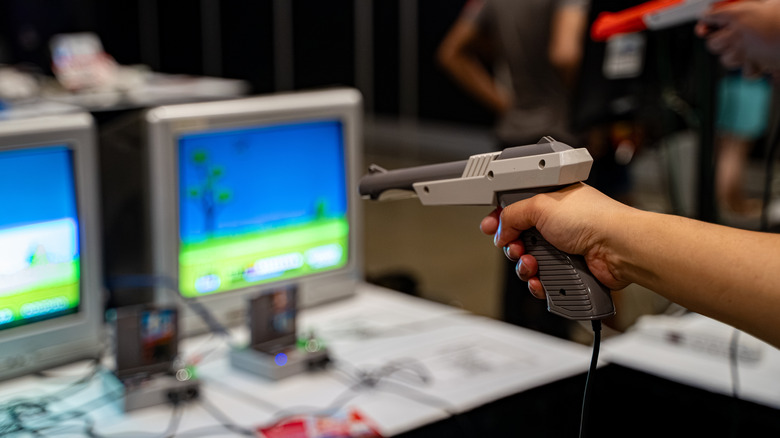
Even now, after all the years that have passed, some people still can't help but remember the infuriating memory of the dog from Duck Hunt laughing at them if they failed to hit their targets. This snickering hound has shot up the ranks to become one of the most hated video game characters of all time, and this wouldn't have been possible without Duck Hunt becoming one of the most popular NES games of all time. This game used a light gun accessory to make its gameplay more immersive, with the NES Zapper being one of the most beloved light guns for gamers who wanted to see just why people were going crazy over Duck Hunt.
The way this light gun works is pretty interesting. It uses a photodiode to sense light and gauge where the player is aiming with their Zapper on a CRT television. In the context of Duck Hunt, the screen turns to black whenever the Zapper is used, flashing a white square in the area where the duck or clay pigeon is hovering at the time you shoot. If the photodiode senses this white light, the target is hit. Otherwise, it counts as a miss. It's deceptively simple and turned the Zapper into one of the most beloved retro game peripherals of all time. Unfortunately, your retro light gun games won't work on LCDs — CRTs use electron beams to rapidly light up the screen, while the pixels on an LCD screen take a bit longer to form an image. Since any light gun requires frame-perfect input to work properly, an LCD pixel won't light up in time to work harmoniously with it.
DDR Dance Pad
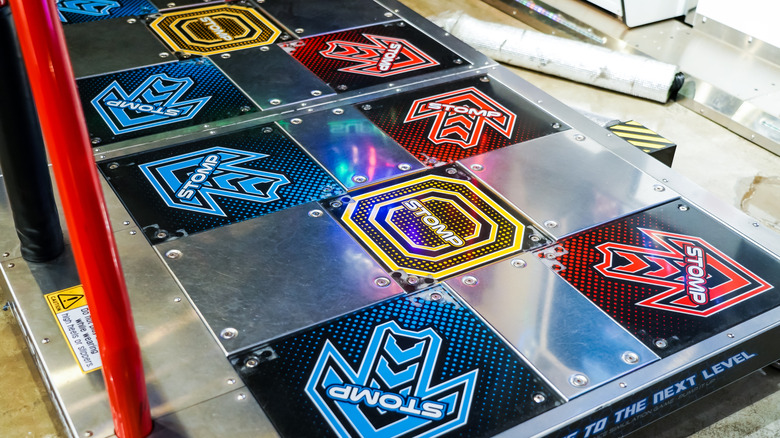
Dance Dance Revolution (DDR) is one of the most iconic gaming franchises of all time that is still dominating arcades to this day. While the popularity of DDR has waned significantly — being effectively replaced by Just Dance — there was a time when people loved using official DDR dance pads at home to dance along to their favorite games. Regardless of whether you picked up a copy of DDR for the PS1, PS2, or Dreamcast, the design was the same — four direction arrows, X and O buttons on the top-left and top-right of the dance pad, respectively, and the Select and Start buttons at the very top of the dance pad — or just Start on the Dreamcast version of the peripheral.
This official Stay Cool pad from Konami boasts an iconic design and is a beloved retro controller in the eyes of many DDR enthusiasts. While the motion-sensing dances of the Just Dance series are engaging in their own right, there's something magical about the feeling of landing perfect movements on a physical dance pad that people seek out to this day. If you manage to get your hands on a DDR Dance Pad or something similar, then you might want to try it out with games like StepMania to enjoy the old-school DDR magic.
Wii Balance Board
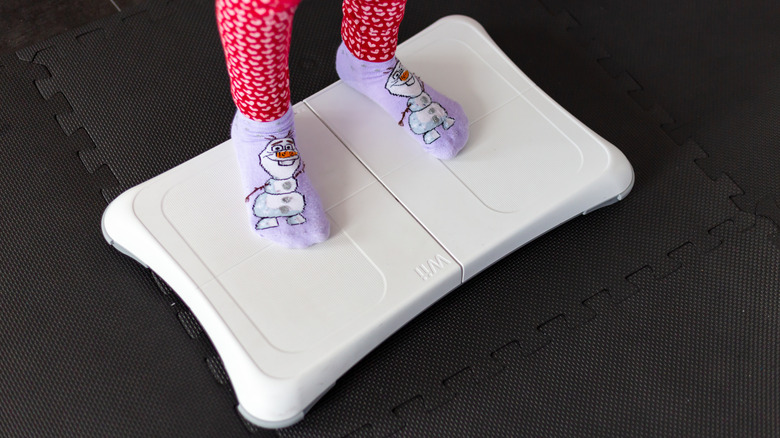
The Wii is home to some of the greatest video games ever made, so it's clear that Wii Fit did something right, given how it sold more than 20 million units and became the highest-selling physical fitness game of all time. Each copy of this game came with the Wii Balance Board, a peripheral that was downright necessary to exercise with this game. This pressure-sensitive pad registers a person's movement, gauging their poses to see if they were following instructions properly.
It's fascinating how this board came to be as a result of designer Shigeru Miyamoto taking inspiration from the weighing scale he used meticulously to gauge his fitness levels. In an attempt to gamify the act of getting in shape, he and his team cycled through several prototypes before landing on the final model of the Wii Balance Board. This peripheral was split into four quadrants, with each section using a separate load sensor to determine a player's center of gravity based on the amount of pressure they exert in each section. Oh, and in case you were wondering if this board worked accurately on carpet, Nintendo accounted for this with extra feet that could be attached to the Balance Board, letting you use it on rugs and carpeted surfaces.
The Duke Xbox Controller
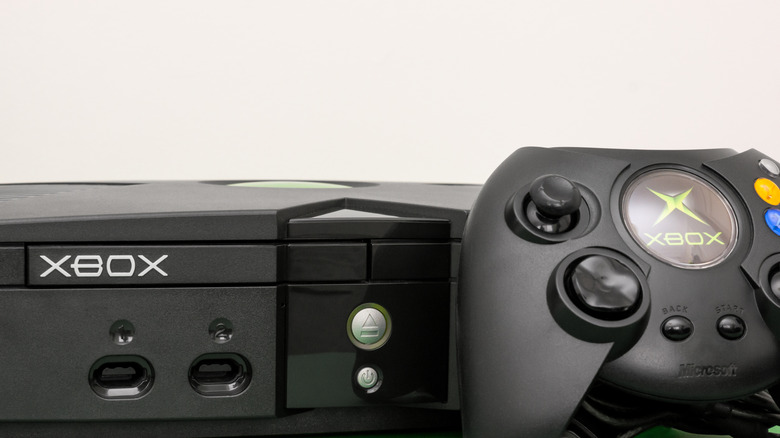
The release of the original Xbox required a controller that would do justice to Microsoft's attempts to enter the console market. The Dakota Pad was one of their controller prototypes, seen in the Xbox's 2001 launch trailer. However, the company further refined this design while maintaining its chunky architecture, leading to the release of maybe the largest video game controller of all time. Lead hardware designer Brett Schnepf named this controller after his son, Duke, and the moniker has stuck ever since.
Is the controller big and bulky? Yes, but people with big hands found it to be surprisingly comfortable. For Xbox fans, mowing down the Covenant in Halo: Combat Evolved with this massive controller just felt right. Modern Xbox controllers may conform to industry standards and take little risks — if any — but "The Duke" harkens back to a time when console manufacturers didn't shy away from injecting a bit of personality into their hardware.