

5 Reasons Why Retro Game Enthusiasts Love Old Controllers
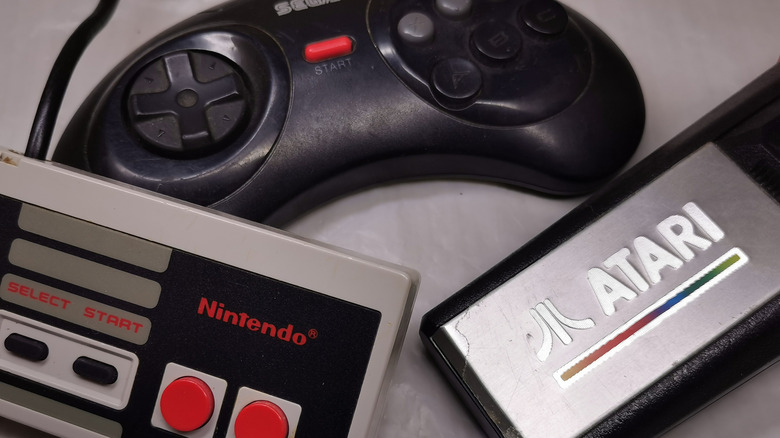
Modern gaming has seen so many advancements that AAA titles look more lifelike than ever. Controllers have taken on a universal format, with the DualSense, Xbox Wireless Controller, and Nintendo's Pro Controller all looking largely the same, barring the placement of the analog sticks and the letters or symbols used for the face, shoulder, and trigger buttons. The time when companies used to experiment with control schemes is long gone, which is a shame given how wacky some controllers have been through the history of gaming. From light gun accessories like the NES Zapper to funky gems like the N64's M-shaped controller, there's no shortage of quirky controllers from a bygone era when games used to be simple. Clearly, these controllers hold a special place in the hearts of players, given how companies like 8BitDo make several retro-themed PC gaming gadgets inspired by iconic consoles.
This nostalgia has also led to some mild controversy, with something as simple as a directional pad (D-pad) becoming a hotly debated topic in gaming, as many people find the older style of retro controllers to be far better than today's counterparts. With modern gaming largely relying on dual sticks for navigation and movement, the idea of playing titles on a retro controller with limited controls may seem archaic. However, regardless of whether players have proper consoles or are using apps to emulate retro games they missed out on back in the day, there's no denying that using a console-specific controller is a far more authentic way to enjoy these experiences for people who want to channel the wistfulness of retro gaming.
Rolling your thumbs and hitting diagonals is easier on older controllers
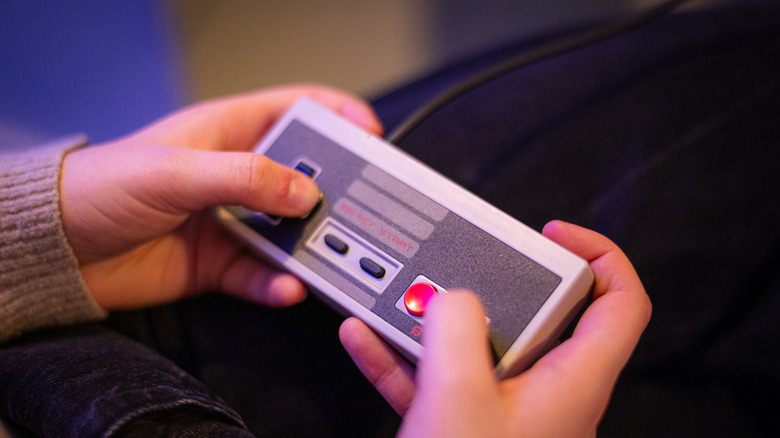
For many players, the D-pads of the modern era feel very stiff and less intuitive compared to retro controllers. This is to be expected — with movement shifting to the left analog stick, D-pads became less of a priority in controllers when it comes to movement. Most people now use these directional inputs as shortcuts to open the map, check in-game information, or quickly use items. However, if you want to play a retro game with a modern controller, then using the D-pad will feel downright clunky to move with, even if these titles were designed with this directional input in mind.
This is because older D-pads were flat and uniform, letting you roll your thumbs around the buttons without feeling any feedback that may cause your thumbs to ache. Sliding your thumb left and right was a great way to switch movement on the fly in fast-paced 2D games — very much required for tough titles like Contra and Shinobi — while the same finger movement made hitting diagonals far more consistent. Meanwhile, on modern controllers, you'll have to either lift your fingers to nail these combination inputs or endure the dull pain of having to make your thumb bump across the D-pad to slide and accomplish the same goal. The latter is simply not feasible for people who want to spend hours playing a retro game without feeling like they'll develop carpal tunnel syndrome.
Authenticity is king
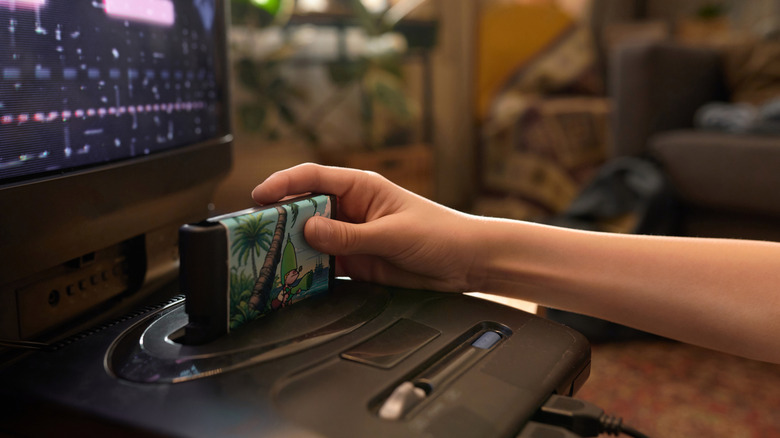
With 4K resolutions, high frame rates, and other nifty tech like HDR and ALLM making your gaming endeavors look and feel better than ever before, most people would assume that playing retro games on modern devices with modern hardware may actually be an upgrade. However, these older games were made keeping in mind the technology of the times, making sure that titles felt good to play on simpler controllers and looked better on CRTs with their scanlines. In a way, this authenticity is lost if you install an emulator on a modern system and play older titles with new controllers that are simply not optimized for this kind of play. That being said, there's nothing wrong with enjoying retro video games for cheap — everyone's mileage just varies in this department.
This is why so many retro game enthusiasts go the extra mile to make their nostalgic experiences feel as authentic as possible. Forget just getting their hands on some of the most beloved retro controllers of all time — these people go so far as to buy retro consoles and old-school CRTs to enjoy a pure experience unmarred by modern, ill-fitting tech. Getting an old controller is just the first step for these people, who are definitely trying to channel the feeling of being a kid as they boot up their console and sit very close to the TV while playing their favorite titles.
Some people are just way too used to older controllers
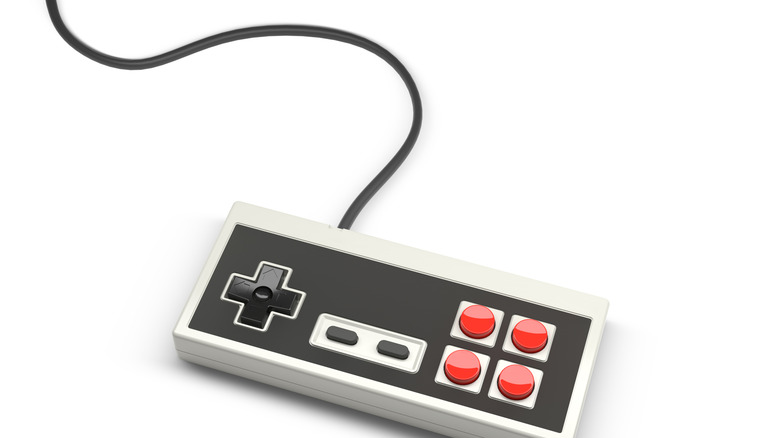
Depending on your first console generation and preferred gaming system, you're either a staunch mouse and keyboard user or prefer using a controller layout that adheres to your muscle memory. If you've been brought up on the dual-analog controllers that Sony introduced with the PlayStation, then you've been lucky enough to get used to a control scheme that has remained largely similar over time, with a few additions here and there. However, if you got into gaming around the time when Nintendo and Sega were the two biggest players, then a controller with a D-pad and limited buttons probably just feels better to use, at least according to your muscle memory.
Sure, you may have eventually gotten used to a modern control scheme because you were pretty much forced to — how else could you play current-gen games without tearing your hair out? — but that doesn't change the fact that retro games will always feel better on older controllers for you. There's no need to remember complex control schemes spanning way too many buttons. A D-pad and a few buttons are all you need to play most retro games, which managed to do a whole lot despite how limited the buttons of older controllers may seem now. The tactile feedback just feels right with these peripherals, and the clicking and clacking of buttons sounds great ... and it's something that modern controllers have forsaken in an attempt to be as silent and immersive as they can.
2D games, especially old-school fighters, feel better on a D-pad
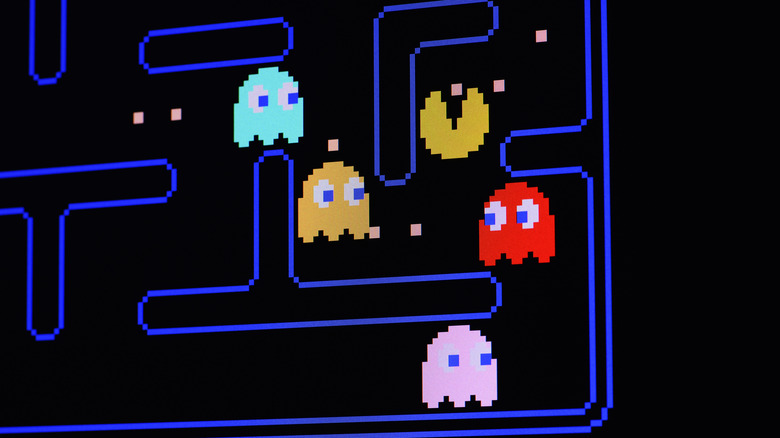
A lot of 2D games require precision input to ensure that you don't lose precious lives. The phrase "Nintendo hard" doesn't exist as a joke — games like the older Teenage Mutant Ninja Turtles games, Battletoads, and Ghosts 'n Goblins require frame-perfect inputs if you want to survive. If you use a modern wireless controller to play these titles instead of an authentic retro device, then you'll face two problems that will prevent you from making these precise movements. For starters, it's well-documented that wired connections (as the old controllers have) exhibit less latency than their wireless variants, although you can usually use a physical wire to connect your wireless controller to the device you're gaming on.
However, the second problem isn't so easily fixable. Analog sticks have dead zones, and the time you waste pushing the analog stick to one side might be the difference between (virtual) life and death. Sure, you can tone down this dead zone in settings, but then you'll have to deal with a joystick so sensitive that an accidental brush is enough to send your character moving in a different direction.
Instead of dealing with this headache, most retro gamers prefer to just use an authentic controller, with a D-pad and just enough buttons to control everything on the screen. Vintage role-playing games (RPGs) didn't need many buttons, and 2D action games will definitely benefit from a controller that provides swifter input. The real winners here, though, are old-school fighting games. There's a reason why special arcade controllers are in demand for this genre even today — old-school fighters just work better with the input schemes of older controllers, letting you nail complex combos and providing palpable feedback.
They're amazing collector's items and showpieces
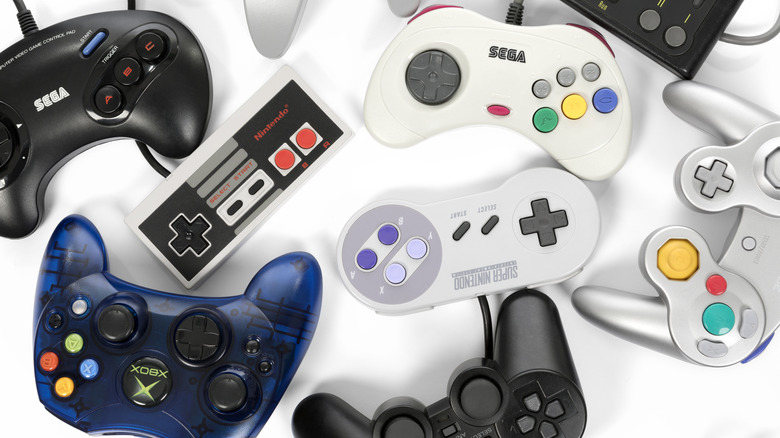
Check any limited edition old-school controller online, and chances are that it's selling for an absolutely ridiculous price. People really do love retro gaming, to the point where some end up sinking up to three figures just to get their hands on their preferred peripheral. It may seem silly, but the flipside is that a retro controller can actually be a good investment if you manage to snag a rare old-school gaming accessory, such as an NES Power Glove or everyone's favorite gaming robot, R.O.B. (Nintendo's Robotic Operating Buddy). Of course, it's not only these rare finds that are collectible — even simple retro Nintendo or Sega controllers from the third and fourth gaming generations have their fans and may someday appreciate in value.
Even if they don't, who said you just need to use these controllers as gaming peripherals? Old controllers have a distinct look to them, enough so that they won't look out of place as showpieces in your house. They can serve as surprisingly minimal pieces of decor, and you can go all out by turning your study or gaming room into a mini retro gaming museum if you manage to get a bunch of retro controllers on a good deal.