

5 Fascinating Facts About Star Wars' Wookiees
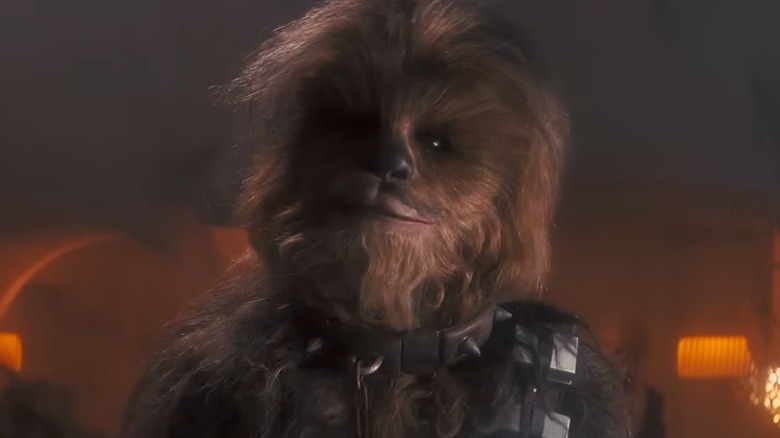
The galaxy of "Star Wars" is full of colorful and unique sentient species. Sure, most of the planets are populated by humans (for some reason), but there are plenty of aliens to enjoy. And then there are the Wookiees. Almost everyone loves a Wookiee. These six-foot furry humanoids are some of the franchise's most popular creations. They live in tree houses, yet their fingers are so dexterous that they are famous — and often enslaved — for their technological tinkering prowess.
They can understand countless languages, yet they can only roar. They are peaceful, yet when angered they can (and frequently will) rip the arms off a droid. And these are just the facts people know about Wookiees. Countless hidden bits of Wookiee lore and design decisions lie just beyond the main "Star Wars" entries, just waiting for fans to discover them. Or you can read this article because these are, in fact, the fascinating facts about Wookiees that you are looking for.
Don't call them Sasquatch
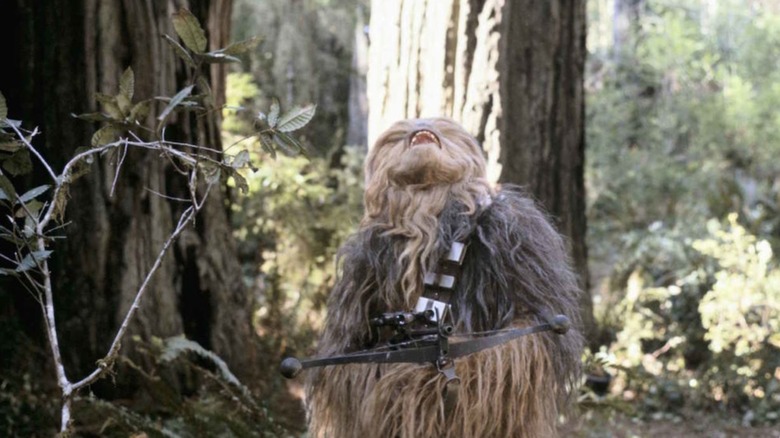
Designers often pull from what they know. Even the iconic X-Wing was inspired by darts in a British pub, and lightsabers started with a random camera shop discovery. Your first instinct is probably to say the people who designed Wookiees were inspired by stories about Sasquatch (the non-canon comic "Into the Great Unknown" references these similarities). In truth, the inspirations drew from multiple sources. The origin of the Wookiee race — specifically Chewbacca — started with George Lucas' personal life.
Once upon a time, Lucas had a pet Alaskan Malamute named Indiana (yes, Indiana Jones was named after her), and whenever she sat in the car with him, people mistook her for a human. This served as the initial idea to give Han Solo a furry co-pilot. For the actual Chewbacca, and the Wookiee race as a whole, design, people drew from multiple sources. And again, none of them were Sasquatch. When Ralph McQuarrie began drawing concept art, he started — at Lucas' request — with a lemur.
Then the main make-up artist, Stuart Freeborn, was told to combine the features of a dog and a cat. As for Chewbacca's voice and the Wookiee language as a whole, Ben Burtt combined the noises of countless animals to create the iconic guttural roars and chirps. Most of these sounds came from bears, but Burtt also mixed in walrus, lion, and badger cries to create a truly chimeric language.
Wookiees can technically have accents
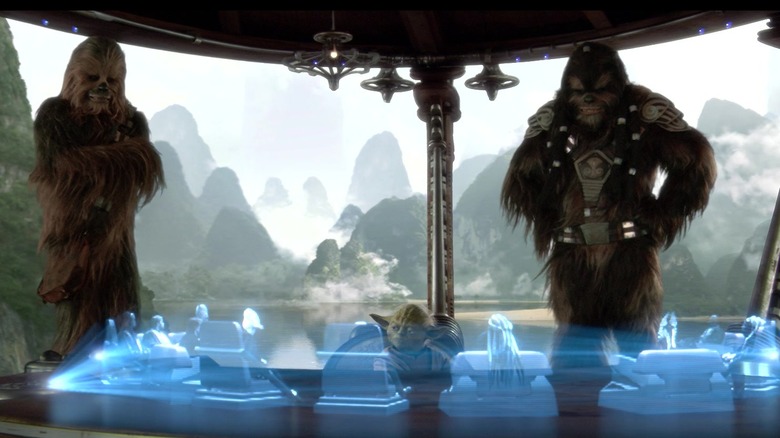
To the untrained ear, Wookiee grunts and roars sound like, well, random grunts and roars. They might have started off that way, but as "Star Wars'" lore expanded, so did the cultures of its countless alien civilizations. Interestingly, Wookiees can clearly understand a variety of languages, but they can only speak their own. This is because it's built into their biology. Wookiees have unusual vocal cords that only let them roar and chirp.
However, every now and then, a Wookiee is born with a speech impediment that ironically makes it difficult for them to speak Wookiee languages but lets them speak Galactic Basic (which sounds remarkably like English). So far, Ralrracheen is the only Wookiee to appear in media (Legends) with this speech problem. To say that Ralrracheen couldn't speak Wookiee languages (plural) wasn't a mistake. The Wookie species technically has three different languages.
The most common is known as Shyriiwook, which is the easiest to translate — people like Han Solo don't even need a protocol droid to understand it. The other two languages are called Thykarann and Xaczik, so people who can understand one Wookiee might not understand another. A side effect of this language diversity is that it creates an overlap in certain translations. For example, between these three languages, Wookiees have a total of 150 words that mean "wood," yet not a single word that translates to "artist." But that's less of a language barrier issue and more of a cultural one.
Reduce, recycle, reuse (old concepts)
Every piece of media goes through numerous drafts before it's ready for the general public, and "Star Wars" is no different. Some early ideas were lost to time, although you can see the "Star Wars" movie we almost got by reading (or watching a review of) the "The Star Wars" comic. Other ideas, meanwhile, were recycled for subsequent "Star Wars" media. Early drafts of "Star Wars" contained names and references to characters who didn't make the final cut, but many of them were reused later down the line.
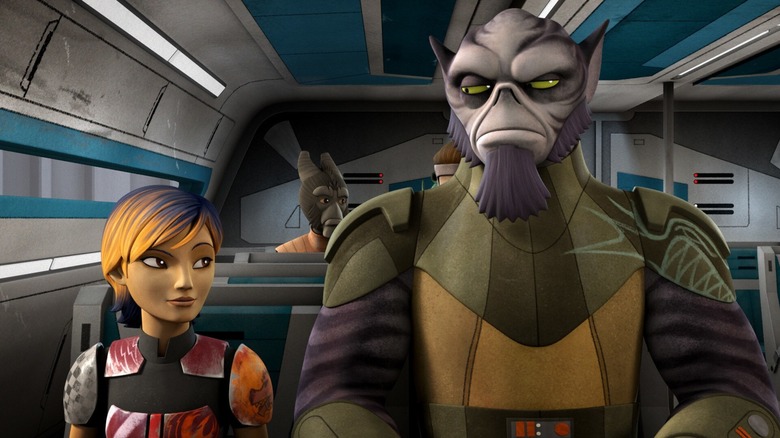
One of the most famous examples was Luke Skywalker's original name (later used in the "Star Wars: The Force Unleashed" duology), but the script also referenced an elderly, feeble-looking Wookiee by the name of Auzituck. Originally, this character was meant to be Chewbacca's father, but the name was recycled for the Auzituck anti-slaver gunships in the "Star Wars Rebels" episode "Spark of Rebellion." That show features quite a few breakout characters, including Garazeb "Zeb" Orrelios (voiced by Steve Blum). Many of the characters have appeared in live-action "Star Wars" shows and movies, including Zeb.
Zeb is a Lasat, a species that Ralph McQuarrie designed from original concept art for Chewbacca, long before he finalized the character as the walking shag carpet fans know and love (and was inspired by a drawing John Schoenherr made for a George R.R. Martin novelette). In fact, this design philosophy was a running theme throughout the show, as many "Star Wars Rebels" vehicles and droids channeled McQuarrie's work.
Strong in the Force, Wookiees almost were not
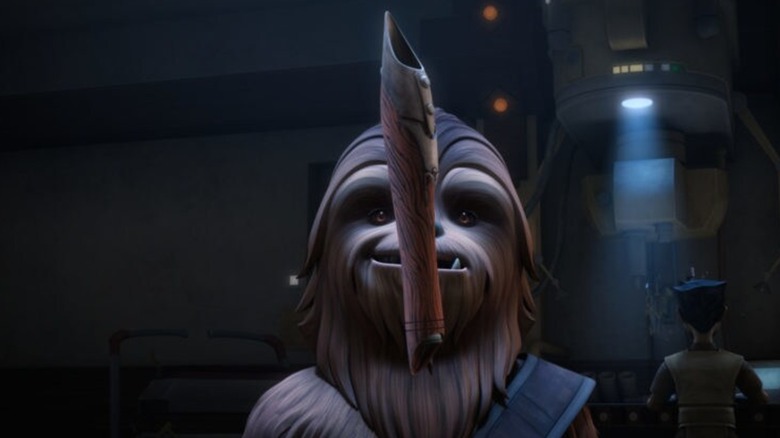
While "Star Wars" is full of opportunities, almost everybody wants to be a Jedi. Not surprising, since you basically become a space wizard with a laser sword that is more than just a weapon. But not everyone can become a Jedi; you're either born with the potential, or you're not. Or George Lucas says you're not allowed. In "Star Wars'" early days, Lucas established that every sentient race in the galaxy can produce members capable of becoming Jedi, and people who made Extended Universe content (tie-in novels, comics, and video games) ran with that knowledge in almost every direction imaginable.
This spawned Mandalorian Jedi, Hutt Jedi, and even Wookie Jedi. Chewbacca's nephew Lowbacca joined the Jedi ranks, and when it came time to flesh out the mythical Clone Wars, Plo Koon's master, Tyvokka, was a Wookiee Jedi. But then Lucas made a blanket ban on Wookiees becoming Jedi. They couldn't even become Dark Jedi (which is distinct from Sith), so all Wookiee Jedi were quietly written out of future works.
For whatever reason, Lucas' decision to ban Wookiees from the Jedi Temple became another huge regret he had with "Star Wars," so he backpedaled shortly after. The "Star Wars: The Clone Wars" episode "The Gathering" introduced audiences to Gungi, the first Wookiee Jedi in a long time. This opened the door for "The Acolyte" to introduce Kelnacca, the first live-action Wookiee Jedi. One can only wonder what the franchise would look like if Lucas hadn't decided to end his Wookiee Jedi ban or if he hadn't imposed it in the first place.
Wookiees have been around since 1971
The "Star Wars" franchise is full of so many proper nouns and terms that some people might need a dictionary to keep everything straight. Leia Organa thought Han Solo was a scruffy-looking nerf herder when they first met, but what's a nerf? Apparently, it's a bovine-like species that used to graze on Alderaan. So where did the writers come up with all these words? Wookiees were drawn from prior movies.
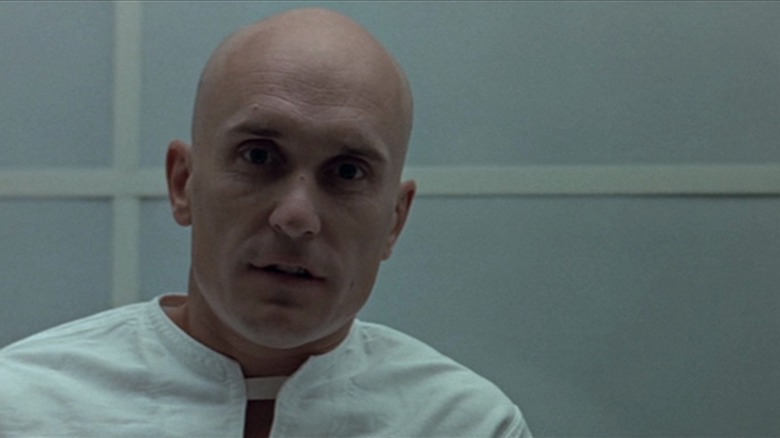
While all fans know about Wookiees from "Star Wars" canon, the term originated in a completely different film, specifically George Lucas' directorial debut, "THX 1138." This must-watch sci-fi movie takes place in a dystopian future Earth where humans live underground, and emotion is outlawed. One man, the titular THX 1138 (Robert Duvall), however, decides to change all that. The film didn't perform well in theaters, which could have made Lucas expect audiences to hate "Star Wars: Episode IV – A New Hope." So what do Wookiees have to do with a film completely unrelated to the "Star Wars" franchise?
One of the actors in "THX 1138," Terry McGovern, ad-libbed the line "I think I ran over a Wookiee back there on the expressway." This was the first instance anyone uttered the word "Wookiee," and back then, it was used to describe a furry, troublesome creature. McGovern had a friend named Ralph Wooky, so he just used it in the spur of the moment. And thus, a throwaway gag turned into one of the most popular alien races in one of the most popular sci-fi franchises of all time.