

5 Of The Weirdest Nokia Phones You Probably Didn't Know Existed
While the iPhone is a popular brand, despite what you might think, it isn't the best-selling mobile phone of all time; that honor goes to the Nokia 1100. While Nokia isn't in the phone business anymore, it played a huge part in shaping the industry, partially because it questioned what it meant to be a cellphone.
When most people think about Nokia phones, their mind goes to the Nokia 3310, a popular retro device with a numeric keypad (the number buttons doubled as an alphabet keyboard) that was touted as virtually indestructible. But Nokia frequently experimented with designs. Just look at the Nokia 3650: a phone that was nothing but rounded edges and a keypad that resembled a rotary phone. Sure, the 3650 was one of the first smartphones in the US to include an integrated camera, but users found the key layout so ungainly that its successor, the Nokia 3660, utilized a more traditional (and comfortable) grid-style key layout. And this was just the tip of the iceberg, as several designs were so unusual, many people erased them from their collective memories.
In this article, we'll go over some of the strangest phones Nokia ever sold that you might have forgotten, ordered in weirdness. We'll not be discussing the Nokia N-Gage because Nokia's failed gaming platform is widely remembered for its poor implementation (and taco shell design). Also, the Nokia 7700 is out because it was canceled before release.
Nokia 6800 line
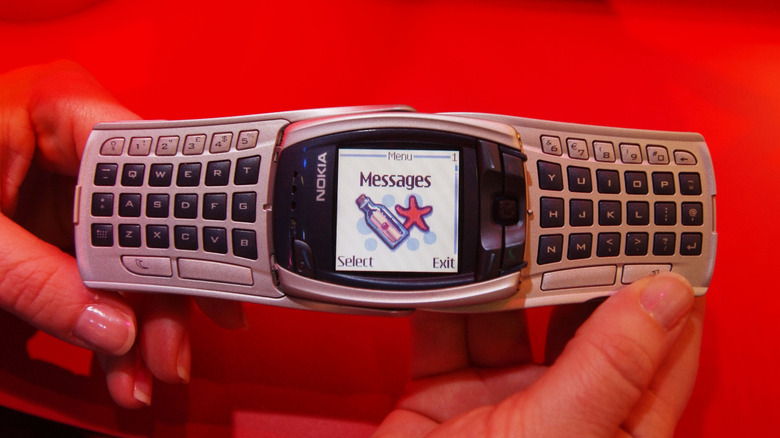
Back when Nokia made phones, text messaging was in its infancy. If you wanted to type out "Hello" on the Nokia 3310, you needed to press the buttons "43555555666" on the keypad. Nokia experimented with alternate methods. These included the 5510, which crammed an entire QWERTY keyboard onto the front, and the Nokia 6800 line.
At first glance, the Nokia 6800, 6810, and 6820 looked like standard cellphones of the time. They had a large screen up top, a numerical pad at the bottom, and squeezed between them were several buttons and a thumbstick for menu navigation. But then you notice the bottom could hinge, and you discover the 6800's secret sauce: the phones could unfold into a full QWERTY keyboard. Unlike modern smartphones with physical keyboards, a large screen split this device's keyboard down the middle. The result looked like an art piece designed to resemble a wristwatch.
The Nokia 6800 line was known as the "messaging phone" or "messaging devices" and supported services based around their typing capabilities. These included email and BlackBerry support. The 6800 line only lasted from 2002 until 2006, when Nokia replaced it with the E70. However, that phone carried on the flip-out keyboard design and spirit.
Nokia 9300
When the Nokia 6800 line flips open, the phones reveal a new set of keys, but they still use the same screen, albeit flipped on its side. But what if the phones opened to not only a keyboard but also a new screen? That's precisely what Nokia released a few years later.
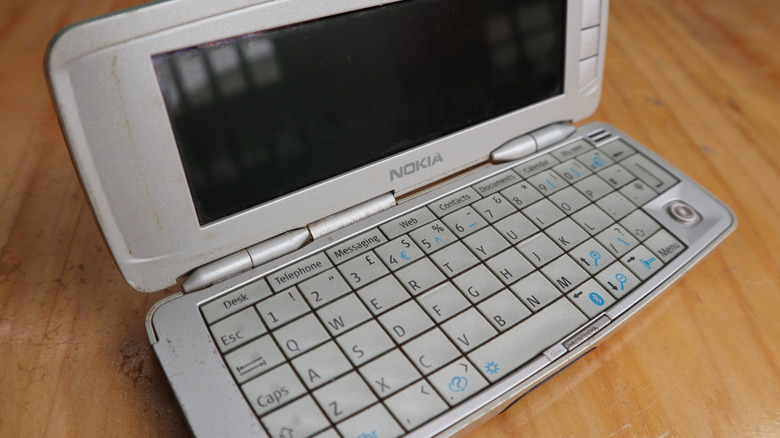
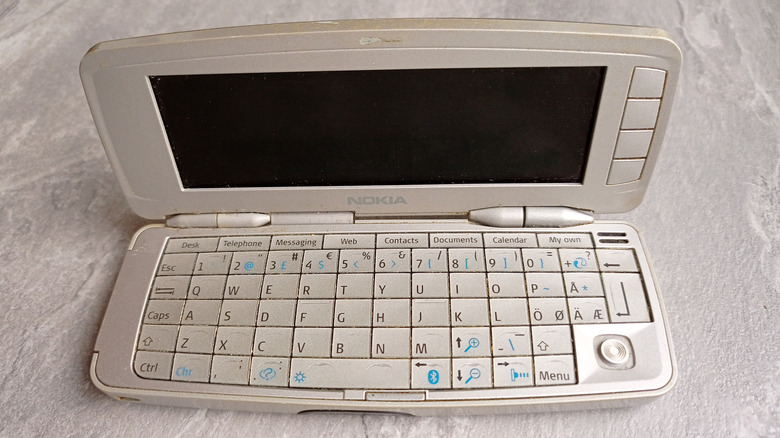
Like the Nokia 6800, Nokia 9300 initially appeared to be your standard cell phone with an equally standard keypad, but once you opened the device lengthwise, it turned into a completely different device. Sandwiched between the 9300's two halves, Nokia hid a larger screen and a full, albeit miniature, keyboard, complete with space bar and thumbstick.
While in this secondary mode, the Nokia 9300 was basically a miniature laptop, squashed and stretched to a shape that could fit into most pockets. The device could even run programs like Microsoft Excel. Confusingly, the Nokia 9300 was remarkably similar to the Nokia 9500 Communicator — both could flip open to reveal a new screen and keypad. Yet the two phones were part of very different lines. Eventually the E90 Communicator (another phone with the same flip function conversion scheme) replaced both the 9300 and 9500.
Nokia N90 line
Smartphones are no longer just about phone calls and instant messages. Many people consider which smartphones have the best cameras when they shop for a new one. Even though many people carry the best cameras designed for tourists, some would rather just reach into their pocket and use their phone, inferior resolution be damned. But before smartphone cameras could fly, Nokia made phone cameras that walked.
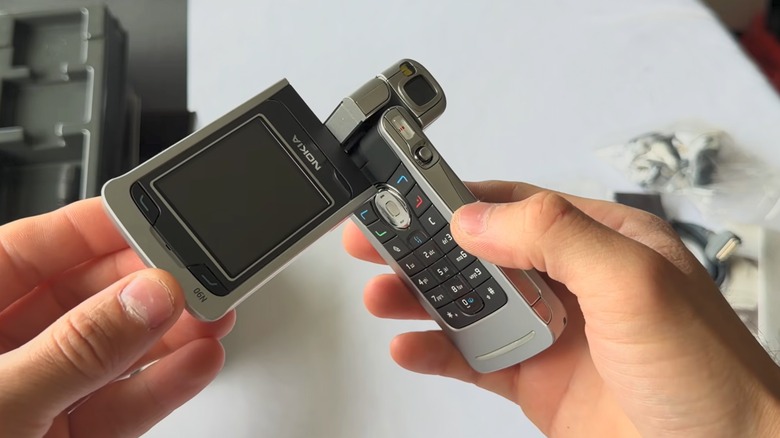
The Nokia N90 was arguably one of the most novel entries in Nokia's Nseries, sporting a unique design that revolved (figuratively and literally) around numerous swiveling parts. You could flip the phone up like normal, but if you tilted the screen 90 degrees, you could then swivel it perpendicularly another 90 degrees and turn the N90 into a makeshift camcorder.The camera portion could swivel as well, just in case you wanted to take a selfie video.
Nokia followed up the N90 with the N93, which continued aping camcorders but with different arrangements of swivels. Instead of letting the camera twist around, Nokia installed a different joint that let the top section swivel even when closed, making it one of the only phones that could flip open on two different axes. However, that was it for the camcorder design. The next in the N90 series, the Nokia N95, was just a high-end phone that could slide open in two directions — one for phone calls, one for multimedia.
Nokia 7600
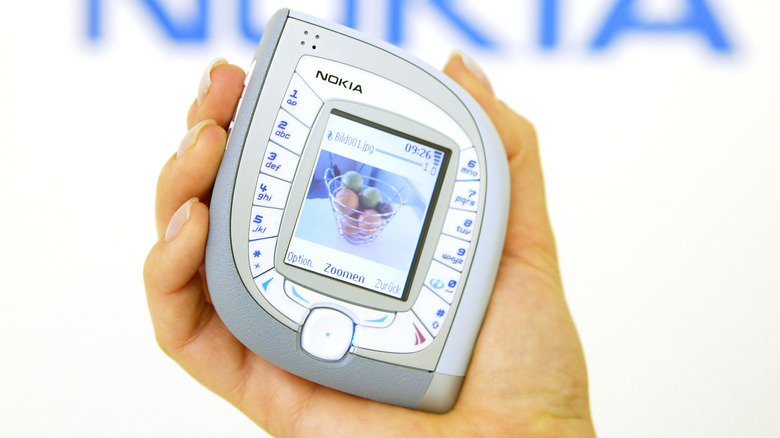
So far, we've mostly gone over phones that flip and fold every which way but the ones you'd expect. But Nokia is as famous for a phone design so plain it's downright iconic — the Nokia 3310 — as it is infamous for the taco-shaped Nokia N-Gage. While the company was usually more restrained in its strange designs, sometimes it built devices that made you ask, "That's a phone?"
The Nokia 7600 was basically a Rorschach test you can touch. Was it shaped like a leaf, or did it resemble an artisanal bar of soap? Whatever it was, one side featured a central screen, number buttons arranged on each side of said screen, and a d-pad underneath. And on the other side rested a camera lens. And we can't forget about the Nokia 7600's voice memo button and optional leather wrist strap.
In the spirit of fairness, owners could swap out plates to customize the Nokia 7600, but they did nothing to mitigate the unorthodox silhouette and painfully unergonomic keypad layout. And how did you make calls on this device? Much like how you needed to hold the Nokia N-Gage on its side, you had to tilt the 7600 at a slight angle, which put one of the sharper corners right in your ear canal. Even if the person you called didn't talk your ear off, using the Nokia 7600 for long enough would certainly make it feel like your ear was ready to fall off.
Nokia 7280
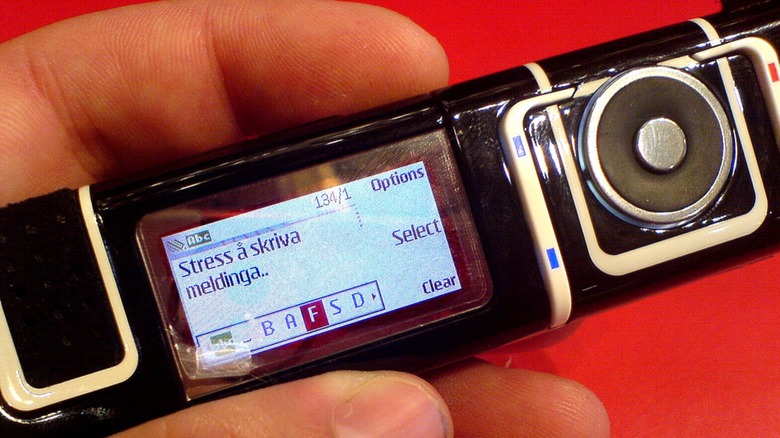
Design quirks aside, every phone in this article has one thing in common: They have plenty of buttons. Some have more than others, but you can still quickly type out the number of the person you want to call. Even smartphones and their touchscreens display simple grid button layouts so you can swiftly enter a phone number. But once upon a time Nokia got rid of all that and called it fashion.
The Nokia 7280 is arguably the company's most unorthodox phone, if not the most unorthodox phone period. The device was introduced as part of Nokia's "fashion line" and was purportedly "inspired by the glamour and elegance of the lavish 1920s." In other words, the Nokia 7280 looked less like a phone and more like a lipstick holder. Or a very fancy MP3 player. The only telltale signs of the device's cellphone nature were its screen and dial.
Yes, the Nokia 7280 was a completely keyless phone. Owners could only navigate its menus — and input numbers for calls – by using the dial and buttons on its "front," which was glacially slow and tedious. To make matters more confusing, the screen was stuck in landscape mode. And the icing on the cake? In order to snap pictures or talk, owners had to pop the top up, turning the Nokia into an art deco "Men in Black" neuralyzer. Little fun fact: You might have seen a Nokia 7280 without realizing what it was, as the phone appeared in music videos for Jennifer Lopez' "Get Right" and The Pussycat Dolls' "Beep."