

iPhone Duo Vs. Pixel 11 Pro Fold: Which Foldable Is Right For You?
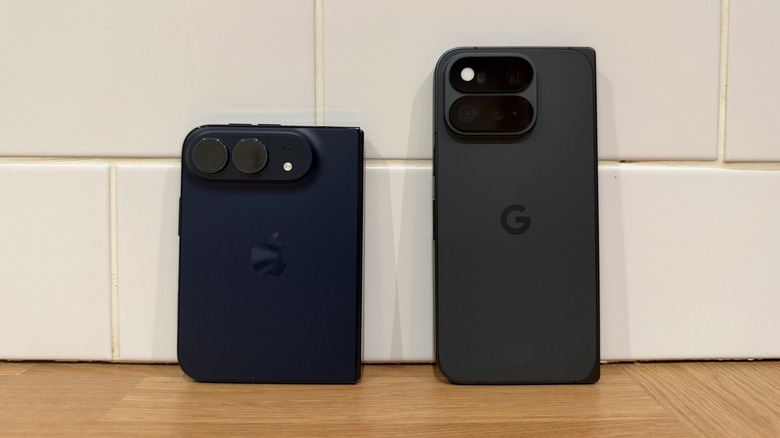
Apple's iPhone Duo and Google's Pixel 11 Pro Fold are both $1,900-ish foldables, but they interpret what a folding phone should be in completely different ways. They both fold sideways; the Duo, which went on sale October 23 with prices starting at $1,999, folds into a short, wide body that opens into a 7.6-inch screen shaped for watching. The Pixel 11 Pro Fold, which has been on sale since August 12 and costs $1,899, keeps a conventional candy bar shape when closed and opens into an almost square 8-inch panel aimed at productivity.
I've used both. I spent two weeks with the Pixel 11 Pro Fold as my main phone, including a trip overseas, and it won me over despite my preference for the passport shape. If you want a foldable that feels the most like a normal smartphone, the Pixel is your best bet. However, I've switched to the Duo full-time. I found that both devices solve different problems, and their similar prices actually disguise how different they are.
iPhone Duo vs. Pixel 11 Pro Fold: What's the same?
While their dimensions differ, both foldables open sideways, offer a usable cover screen and a tablet-sized inner display, and cost within $100 of each other. The iPhone and the Pixel both carry an IP68 water- and dust-resistance rating, which still isn't a given on foldables in 2026. That puts them ahead of the IP48 rating on Samsung's Galaxy Z Fold 8. Because Apple opted for Touch ID instead of Face ID on the Duo, both phones use a side-mounted fingerprint sensor rather than an under-display reader. In my experience, the side-mounted approach is quicker and more reliable on a device you hold differently when it's open versus closed.
Both phones also support a wide array of magnetic accessories. The Duo works with MagSafe accessories and Qi2 chargers, so it can wirelessly reach 50% battery in around 30 minutes, while the Pixel 11 Pro Fold has built-in Pixelsnap magnets and supports Qi2 at up to 25W. Standard MagSafe accessories you already use every day also snap onto the Pixel without trouble. However, most MagSafe accessories don't fit the iPhone Duo properly because the folded body is too short.
Software support is strong on both sides. Google ships the Pixel 11 Pro Fold with Android 17 and a full suite of Gemini AI features, while Apple ships Siri AI and Apple Intelligence with iOS 27. Neither software update is exclusive to the foldable in question, though no other iPhone supports Split View.
iPhone Duo vs. Pixel 11 Pro Fold: What's different?
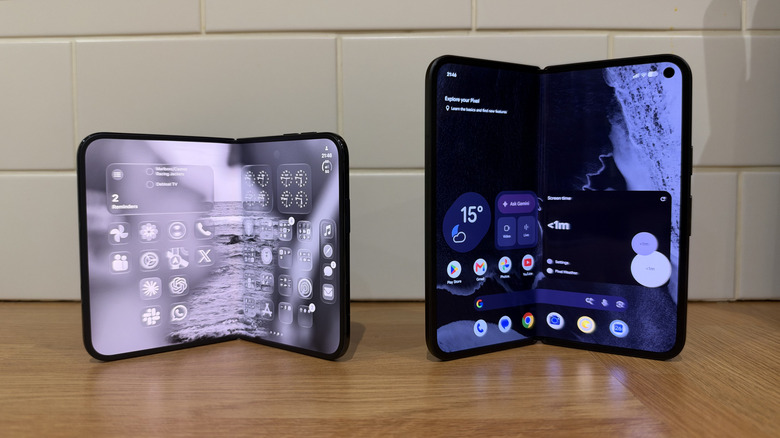
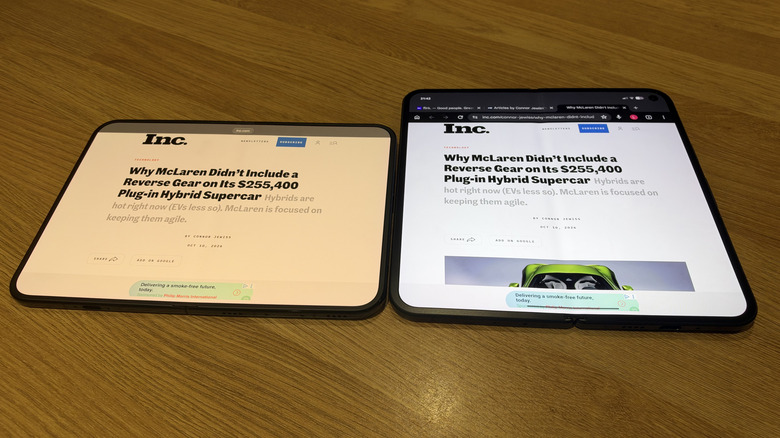
The Pixel 11 Pro Fold's 6.5-inch outer display has normal phone proportions. When it's closed, it behaves like an ordinary handset, and you could go all day without unfolding it (though what's the point?). The iPhone Duo's 5.4-inch cover screen is shorter and wider, but still delivers 90% of the screen area of an iPhone 18 Pro. When open, the Pixel's 8-inch panel is almost square at 2,076 x 2,152 resolution, which means black bars take up a large chunk of the screen when you're watching widescreen video. The Duo's 7.6-inch inner display shares the cover screen's aspect ratio, which suits widescreen video much better.
The Pixel's crease is visible nearly all the time, and you can feel it under a finger while swiping, which I noted in my full review. The Duo uses a matte nano-texture inner display, so while the crease sometimes catches the light at an angle, it is much harder to see straight on, and I can hardly feel it at all. Apple also hides the inner camera beneath the display rather than using a hole punch.
Speaking of cameras, the Pixel 11 Pro Fold packs a 48MP main sensor, a 10.5MP ultrawide lens, and a 10.8MP 5x telephoto lens with AI-powered Super Zoom up to 30x. The iPhone Duo has only a 48MP Fusion Main sensor and a 48MP Fusion Ultrawide camera with a digital 2x crop, with no telephoto lens. While the Pixel offers an extra camera, the Duo has the bigger battery. The Pixel's 4,750 mAh cell gave me 5 to 6 hours of screen time but charges slowly at 30W. Apple rates the Duo's 4,883 mAh cell for 31 hours of video playback on the inner display.
Which foldable smartphone should you buy?
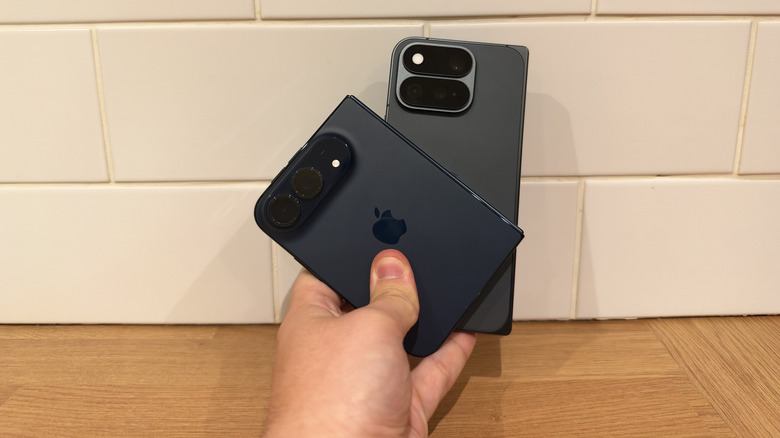
Buy the Pixel 11 Pro Fold if you want a foldable that works as much like a regular smartphone as possible, or if the camera is your deciding factor. The 5x telephoto lens is the single biggest functional advantage either phone has over the other, and the near-square inner screen is better for running two full-size apps side by side. You should buy the iPhone Duo if you watch a lot of video on your phone, want a smaller folded device, or already use an iPhone and switching platforms is an obstacle. The passport shape makes more sense to me than the tall one, because I think the point of a foldable should be shrinking the phone you carry rather than enlarging the tablet you unfold. Apple's software polish on its foldable is also well ahead of what Android foldables have managed, with Split View, app pairs, and an interface that reshapes itself between the two screens.
Both cost close to $2,000, roughly double the price of a good conventional flagship, and both make real compromises. If you want the cheapest route into this shape, Samsung's Galaxy Z Fold 8 undercuts both at $1,900 and weighs less than either, though it only has an IP48 rating and no telephoto lens. If the camera is what you care about, Google's Pixel 11 Pro and Apple's iPhone 18 Pro both cost $1,099 and take better photos than any foldable.