

5 Budget Android Phones That Actually Support eSIM

These days, several dual SIM phones feature an embedded SIM card (eSIM). It's integrated directly into the phone's motherboard, with carriers allowing you to download their profiles and start using their network features right away. You don't need to go to the store to get a physical SIM card or wait for one to arrive in the mail — you just download the eSIM, activate it, and you're good to go. It's super convenient, particularly for people who are traveling, especially when it comes to avoiding roaming fees. While many modern flagship phones, including iPhones and Samsung Galaxy S phones, support eSIMs, you will have to do a little digging to find budget phones that do. This is mostly due to the hardware limitations of the budget phones.
However, you don't need to drop flagship or even midrange money in order to find an Android phone with eSIM support. iPhones are a different case. Unless someone has an unboxed secondhand unit of an older iPhone that is still getting updates or you're looking to buy refurbished, you're not going to find a new, modern iPhone while truly on a budget. Android phone manufacturers such as Samsung and Motorola, on the other hand, have several budget and even ultra-budget phones that you can pick up brand new that have an embedded SIM.
Samsung Galaxy A17 5G
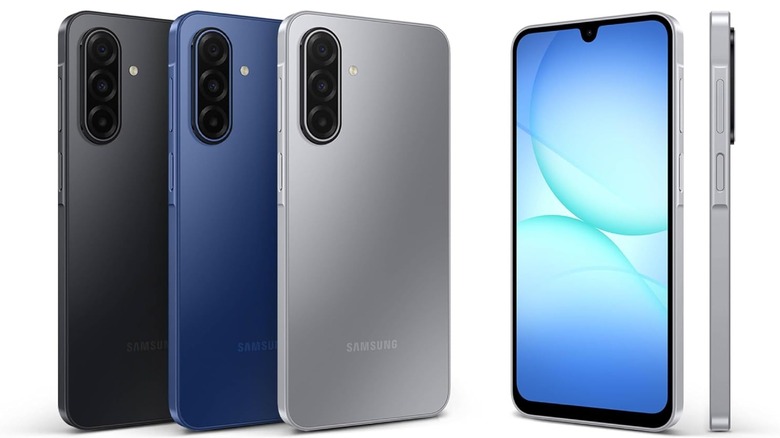
The Galaxy A series is one of Samsung's popular lines of budget and mid-range phones. The Samsung Galaxy A17 5G starts at $269.99, and it supports two nano SIMs or a combination of a nano SIM and an eSIM. It has 4 GB of RAM and 128 GB of internal storage. You can extend the storage up to 2 TB, as it's one of the Android phones that still come with a microSD slot.
With an entry-level Exynos 1330 chipset, you're not going to be running demanding games, and it can struggle with multitasking, especially with that paltry amount of RAM. Still, the Samsung Galaxy A17 5G is a decent phone for everyday tasks, such as streaming, browsing, and basic photography (the 50 MP rear camera even does a good job in well-lit rooms). Plus, the phone was released in August 2025, with Samsung promising six OS upgrades and six years' worth of security updates. So this phone won't become obsolete until 2031, at least when it comes to software.
If you want something ultra low-budget in the Samsung Galaxy A series, then the Samsung Galaxy A16 5G is available for $154.99. Almost everything, including the RAM, storage, display, and chipset, remains unchanged. It has one less year of support than the A17. Though do note that the A17 offers a slightly better camera thanks to optical image stabilization (OIS). The feature reduces unintentional small movements that cause blurry photos and shaky videos, resulting in better image quality.
Samsung Galaxy A36 5G
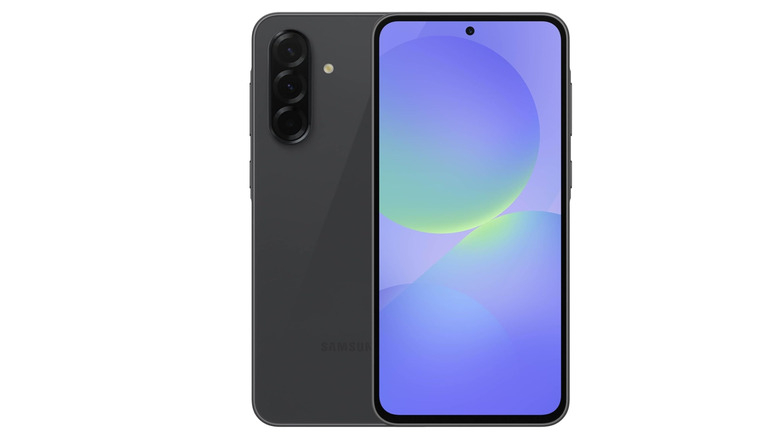
Another phone worth checking out in the Galaxy A series if the Samsung Galaxy A17 5G is too far on the low end for you is the Samsung Galaxy A36 5G. It costs $399.99 on Amazon and features the same SIM configuration as the A17. It also has the same-size screen, but a refresh rate of 120 Hz for smoother scrolling. It has 6 GB of RAM, meaning it has better multitasking capabilities. It has internal storage of 128 GB, but it doesn't offer a microSD card slot. It's packing a midrange chipset in the Snapdragon 6 Gen 3, meaning it can run games optimized for low-end devices, like "PUBG Mobile" and "Call of Duty Mobile," at 55-60 FPS on low or performance settings. However, action-heavy games like "Zenless Zone Zero" and "Wuthering Waves" might drop below 30 FPS during intense moments.
What makes it even better than the A17, though, is its additional AI features. Both have AI-powered Circle to Search functionality, which was previously only found in Samsung flagships, and both feature Gemini integration. But the A36 also uses AI to analyze your gallery and create custom filters, as well as to provide intelligent object removal and edit suggestions. Furthermore, it has an IP67 dust- and water-resistance rating. It can be submerged in water as deep as 3.3 feet for up to 30 minutes, though this ability will diminish with wear and tear. It also has a 5,000 mAh battery and supports up to 45 W fast charging.
Motorola Moto G (2026)
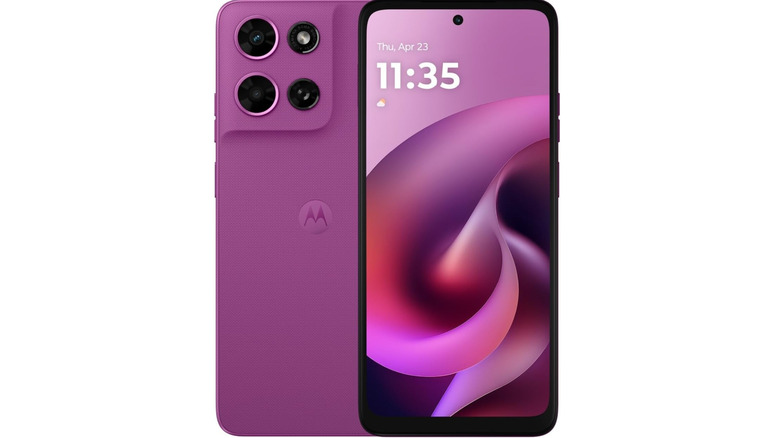
The Motorola Moto G (2026) costs $299.99 and is designed to function as a capable daily driver. You can use a combination of a nano SIM and an eSIM. It's got a decent 6.7-inch display that features a 120 Hz refresh rate. However, you shouldn't think that you will be running games at 120 FPS because it uses the underpowered MediaTek Dimensity 6300 chip and 4 GB of RAM. At the same time, the phone is better at multitasking than those figures might suggest because it uses RAM Boost — this is a feature that uses part of the device's internal storage to extend the available amount of RAM. In RAM Boost mode, you can get up to 12 GB of RAM, but this means there will be slightly less of the 128 GB of internal storage available (it's extendable via a microSD card, though).
One notable feature is that the rear of the Motorola Moto G (2026) is made of textured pleather (i.e., fake leather), with fuchsia as one of the bold color choices. For a budget phone, it also stands out thanks to its AI-powered camera system. The 50 MP rear camera allows you to capture high-resolution photos in various lighting conditions. For example, in low-light conditions, the camera uses AI-enhanced night vision. It is supported by a 2 MP secondary macro camera, and the 32 MP selfie camera can capture extreme close-ups thanks to the power of AI. The 5,200 mAh battery is also enough to last you through the day, with a maximum of 30 W super-fast charging to get it juiced up quickly.
Motorola G Power (2026)
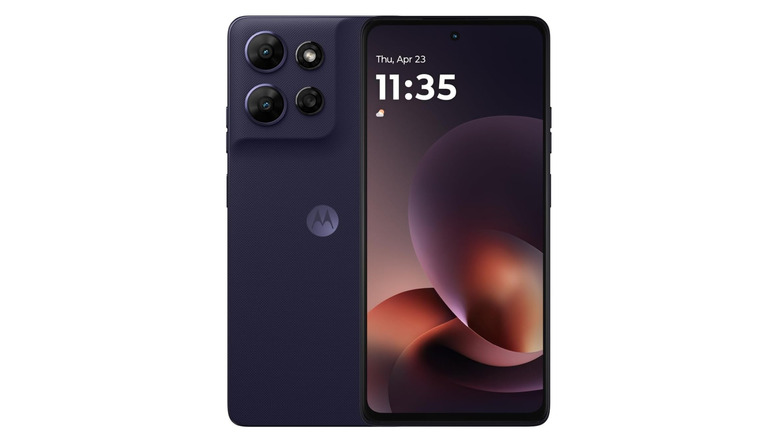
For a hundred bucks more than the Motorola Moto G (2026) — $399 — you can get the Moto G Power (2026). It's got a 6.8-inch display, so it's slightly bigger than the Moto G. However, this phone has a better resolution of 1080p versus the Moto G's 720p. Since these screens are quite large, there will be a noticeable difference in picture quality, especially when it comes to streaming. With 8 GB of RAM, the Moto G Power's multitasking capabilities are significantly better than its sibling's. Factor in RAM Boost mode, and that goes up to 24 GB of total RAM available. Gaming is still a bust, though, as it uses the same Dimensity 6300 chip.
There are also noticeable improvements on the camera side. The main camera is still 50 MP, but it now features OIS. The secondary macro camera has been bumped up to 8 MP and has an ultrawide lens. One of the more notable features it has going for it, despite being a budget option, is a Corning Gorilla Glass 7i screen (the Moto G features Corning Gorilla Glass 3). It offers two times better scratch resistance than alternatives and can be dropped from a height of 3.3 feet and survive, even on rough surfaces like asphalt.
TCL Nxtpaper 70 Pro
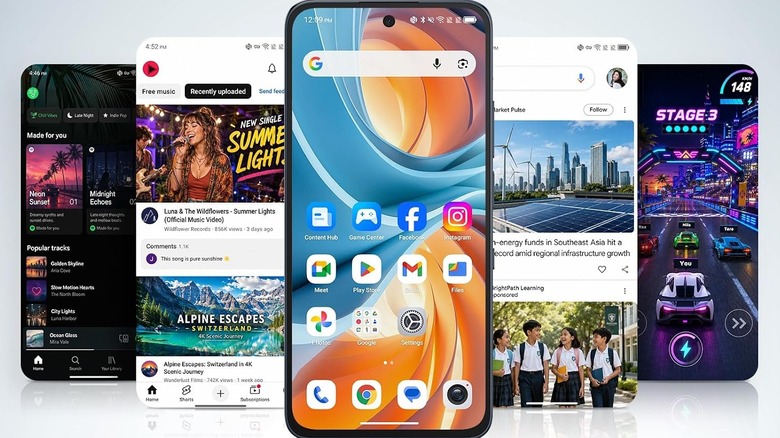
TCL is a Chinese manufacturer known for producing some of the most budget-friendly TVs. However, TCL also makes other electronics, including its Nxtpaper line of budget smartphones. One of them is the TCL Nxtpaper 70 Pro, and it costs $329.99. "Nxtpaper" refers to a technology that combines hardware and software to create a display that mimics the look of real paper with full-color ink. Nxtpaper displays are also anti-glare and anti-reflective, offering good clarity when outside. Furthermore, it has physical filters built into the display that reduce the emission of blue light, a potential sleep disruptor, to 3.41%.
The TCL Nxtpaper 70 Pro has a 6.9-inch flicker-free display with a refresh rate of 120 Hz. With the press of a button, it can switch display modes. These include a regular color display, Ink Paper that mimics black ink on white paper (similar to an E Ink display), Color Paper for reading comics and visual novels, and Max Ink for power saving. It also has an advanced camera system for a budget phone, with a 50 MP rear camera, 8 MP ultra-wide camera, and 32 MP selfie camera. It supports smart AI features, including night mode, cinematic filters, and automatic correction of unintentionally tilted horizontal shots. It also supports Wi-Fi 6E for faster streaming and downloads.
Methodology
We defined "budget" Android phones as anything that costs below $400. We also picked phones that are currently available on the market new and in-box, meaning refurbished phones, no matter how powerful they are, weren't up for consideration. We also opted for phones that are still receiving OS upgrades or security updates to avoid recommending phones that have reached end-of-life (EoL) status. We also wanted to make sure that the Android phones have at least an average rating of four stars out of five on Amazon. If there weren't enough Amazon reviews, we looked at professional reviews and the manufacturer's store ratings to ensure that each phone comes highly recommended.