

5 Futuristic Inventions From The Jetsons That Are Now A Reality
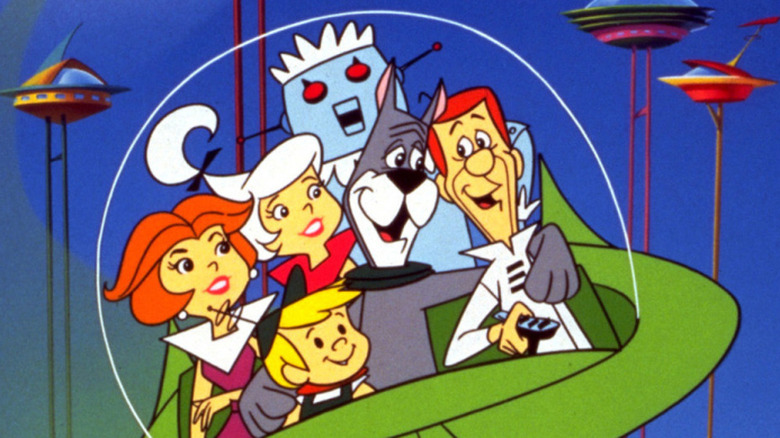
"The Jetsons," Hanna-Barbera's alternative to "The Flintstones," was set far into the future, in 2062. That's only 36 years away now, so at some point we're going to expect the existence of a gravy hose, video chats, and watches with video screens — wait, are we already living in the pre-Jetsons world? Maybe the ongoing expansion of AI data centers will drive us into the stars, just as humans were driven off Earth in those really high buildings.
Watching an episode of "The Jetsons" is fascinating, as the team at Hanna-Barbera was endlessly creative with the gizmos and gadgets everyone uses. Highlights include, in Season 1, a potato masher for mass-producing mashed potatoes, and in Season 2, a game of chess that is played with miniature missiles. While, yes, we'd all love a gravy hose to be something made at industrial scale, it is too pure of an idea for this world.
Instead, "The Jetsons" managed to come up with some ideas that would eventually take shape. Much like how "Star Trek" influenced or popularized some ideas that we see today, "The Jetsons" was doing it cartoon-style. For everyone's sanity, let's just hope the various AI chatbots we have today don't get as snarky as some of the machines in the show.
Digital encyclopedias
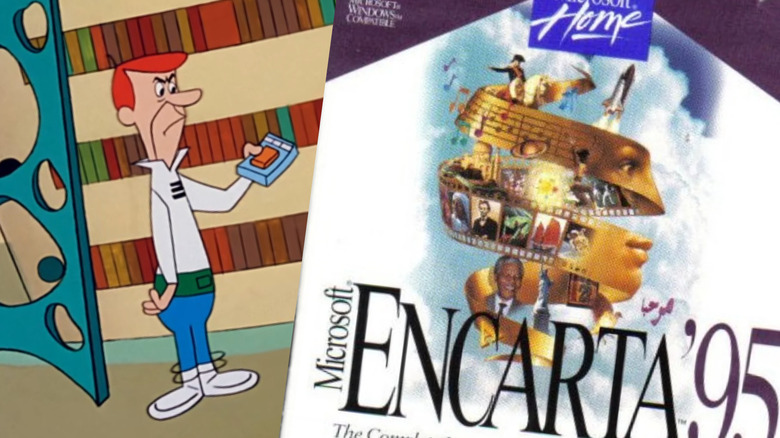
When George Jetson is looking for information on a creature from space, he whips out the digital encyclopedia. The episode "Elroy Meets Orbitty" shows George getting information from a small device containing all of volume "O." The gag is that even in the future, we wouldn't have found a way to cram all of human knowledge into something so small.
We did, though, but not until the 1980s, when Encyclopædia Britannica published its first digital version in 1981. A CD-ROM version of the Academic American Encyclopedia was released in 1986, and Wikipedia wouldn't start until 2001, born out of Nupedia. The difference is that Nupedia was peer-reviewed, while Wikipedia is open for editing and then verified by volunteers. During the 1990s and into the early 2000s, Microsoft would also publish Encarta, an interactive encyclopedia.
George has trouble with the encyclopedia, however, almost mirroring some of the issues we're having with LLM-driven chatbots like Google Gemini, ChatGPT, and Claude. Rather than give information on the mysterious creature, it tries to fulfill its task by presenting the wrong answer. It's funny, but also bleak at the same time, considering that's where we're at now.
Virtual assistants
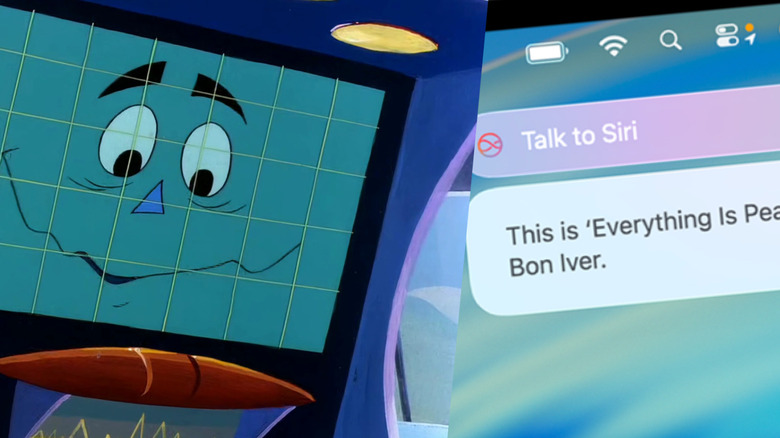
"The Jetsons" features multiple voice-activated computer assistants, rather like what we have today. That includes getting things wrong, much like the digital encyclopedia. George uses "Rudi" while at work, a voice-activated alarm, and there's the boss, who has a "luxury" digital assistant on his desk.
Digital, computer, or virtual assistants, whichever name you'd like to give them, have been bugging us for decades at this point. Voice-controlled technologies aren't new, with AT&T (then Bell Labs) developing "Audrey" in 1952. With a designated talker, it could recognize numbers for dialing. IBM's Shoebox in 1961 could recognize a whopping 16 words, as well as numbers 0 through 9. However, the vision of these digital assistants shown in "The Jetsons" was closer to that of Siri, Gemini, Bixby, or one of the other now AI-driven onboard helpers.
One of the most prominent is Alexa, on Amazon Echo devices, with millions sold and lodged in the corners of homes across the United States. Large language models have mostly begun to take over the space, with ChatGPT and Claude even inducing AI psychosis in some users as they become addicted to the sycophantic nature of the assistants.
Robot vacuums
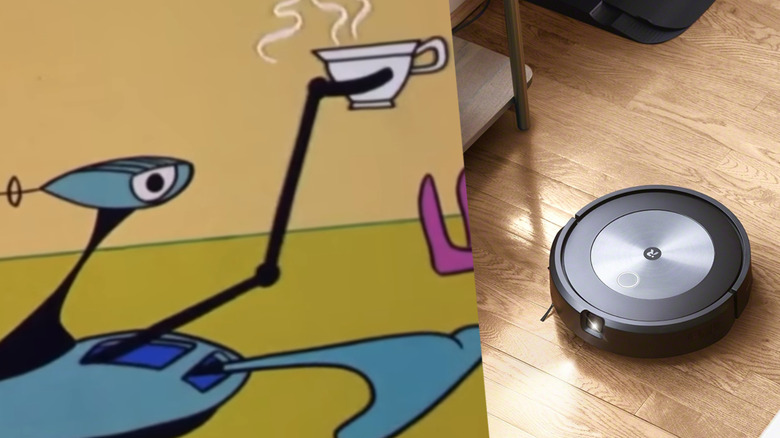
The Jetson family might have had Rosie the Robot to aid them in everyday chores, but throughout the show they still had various robots performing different tasks. One that has been around longer than we realize is the vacuum robot. Roomba entered the world in 2002, almost a quarter-century ago as of writing.
Of course, robot vacuums in "The Jetsons" were a little more sophisticated than the bumbling Roomba, even offering Jane Jetson a cup of coffee as she complains about all the housework she has to do. Robot vacuums have gotten smarter as things have progressed, with the technology being used to even develop lawn mowing robots. Even "The Jetsons" still had a robot pushing a mower.
In fact, robot vacuums are now so prevalent that we're able to rank ten of them by expert opinion. Some of them even spray solution to aid in cleaning the floor, or are able to remove stains from the carpet. However, there's no sign of one that will give you a cup of coffee or put out your cigar.
Video calls
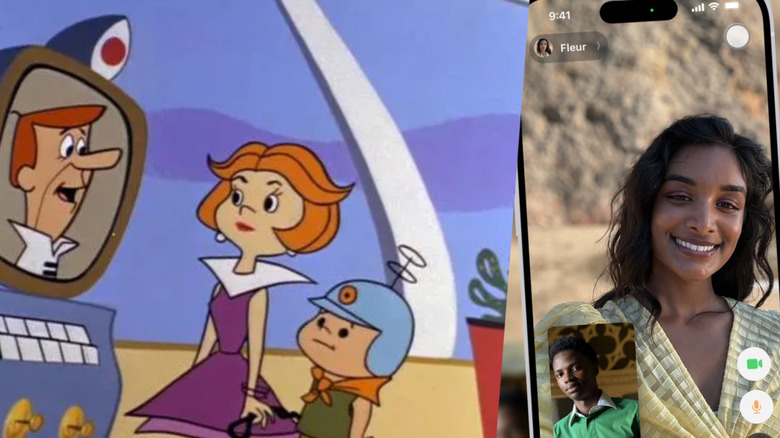
Throughout the show, the Jetsons call each other or get called via video multiple times. In fact, it has become one of the main forms of communication within the world of "The Jetsons." While it might seem like something that the show may have conjured up or pinched from the various sci-fi materials around at the time (even the later "Star Trek" would still use radio communication), video calling was actually first performed in 1927, with AT&T having President Hoover call over a one-way video signal to New York, nearly 200 miles away.
Video calling would improve just a few years later, and in 1931, the first two-way video call took place. However, with the Great Depression and World War II on the horizon, the entire idea was effectively put on pause while the world did its thing. AT&T would try again with the Picturephone in the 1970s, but both versions failed to gain traction, with a reported peak of 500 users. It didn't help that it cost $975 a month to rent.
The BBC featured video calls in a 1986 edition of "Tomorrow's World," performing the first video call from the BBC office to Portsmouth. Unlike the far more advanced video chat tech that came with MSN, Skype, or FaceTime, in '86, it sent around seven frames per second.
Food-making machines
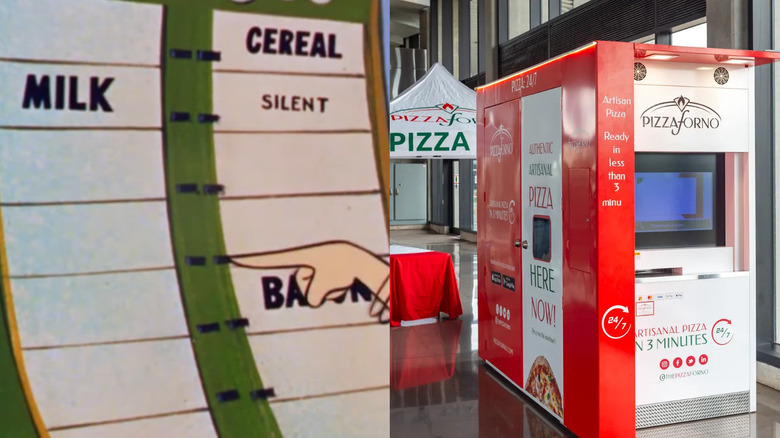
Multiple food machines make up the robot roster in "The Jetsons." These machines are actually getting fairly common, with the closest one to fruition being the pizza machine. In some locations across the world, a machine will now make a pizza from scratch and dispense it via the vending machine it's attached to. At least it doesn't fly out, forcing someone to don a baseball mitt to catch it.
In recent years, clever folks behind 3D printing technologies have cracked how to produce food from the contraptions. On the consumer end, food-making machines, like Posha, will do all the heavy lifting after being supplied the ingredients. Not quite as automated, but it appears to work in the early coverage of the device.
Restaurants are now beginning to appear with robots taking over the cooking process from humans. Again, it's not quite a giant cylinder crushing potatoes or the breakfast machine pouring your morning drink, but we're slowly getting there. Hopefully, again, we get that gravy hose.