

iPhone Duo Vs. Galaxy Z Fold 8: Which Passport-Style Foldable Is Best?
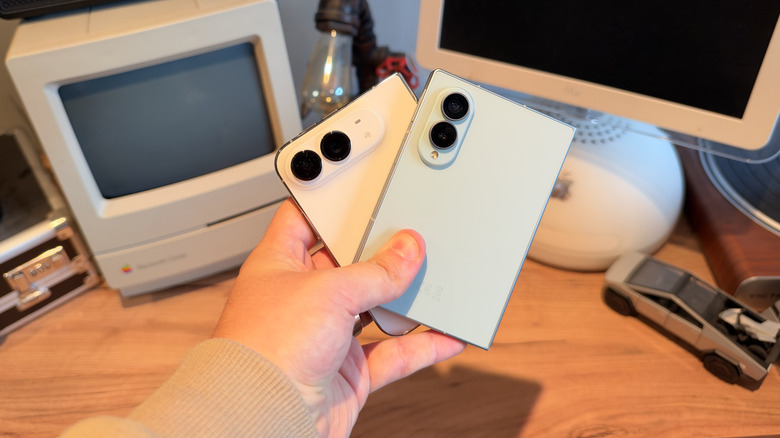
Apple's iPhone Duo and Samsung's Galaxy Z Fold 8 are the two foldable smartphones from 2026 chasing the same idea. Both fold sideways into a short, wide body — dubbed passport-style — and open into a roughly 7.6-inch screen shaped for watching things. It's an alternative form factor to the tall, narrow panels that earlier foldables used.
The iPhone Duo starts at $1,999 and reached stores on October 23 after Apple announced it at its September 9 event. The Fold 8 arrived in July at $1,900. Considering the two phones are only priced $100 apart, the choice between them is mostly a choice between iOS and Android rather than a choice about money.
I've used both. The Fold 8 has been in my rotation since launch, among other phones I've reviewed. It's the phone that convinced me this shape was the right one for a foldable in the first place. The Duo brings me to the same conclusion and is an excellent device, albeit one with its own set of trade-offs around weight, durability, and cameras. Here's what the two have in common, where they split, and which one you should buy.
iPhone Duo vs. Galaxy Z Fold 8: What's the same?
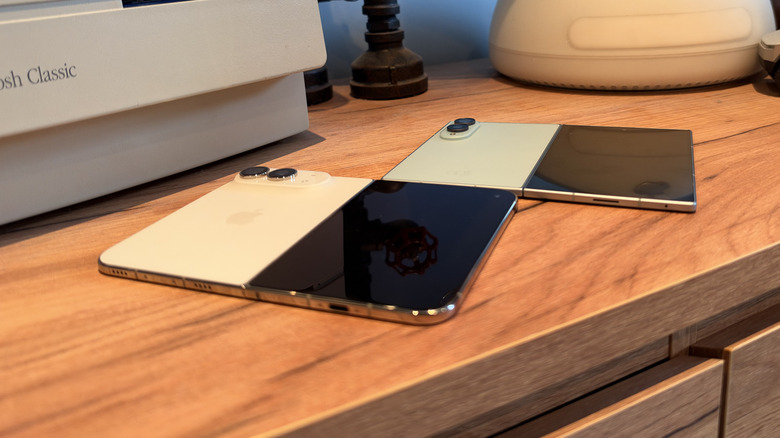
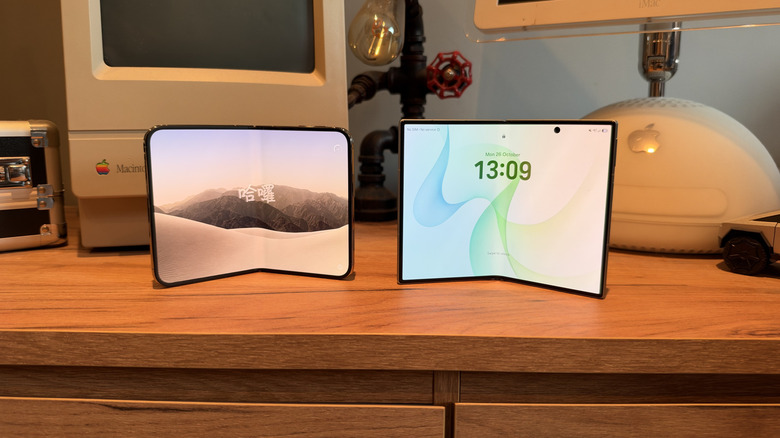
Apple's inner display measures 7.6 inches, and so does Samsung's, with both using a squarer aspect ratio that leaves far less letterboxing on widescreen video than the near-square panels used by taller book-style foldables. The cover screens are very similar too, with the Duo clocking in at 5.4 inches and the Fold 8 at 5.5 inches. Both are large enough to run full apps properly, which is what separates this style of foldables from flip phones, where the outer screen acts more like a widget panel rather than a full-on usable display.
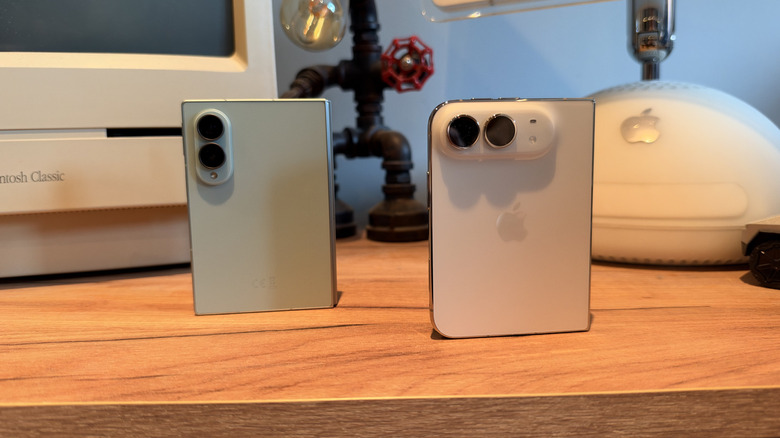
Both phones also feature the same type of cameras. The Duo comes with two rear cameras, a 48MP Fusion Main and a 48MP Fusion Ultrawide, while the Fold 8 pairs two 50MP sensors (also a main and ultrawide). Neither includes a dedicated telephoto lens, because neither chassis has room for one at this thickness. To get around this, both fall back on cropping into the main sensor for digital zoom.
Apple didn't include Face ID on the iPhone Duo, so the device comes with Touch ID instead. Both phones feature a fingerprint reader built into the side power button rather than under the display. The Duo's power button is raised to help you find it, while the Samsung's sits more flush with the chassis. Both phones start at 256GB of storage, use titanium in their construction — with Samsung placing a titanium plate under the inner display and Apple building the frame from titanium — and use a vapor chamber to manage heat.
iPhone Duo vs. Galaxy Z Fold 8: What's different?
Samsung's passport-style foldable is both thinner and lighter than Apple's. The Fold 8 weighs 201g and measures 4.5mm unfolded and 9.7mm folded, while the Duo weighs 254g and measures 5.2mm unfolded and 11.3mm folded. In practice the Duo doesn't feel heavy to me, and it's only slightly heavier than an iPhone 18 Pro Max. But if you often notice how heavy your phone is, the Galaxy Fold 8 is the clear winner in this department.
The Duo carries an IP68 water- and dust-resistance rating — good for 19.6 feet for up to 30 minutes — while the Fold 8 is only rated IP48, which offers far weaker protection against dust. Apple also uses a matte nano-texture finish on the inner one, which is why the Duo's crease is harder to spot than it is on the Fold 8's glossy panel. Samsung's hole-punch camera on the inner display also cuts into software elements depending on orientation, which Apple avoids by hiding the FaceTime camera under the screen.
The Duo packs Apple's A20 Pro chip (the same as the iPhone 18 Pro) and runs iOS 27, which introduces Split View to the iPhone. Meanwhile, the Fold 8 packs the Snapdragon 8 Elite Gen 5 for Galaxy and runs One UI 9 on Android 17. Samsung's desktop-style window management is better for power users than iOS. Samsung lists a 4,800 mAh battery with 45W wired and 20W wireless charging. The Duo has a slightly larger battery at 4,883 mAh, rated for up to 31 hours of video playback on the inner display. The Duo is eSIM-only, while the Fold 8 supports a physical SIM. Plus, the Duo will gain Apple Pencil support later this year, while the Fold 8 doesn't work with any S Pen.
Which passport-style foldable smartphone should you buy?
The operating system (OS) will probably decide which of these passport-style foldables you should buy. These are two very similar phones, priced $100 apart, so picking whichever OS you already use is the most sensible answer unless a specific feature pulls you the other way.
You should buy the Galaxy Z Fold 8 if you want the lighter, slimmer phone, a physical SIM slot, or if you use the kind of heavy multi-window multitasking that One UI handles better. It's also the cheaper of the two. You should consider the iPhone Duo if you use an iPhone already, if durability matters more to you than weight, you want a more premium experience, or value stylus support. An IP68 rating against an IP48 rating is arguably more important on a foldable phone, as they're more fragile, especially if you spend time around dust or sand. Plus, the Duo's nano-texture inner display solves the crease problem more convincingly than any foldable I've used.
Neither of these phones is the right choice if you care about zoom shots, because neither has a telephoto lens. The Pixel 11 Pro Fold costs $1,899 and includes a 5x telephoto, which makes it the better foldable camera phone of the three even though its taller shape is worse for watching videos. Samsung also sells the Galaxy Z Fold 8 Ultra if you want a 200MP main camera and a slightly larger battery in the same broad design.