

5 High-Quality Headsets Worth Buying Instead Of The PlayStation Pulse
We may receive a commission on purchases made from links.
The video game industry has been in the midst of a console war since the beginning. The participants change, but the war rages on. The Xbox Series X/S and the PlayStation 5/PS5 Pro are this generation's primary combatants, but the deciding factor isn't the games (insert your own joke about Xbox not having exclusives). It's capabilities.
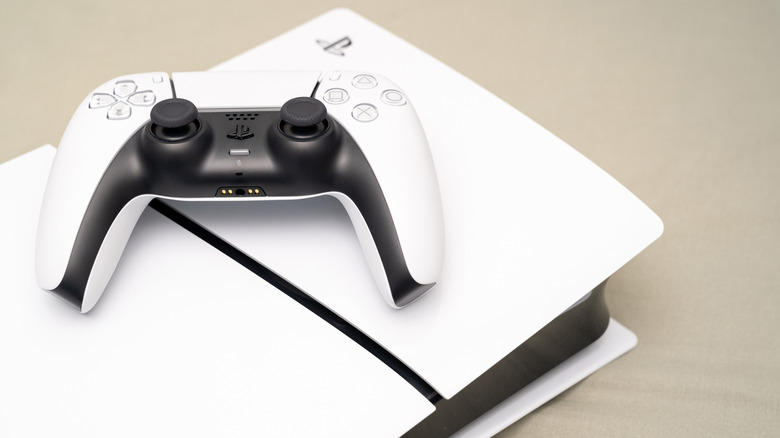
If we're being frank, you should buy a PS5 instead of an Xbox. The DualSense controller is way more comfortable (and doesn't rely on AA batteries), but more importantly, the PS5 has superior 3D audio. Yes, both consoles utilize 3D audio technology, but the general consensus is that PS5 3D audio is clearer. Heck, when Sony announced the PS5, it advertised its 3D audio capabilities alongside a proprietary peripheral: the Pulse 3D headset. However, you don't need one of these devices to enjoy PlayStation games with the console's Tempest 3D audio system. Plenty of other headsets work with (or are designed for) the PS5. But if you want the best audio experience without disturbing your family and neighbors during those late-night gaming sessions, you will need a high-quality product. Doubly so if you want pitch-perfect 3D audio.
Read on to learn which high-end headsets improve your PS5 gaming experience the most. All entries are ordered by price. Since we are discussing high-end products, expect entries to get a little pricey.
SteelSeries Arctis Nova 7P
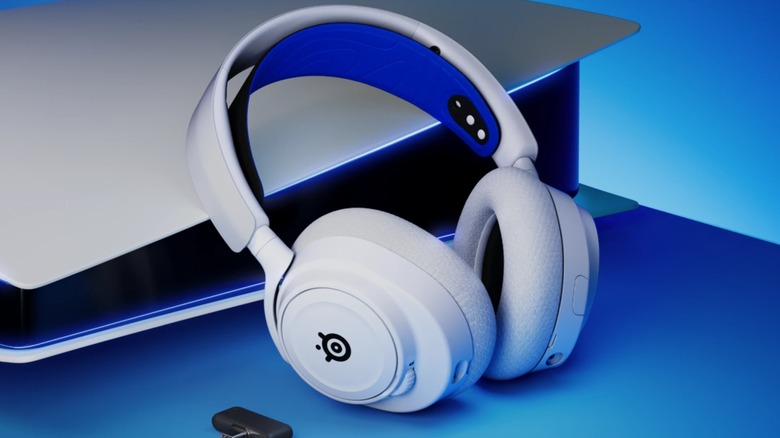
Many people view SteelSeries as a reliable brand that supplies quality products. We previously covered its headphones — we heaped plenty of praise on the SteelSeries Arctis Nova Elite and SteelSeries Arctis Nova Pro Omni. That said, these products are a little too expensive for most audiences, but you don't need to break the bank to experience Tempest 3D audio.
The SteelSeries Arctis Nova 7P is touted as a mid-range headset on paper, but in practice it is more like a high-end audio device. Well, the low end of high-end, but the point still stands. The 7P's neodymium magnetic drivers provide rich sound, and its batteries deliver an alleged 38 hours of life. While the Arctis Nova 7P doesn't include active noise cancelation, its thick ear cups muffle other noises so you can focus on your game. And whereas rival headsets use microphones that either flip up or need to detach, the Arctis Nova 7P's mic slides into the exterior shell, almost completely disappearing from the silhouette.
In terms of features, the Arctis Nova 7P is fully compatible with Tempest 3D, and it can connect to the console and your phone at the same time with simultaneous 2.4 GHz (via a dongle) and Bluetooth connections. You can use this capability to talk on the phone during online matches or use the SteelSeries app to customize your headset's equalizer (EQ) profile. Either make your own or utilize a premade profile from an ever-growing list designed for specific games. Oh, and since the Arctis Nova 7P utilizes a dongle and Bluetooth, you can use it with more than just your PS5. You can currently buy this headset for $200 on the SteelSeries webstore.
Razer Blackshark V3 Pro
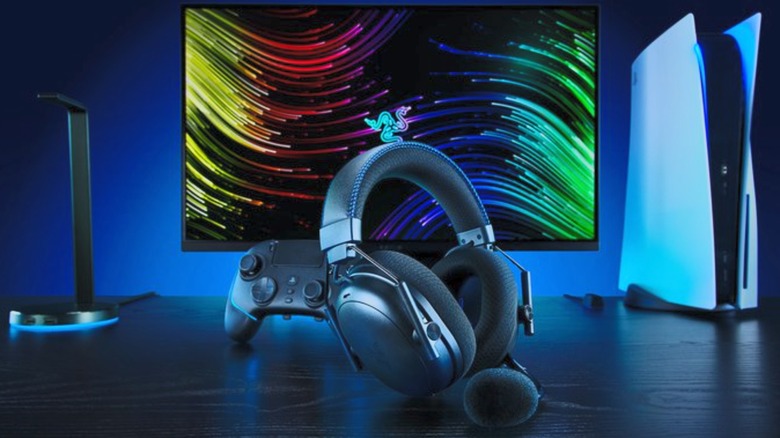
When most people think about third-party gaming peripherals, especially for PC, Razer frequently comes to mind. The company makes mice, keyboards, and of course headsets. Previously, we reviewed the Razer Blackshark V2 Pro and praised its audio quality, but that was in 2024. Razer has a new high-end headphone for consoles.
The Razer Blackshark V3 Pro, as its name suggests, is the Blackshark V2 Pro's successor and is crammed full of features and components designed for competitive esports gamers and the average user alike. It all starts with the V3 Pro's Triforce (no, not that Triforce) bio-cellulose 50 mm drivers for crisp sound. Add different levels of active noise cancellation to fine tune your sound isolation, swiveling ear cups, and a 12mm capsule mic, and you should have a great soundscape whether you're playing alone or in a team.
Since the Blackshark V3 Pro is designed with esports players in mind, Razer's engineers did their best to cut down latency and stuff 70 hours of battery life into the device. Plus, unlike the V2, the V3 even includes an audio jack. And like the Arctis Nova 7P, the Blackshark V3 supports simultaneous 2.4 GHz and Bluetooth connections, as well as multiple EQ profiles. However, if you want your Blackshark to support the PS5's Tempest 3D audio, you need to purchase the specific PS5 version; the Xbox and PC models only support THX Spatial Audio, so keep that in mind while shopping. Plus, while most of the V3 is an upgrade over the V2, microphone quality is comparatively worse. You can buy the Razer Blackshark V3 Pro for $250 through the Razer website.
Logitech G Astro A50
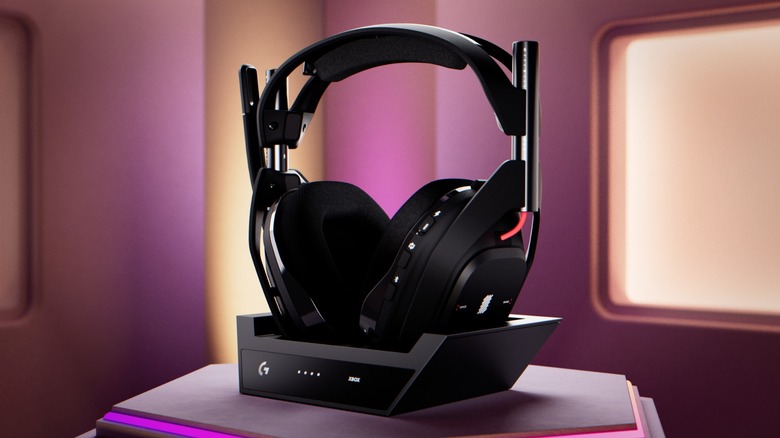
Logitech is the opposite side of the gaming gear coin that Razer occupies. Both companies fill the same niche since they manufacture and sell similar products. Ironically, while most Razer products are expensive when compared to Logitech's offerings, the opposite is true for their flagship headsets. But that price difference is justified, given the right setup.
In 2017, Logitech purchased Astro Headsets, and currently, the Logitech G Astro A50 is considered one of the better gaming headsets on the market. The gadget uses 40mm graphene drivers, which purportedly cut down on audio warping, as well as a 48 kHz microphone that delivers clear voice chat. However, the Astro A50's true magic lies in its connectivity. The headset can sync up to multiple platforms at once — including the PS5, Xbox, and PC — and swap between them with the press of a button via Playsync Audio. It's all thanks to the charging base that doubles as a connection hub.
While this article revolves around headsets designed for PlayStation, we cannot deny the appeal of a device that simplifies the act of swapping between platforms. No more moving around dongles and cables. However, therein lies the rub: Playsync Audio only works if all of your consoles (and PC) are plugged into the hub. You need a good place to station the dock, and if your cables don't reach, you need to either reorganize your gaming setup or invest in longer cables. And then there's the price. At $299.99 through the Logitech store, the Logitech G Astro A50 isn't the most expensive product in this article, but its potential value significantly decreases if you only use it for your PS5.
Audeze Maxwell 2
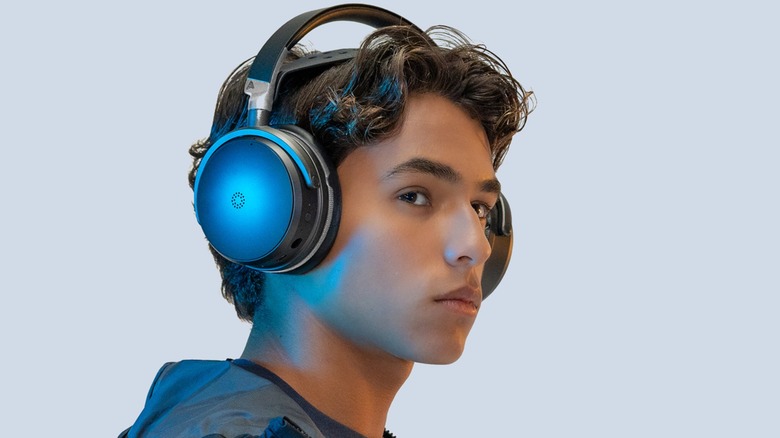
The majority of gaming headsets (or at least popular gaming headsets) come from companies that specialize in gaming peripherals. We've almost become complacent in this expectation. But can a company that specializes in professional headphones for general music listening build a quality gaming headset? Yes. Yes it can.
The Audeze Maxwell 2 is considered one of the best major headphones designed for audiophiles, and for good reason. The headset utilizes 90mm planar magnetic drivers for unparalleled sound, and Audeze claims that the battery lasts for over 80 hours — one of the longest lifespans of any gaming headset. Plus, while plenty of headsets have their own methods for clearing up microphone audio, the Audeze Maxwell is one of the few that includes a pop filter. Oh, and the PlayStation version of the headset works with Sony's Tempest 3D audio. The Xbox model only has Dolby Atmos.
Depending on who you ask, the Audeze Maxwell 2 provides the best audio quality for any price point – and that's saying something because it isn't the most expensive gaming headset out there. However, it isn't perfect. At around 1.23 lbs, the Maxwell 2 is almost double the weight of most rival headsets. Sure, 1.23 lbs doesn't sound like much, but tell that to your neck after four hours of nonstop gaming. You can purchase the Audeze Maxwell 2 for $329 on the Audeze site — $429 if you want the active noise canceling version.
Sony Inzone H9 2
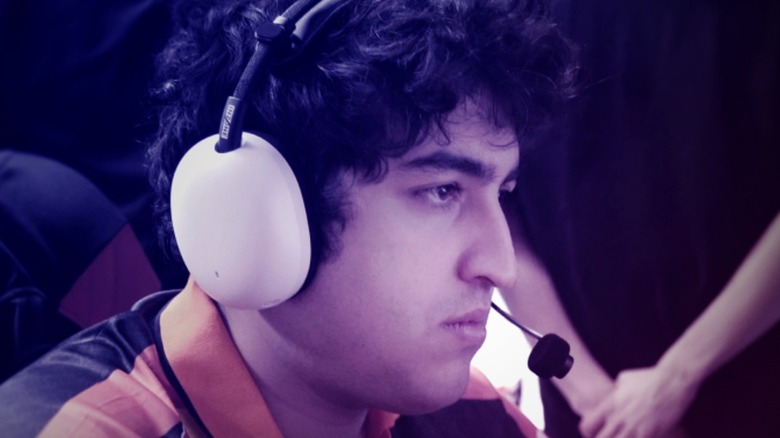
While the PlayStation consoles make up Sony's most popular product line, the company has a long history in video and audio. Without this tenure, the company would have needed to rely on third-party companies for headsets instead of releasing the Pulse 3D headset. But by that same token, Sony has a high-end gaming headset that surpasses the Pulse 3D.
The Inzone H9 2 is a robust headset that punches well above its weight class (physical, not price). The gadget includes carbon composite drivers to provide the same level of audio clarity as the Sony WH-1000XM6 – Sony's flagship noise canceling headphones. Many of the H9 2's other features are ones you have seen throughout this article. Active noise canceling? Check. EQ profiles for various games? You got it. Simultaneous 2.4 GHz and Bluetooth connectivity? But of course. Yet despite holding its own against other gaming headsets, the Inzone H9 2 weighs a comparatively scant 0.6 lbs. You don't have a truly ergonomic setup unless you have headphones that let you play for hours without neck strain. Oh, and the Inzone H9 2's suspension strap is also quite comfortable.
When we reviewed the Inzone H9 2, we praised all of the above features, but we had some complaints. One common point of contention among users stems from the battery life, which clocks in at only 30 hours. That's pretty short. Although, if you deactivate noise canceling, you can stretch that battery life to just shy of 50 hours. Such is the price you pay for such a lightweight headset. And speaking of price, the Inzone H9 2 retails for $350 (discounted to $260 at the time of writing) through the Sony store.
Methodology
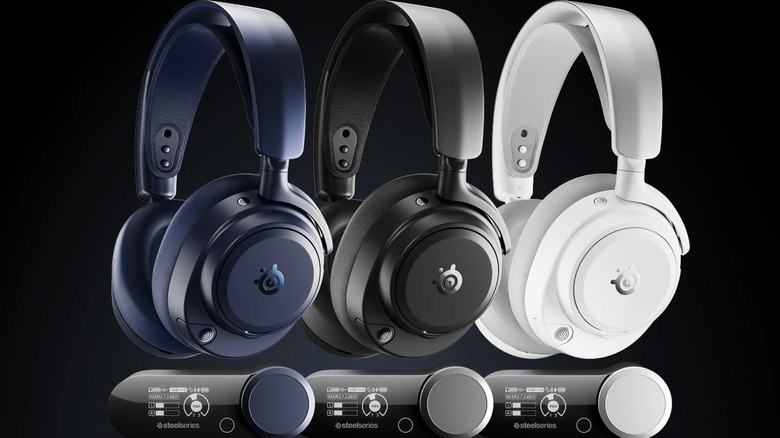
For this article, we looked for the best high-end gaming headsets. No headphones or earbuds allowed. Plus, we must emphasize that we specifically went looking for gaming headsets. Any headset or headphones can work with gaming in a pinch, but we wanted to focus on headsets designed to help you communicate with allies in "Fortnite" or instill a creeping sense of dread while playing "Resident Evil Requiem."
We evaluated the headphones based on their driver size, microphone quality, and battery life. We also gave bonus points if the device included support for Tempest 3D audio. This is an article about alternatives to Sony's Pulse 3D headset, after all.
After everything was said and done, we still had a few too many entries for an article, so it was time for a bit of culling. We decided to give every brand a fair shake and limit the list to one headset per line. Otherwise, 80% of this article would have been nothing but SteelSeries. We went with the headsets with the best reviews (and used personal experience in the case of tiebreakers). We cut out the ones with the lowest reviews (which were still pretty dang high, all things considered), and that was it.